Pull slowly.
SAME THREADS
The upper thread supports the weight and the downward pull. With comparable thread strengths, it reaches its breaking point first.
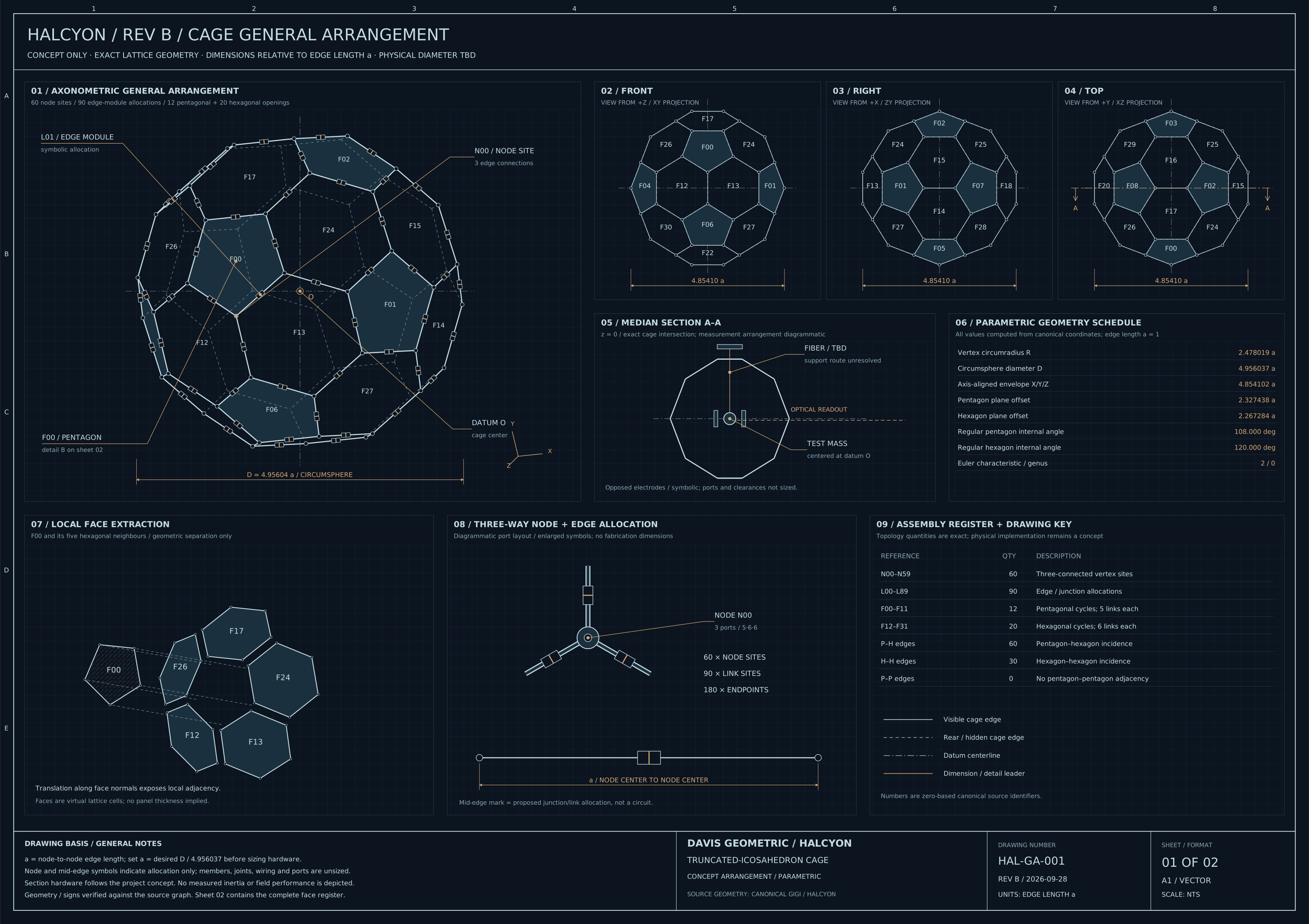
A ninety-link cage. A proposed circuit architecture. An experiment designed to test a question about inertia.
Explore the geometry, follow the wiring, and look inside the measurement design.
60 vertices. 90 links. A geometry you can inspect from every angle.
Every previous attempt either failed to predict a specific number in advance, or saw the effect shrink the moment the measurement got serious. The framework gets it right by doing the opposite: declare the prediction up front, then let the experiment falsify it.
The pattern repeats because the discipline is missing. Halcyon's experiment is decided before it runs — a slope above the published sensitivity floor measures the coupling; a curve consistent with zero within the preregistered systematics budget falsifies the predicted Branch-XIII magnitude. Either answer is publishable. That's the difference.
One weight, two threads, two outcomes. Pull slowly and the upper thread breaks. Give a sharp pull and the lower thread can break first. Watch how the loading changes.
The upper thread supports the weight and the downward pull. With comparable thread strengths, it reaches its breaking point first.
The lower thread can reach its breaking point before the mass moves appreciably. The upper thread stays intact and the mass remains suspended.
Motion and peak-load bars illustrate the sequence; they are not calibrated force or timing measurements. About the textbook experiment ↗
The mass and gravity stay the same. A slow pull and a sudden pull produce different tensions and motion. The thread experiment illustrates ordinary inertia; it does not, by itself, demonstrate a change in mass.
Apply a known force across a range of frequencies. Fit effective mass, stiffness and damping separately. Then ask whether changing the apparatus state changes that response beyond the measurement uncertainty.
Explore the engineering benchThe following is the project’s proposed modeling framework. Its state-dependent inertial coupling requires separate validation; it is not established by the two-thread demonstration.
D = τ / tload = r τ / F*with r = dF/dt, F* the relevant breaking-force scale, and τ the inertial relaxation time of the bulk. D << 1 is quasi-static (upper bears mg + F); D >> 1 is impulsive (lower bears F alone). In an idealised elastic model the inertial crossover sits at
ωc = √(K/μ), τμ = √(μ/K), μ = K τμ²For a real apparatus, damping returns:
χQ(ω) = 1 / ( KQ + i cQ ω − μQ ω² )For a measured normal mode with shape φn(x):
μeff(n)(Q) ∼ ∫ κQ(x) τQ²(x) |φn(x)|² dVThe falsifiable Halcyon claim, written cleanly:
∂Q μQ ≠ 0 (at fixed KQ, cQ, drive amplitude, thermal & EM systematics)Fit KQ, μQ, cQ separately from the full transfer function. A shift in ωc(Q) alone proves a shift in the ratio KQ/μQ, not in μQ by itself; the clean inertial-shift claim requires the full fit.
This describes the proposed experimental signature, not an observed result. The engineering bench currently models ordinary forces and explicitly injected changes.
The same physical apparatus, holding the same test mass, is predicted to produce different effective inertial response depending on the programmed gauge sector Q the cage drives the field into. The experiment is the meff/m0 curve across sectors.
The slope of meff/m0 against Q is the coupling constant α. A flat slope falsifies the framework. A non-flat slope measures α. The numbers above are predicted; the experiment will return what it returns.
Choose a story using the plain-language guide: watch differences develop from a cold start, compare a field at equilibrium, or watch the orange loop-mismatch meter drain during relaxation. Color, line width, and the live trace reveal the recorded evolution. In Give it a nudge, compare a suspended mass with its normal reference using a calculated response and an adjustable inertia assumption. The new Engineering bench calculates forces, measurement noise and parameter fits, with editable apparatus assumptions and downloadable results.
Truncated icosahedron · 60 vertices · 90 links · 32 faces · χ = V − E + F = 2
Inspect category verdicts, measured values, and tolerances from the saved validation run, including the documented finite–size discrepancy. The report reads the kernel’s JSON directly.
A geometric apparatus that takes a topological charge sector as input and produces a measurable inertial response as output.
Sixty vertices, ninety edges, thirty-two faces — Euler characteristic two, the topology of a sphere. Each edge holds a Josephson junction whose phase encodes a link variable in SU(2).
Driving the junctions in a chosen pattern forces the gauge field into a target topological sector Q. The Davis Field Equations framework predicts the field locally modifies effective mass.
A milligram tungsten sphere hangs at the cage's center. A calibrated electrostatic kick is applied; a sub-nanometer interferometer reads the response. The ratio meff/m0 swept across Q is the signal.
The substrate is standard lattice gauge theory — Wilson, Kogut, Susskind, Migdal, Witten. The lines in violet are framework contributions, proved or specified in published papers.
The graveyard is full of work that buried its limits. Halcyon declares them up front.
S = 2.87 (matter-sector v1, SU(3))Gr = 85 (matter-sector v1, SU(3))6.13 × 10⁻³ at β=2.5 (PASS)4.00 × 10⁻¹⁵ (PASS)4.49 × 10⁻² (FAIL; finite-trajectory ergodicity caveat)|ΔU|∞ = 6.72 × 10⁻¹² (PASS)|δH/H0| = 3.78 × 10⁻⁵ (PASS)The field has a graveyard of inertia claims that shrank as measurement improved. The defence is pre-registered failure paths. No inertia number is published until the apparatus has cleared this chain.
{Wγi}, mean plaquette
〈P〉, sector surrogate Qsurrogate,
and Wilson action SW must agree on the sector
label and reach a preregistered separability threshold across
seeds before any mechanical channel is unblinded.
Qsurrogate(t),
〈P(t)〉, and max·|Gv(t)|.
Runs whose sector leaves the preregistered band during measurement
are invalid. No post-hoc rescue.
Four matched drives in every block. The inertial claim only survives if the response follows Q, and only the real Q-sector drive.
| Control | Drive program | Expected (α = 0) | Expected (α ≠ 0) |
|---|---|---|---|
| Q-sector drive | Real Q = 1, 2 program | no signal | predicted signal |
| Power-matched null | Same total RF power, no sector winding | no signal | no signal |
| Scrambled-phase | Same per-channel spectra; gauge structure destroyed | no signal | no signal |
| Dummy cage | Same electrical load, no valid SU(2) encoding | no signal | no signal |
Ten null hypotheses. Strike each one and the experimental claim becomes load-bearing. The simulation owns seven of the rows; three are hardware-only (thermal, EM, mechanical pickup) and become predictions the apparatus carries. The keystone H9 — whether the τQ model itself is overfitted — sits outside the grid because it tests the model, not the system.
--battery-fast run, 78.5 min wall (battery_fast_20260620_104846.json). H7's marginal failure is the smoke-mode extractor floor.
The full battery run (111 min, battery_full_20260620_181227.json) with the proper per-Q χ(ω) fit returns FAIL_SIGNAL_MISSING at the SPEC's default αHalcyon = 1: predicted shift is ~60 ppm of baseline, below the lock-in noise floor. A calibrated re-run at αHalcyon = 1000 (battery_calibrated_20260621_011304.json) closes the calibration gap (χ2/dof drops 5 orders) but surfaces the deeper blocker: H8 Q-drift is structural — the simulation has no active Q-pinning mechanism, so the initial-condition bias relaxes back to the trivial vacuum during measurement. A real apparatus pins Q through continuous cage drive; the simulation models it as a passive initial condition. See Solves Vol. 4 Appendix A.7.2 for the three-stage diagnostic. Each stage, by failing, sharpens the experimental claim.
All three are publishable. The experiment is sharp because it commits to what each means in advance.
| Outcome | What it means |
|---|---|
| α ≈ αpredicted | Inertia couples to gauge topology at the predicted magnitude. Revolutionary. |
| 0 < α << αpredicted | Framework magnitude wrong; coupling may be real but smaller than Branch XIII predicts. Constrains the model. |
| α = 0 ± αmin | Predicted coupling falsified at this sensitivity. Constrains the next experiment. |
Operational β envelope. The operating β
for the buckyball will be selected from
β ∈ {2.4, 2.5, 2.6, 2.7, 2.8} based on which
point shows the most stable sector separation, energy conservation,
Gauss covariance, and canonical agreement — not the lower edge
by default. The validation report's local envelope sweep is the gate.
The canonical plaquette mean is the same number in the Halcyon verdict JSON, in the live GIGI engine's response, and in the Solves Vol. 4 chapter because all three read from the same substrate object.
The entire chapter's measurement chain is five statements against the live engine. The buckyball (V=60, E=90, F=32, χ=2; SU(2)) is instantiated once; everything downstream is a query. Reproduced here byte-for-byte from Solves Vol. 4 §2.1.
1. LATTICE buckyball FROM TRUNCATED_ICOSAHEDRON TOPOLOGY "S2"
2. GAUGE_FIELD U ON LATTICE buckyball GROUP SU(2) INIT IDENTITY
3. GIBBS_SAMPLE U BETA 2.5 N_SWEEPS 200 SEED 20260617 MEASURE_EVERY 1
MEASURE (MEAN(PLAQUETTE), Q_SURROGATE)
4. E_FIELD E ON GAUGE_FIELD U INIT MAXWELL_BOLTZMANN BETA 2.5 SEED 20260617
5. SYMPLECTIC_FLOW U FROM (U=U, E=E) BETA 2.5 DT 0.02 N_STEPS 1000
PROJECT_GAUSS { tikhonov: 1e-14, cg_tol: 1e-10, cg_max_iter: 200 }
MEASURE_EVERY 20 MEASURE (H_TOTAL, MEAN(PLAQUETTE), Q_SURROGATE, GAUSS_RESIDUAL_MAX)
Schema v1.2 production run halcyon_dde14a276d54 (2026-06-17, 2764.66s wall).
Eight PASS, one NOT_APPLICABLE (sector classifier — Qsurrogate dispersion does not
populate all three operational bands at β=2.5; π2(SU(2))=0 on S2 is
the structural reason), one disclosed FAIL (microcanonical-vs-canonical on a 93-DOF finite trajectory).
The buckyball substrate is instantiated in GIGI's Rust engine. The 5-statement block above returns 〈P〉 inside the blocked-SEM band, with end-to-end performance of ~20 ms in-engine compute, ~140 ms verifier round-trip over public internet, and <100 ms cached read.
Solves Vol. 4 transcribes results directly from the engine. The chapter's canonical, its verdict distribution, the verifier recipe, and the Section 5 closure receipt all cite the same substrate the engine holds.
A matched-RNG mode ports GIGI's random-number generators into the Halcyon kernel, giving byte-for-byte reproducibility of the gauge and E-field initializers. Random-field initialization is matched; dynamical evolution remains statistical.
Byte-identity is not the architectural contract. Two independently-seeded canonical receipts on two independent CSPRNG streams (PCG64 in the kernel, xorshift64* in the engine) landing inside the same blocked-SEM band is the science. Matched-RNG is the engineering-side demonstration that byte agreement is achievable when wanted — not the default the page promises.
Anyone can verify the result by running the 5-statement block against the live engine. The verifier
returns the canonical mean, the delta from the Halcyon spine, the tolerance band, PASS/FAIL, the
thermalization wall-clock, and a cryptographic witness — the SHA-256 of the canonical buffer
snapshot. The citation handle is
ea7b934ca3fbe9897e9f11851647388972004a2ca025100179a92dd966516591.
GIGI_URL=https://gigi-stream.fly.dev \n GIGI_API_KEY=$YOUR_KEY \n python -m inertia_damping.scripts.verify_canonical_receipt
This is operational, not foundational. The strong-coupling lattice mass gap proved in v6 is still the lattice gap; the Clay continuum problem is still open; the single open inequality m̂(β) ≥ c− f2(β) is still open. What changed is where the lattice numbers live — on a substrate that is itself a queryable mathematical object, addressable by GQL, version-pinned by deploy hash, reproducible by anyone with the endpoint.
A Gi_System is a scientific instrument whose every observable is gauge-invariant, whose every operation is local, and whose every claim is gated by an analytical target with no tunable tolerance.