First contact
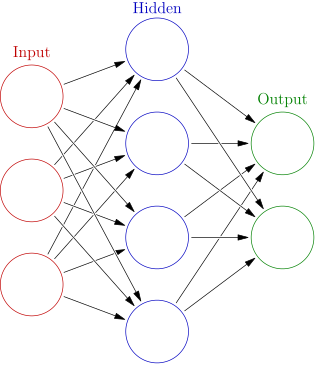
We start without code. On the whiteboard, we work through what it means for a machine to "decide" something — using a paper-and-pencil exercise where you trace a decision tree from input ("is it raining? · is it cold?") to output ("bring an umbrella, wear a coat"). By 11 AM you can name the three pieces of any learning system — inputs, weights, output — and explain a perceptron with nothing but addition and multiplication. We also cover what an algorithm is, what training data is, and what the word "model" really means in this context (hint: it's not metaphorical).
What does it actually mean for a machine to "decide" something? We figure it out without touching a computer — drawing decision trees on the whiteboard ("is it raining? + cold? → wear a coat"). By 11 AM you can explain how a brain-cell-shaped thing called a perceptron makes decisions using just adding and multiplying. You can probably teach this to your parents over dinner.
Open your own Google Colab notebook — yours forever, no install, runs free in Google's cloud. Your first Python program is a greeting bot: it asks for your name, your age, and what you're scared of, then composes a personalized response. You learn variables, strings, input/output, and your first if-statement. The bot you build on Day 1 grows every day — by Friday it can hold a multi-turn conversation that remembers what you've told it.
Open Google Colab on your laptop — it's free, lives in the cloud, no install. Write your first Python program: a greeting bot that asks your name, your age, what scares you, then writes back. You learn variables, strings, and if-statements. The bot keeps growing all week — by Friday it can hold a real conversation that remembers everything you told it.