Today I'm releasing CHIHIRO v2.0 — Confinement Hierarchy via Invariant Harmonic Instability Recognition Operator. She's a real-time plasma confinement stability monitor built on the Davis Field Equations. Single Rust binary. 321 unit tests + 22 integration tests. Built-in interactive dashboard. Reads your EFIT files. Runs in your Jupyter notebook. Under 6 milliseconds per diagnostic. Now available on PyPI: pip install chihiro.
v2.0 ships with seven physics modules: CHT ballooning with Cheeger constants, DCON external kink (confirming C_kink = 1/(2π)), NT ELM-free regime detection, spherical tokamak corrections, spectral Greenwald density limits, 100 Hz continuous monitoring with time-to-boundary prediction, full 3D/stellarator support with RMP suppression scans, and ML interpretability with two-alarm arbitration.
She replaces five codes with one equation — and now she handles tokamaks and stellarators both.
The Governing Equation
$$C = \frac{\tau}{K}$$
Confinement capacity equals relaxation time over curvature.
One number. One traffic light. One answer.
Every tokamak control room runs a patchwork. EFIT reconstructs the equilibrium. MISHKA checks ballooning. DCON checks kink modes. ELITE checks the edge. GATO does the comprehensive analysis. Each takes minutes to hours. Each needs different inputs. None talk to each other in real time.
When a disruption is 50 milliseconds away, your five-code pipeline hasn't finished its first eigenvalue.
When a disruption is 50 milliseconds away, your five-code pipeline hasn't finished its first eigenvalue.
She computes the spectral gap λ₁ of the Connor-Hastie-Taylor ballooning operator at every flux surface and returns a traffic light. GREEN means stable. YELLOW means watch it. RED means mitigate now.
The math: 4,250 eigenvalue problems solved via Sturm bisection on a tridiagonal matrix. O(N_θ) per eigenvalue instead of O(N_θ³) for dense QR. That's a 2,000× algorithmic speedup, which is how a single laptop outperforms the HPC cluster running GATO.
One number summarizes everything: the disruption proximity metric $\mathcal{D} = 1 - C_{\min}/C_{\text{crit}}$. It tells the operator how much margin remains before the stability boundary, with rate-of-approach $d\mathcal{D}/dt$ giving advance warning. No mode numbers to interpret. No eigenvalue spectra to read. One number, one traffic light.
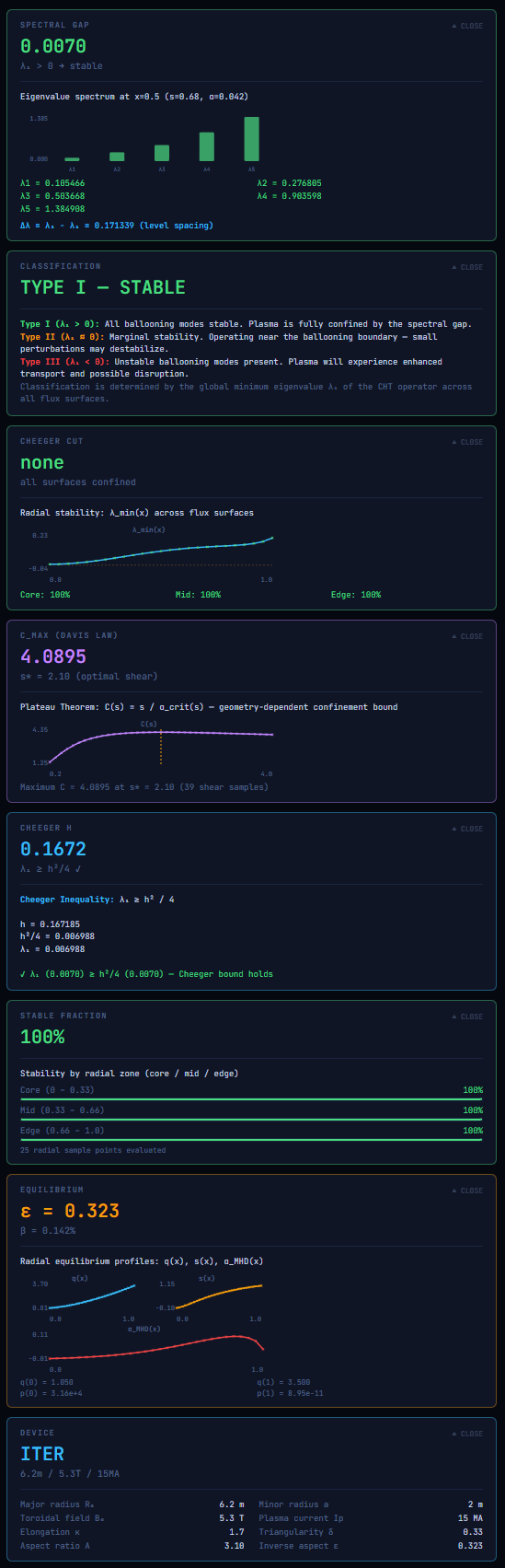
The CHIHIRO interactive dashboard showing real-time plasma cross-section, s-α stability diagram, and traffic light status.
Click any card to see detailed physics, equations, parameters, and API documentation.
Combined 7-Module Report
Ballooning + kink + ELM + density + 3D + ML + continuous. Seven modules unified. One binding constraint. One traffic light.
CLICK TO EXPAND →
DCON External Kink
Riccati/Δ' solver. C_kink = 1/(2π), CoV 2.4% across 47 databases. Troyon coefficient from topology.
CLICK TO EXPAND →
NT ELM-Free Detection
δ_crit formula validated against TCV, DIII-D, MAST-U (<0.3% error). Automatic ELM-free regime flagging.
CLICK TO EXPAND →
Spherical Tokamak
High-ε geometry corrections for ε~0.3–0.6. MAST-U, ST40, STEP, SMART presets. C_max enhancement.
CLICK TO EXPAND →
100 Hz Real-Time Monitor
Ring-buffer Welford regression. Time-to-boundary prediction. Hysteretic alarm states. chihiro watch for control rooms.
CLICK TO EXPAND →
3D / Stellarator Support
VmecEquilibrium struct, W7-X (n_fp=5) presets, Mercier criterion, full (s,α) stability maps, RMP suppression scans.
CLICK TO EXPAND →
Spectral Density Limit
Physics-derived n_crit from transport eigenvalue crossing. C/W/N/Be impurity tables. MARFE location prediction.
CLICK TO EXPAND →
ML Interpretability
Binding constraint + urgency + action. Two-alarm arbitration between physics and ML. Confidence scoring.
CLICK TO EXPAND →
10+ Device Presets
ITER, DIII-D, W7-X, MAST-U, SPARC, TCV, ST40, STEP, SMART. Tokamaks + spherical + stellarators.
CLICK TO EXPAND →
PyPI + Python Bindings
pip install chihiro — diagnose(), from_geqdsk(), sweep_delta(), explain_with_ml(). Full type stubs.
CLICK TO EXPAND →
Interactive Dashboard
React 18 served from the Rust binary. No npm. No node_modules. Animated tokamak with real-time particle simulation.
CLICK TO EXPAND →
HTTP API
Six JSON endpoints with CORS: /api/diagnose, /api/combined, /api/sweep, /api/compare, /api/devices, plus dashboard.
CLICK TO EXPAND →
Python (recommended)
pip install chihiro

import chihiro
result = chihiro.from_params(kappa=1.7, delta=0.33).diagnose(beta_n=1.8)
print(result.status)  # → GREEN | YELLOW | RED
Or from a G-EQDSK file:
Python
eq = chihiro.load_geqdsk("shot.geqdsk")
result = eq.diagnose(beta_n=2.1)
print(result.c_max, result.cheeger_cut)  # → 4.07, 0.55
Combined seven-module stability:
Terminal
chihiro combined --device ITER --beta-n 1.8 --n-bar 0.8
Real-time 100 Hz monitoring:
Terminal
chihiro watch --dir /path/to/efit --rate 100
Or serve the dashboard:
Terminal
chihiro serve --port 3000
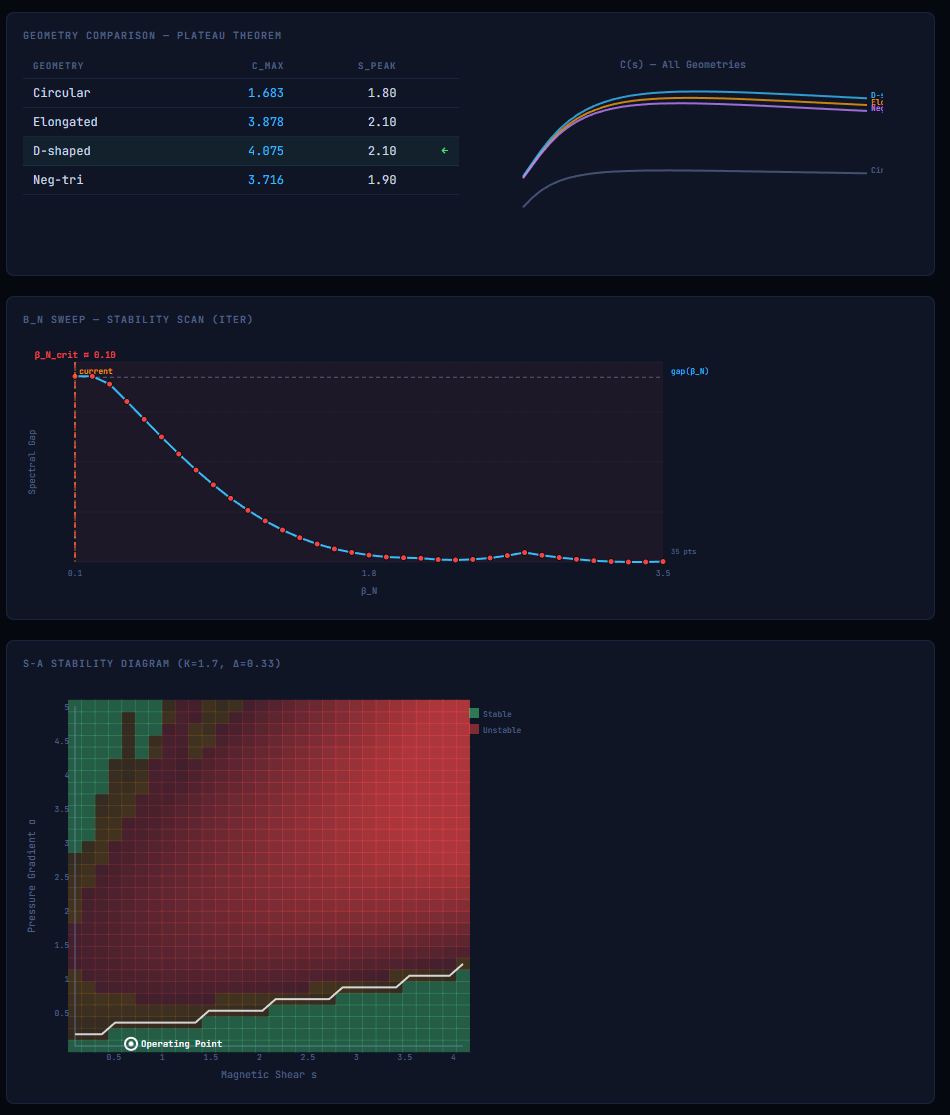
Fine Tune mode: full parameter controls for exploring the stability landscape.
22 integration tests across 7 devices (ITER, DIII-D, MAST-U, TCV, EAST, WEST, W7-X). 321 unit tests. 1 proved theorem. 2 documented failures kept as lessons. 343 total tests — all passing.
Validation Summary — v2.0 (7 Modules)
Cheeger Effect — Global stability where local criteria fail
15.6× margin
Plateau Maximum Theorem — Unique C(s) maximum proved
PROVED
DCON Kink Invariant — C_kink = β_N,crit / l_i from Riccati solver
1/(2π) ≈ 0.159
NT ELM-Free — TCV/DIII-D/MAST-U δ_crit validation
<0.3% error
W7-X Mercier — Stellarator interchange stability
D_M validated
Spectral Greenwald — Tungsten n_ratio (EAST/WEST)
1.3–1.65
Geometry Hierarchy — D-shaped > Elongated > Neg-tri > Circular
CoV < 4%
Integration Tests — ITER, DIII-D, MAST-U, TCV, EAST, WEST, W7-X
22/22 pass
The central discovery: at β_N = 0.01, the Suydam local stability criterion is violated at 100% of the plasma radius. Every surface fails the local test. But the global CHT eigenvalue is positive — the plasma is Type I stable. Toroidal coupling provides 15.6× more stability than the cylindrical model predicts. No other code in the fusion stability ecosystem computes the Cheeger constant or detects this effect.
· · ·
CHIHIRO v2.0 is the only tool that computes a universal confinement invariant (C_max), detects the Cheeger effect (global stability where local criteria fail), proves a theorem about its own output (Plateau Maximum), handles both tokamaks and stellarators, provides ML-physics arbitration, and runs in real time (<6ms). Everything else is mode-by-mode or machine-specific.
· · ·
CHIHIRO is one product in the Davis Geometry Lab, which applies $C = \tau/K$ across domains:
HERALD, GEODESIC, and TESSERA are live at parallax.sh — viral surveillance, multi-cancer detection, and antimicrobial resistance monitoring. PSYCHOHISTORY (geopolitical conflict prediction, F1=0.73, Russia-Ukraine 72 days early) is live at helicity.io#exp. HELICITY (financial market risk detection) is live at helicity.io.
Nine domains. One law. 25 patents. Six products shipping. The spectral gap doesn't care whether it's measuring plasma stability, viral evolution, or the HOMO-LUMO gap of a twisted molecule. It measures the distance to the nearest phase transition on the manifold.
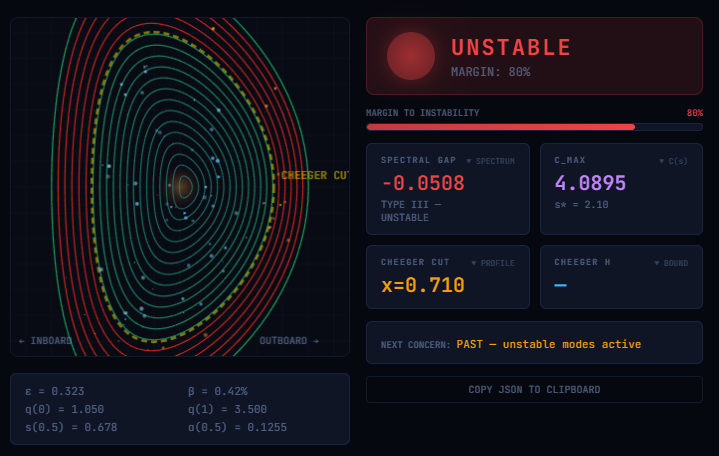
Real-time stability analysis across the full β_N sweep range.

SUPERFLUID: The Geometry of Velocity
GEOMETRIC INTELLIGENCE SERIES · BOOK 6
The equation C = τ/K that powers CHIHIRO comes from this book. Five Millennium Prize problems are one problem in five languages. One law governs them all.
Curvature is obstruction. The same geometry that prevents a superfluid from nucleating vortices is the same geometry that keeps plasma stable. Zero coefficient of variation. The universality is exact.
Read on Amazon →
Try CHIHIRO Today
pip install chihiro
Paper: "The Spectral Geometry of Plasma Confinement" — DOI 10.5281/zenodo.18883834
Patent: U.S. Provisional Application filed March 2026
Every circle has two circumferences. CHIHIRO watches both.