A note from Bee

Hi there! My name is Bee, but most of my friends call me Gigi. Thank you for taking a minute to learn about me and about Davis Geometric.

I spent the last two decades doing in-the-trenches engineering on some of the world's most iconic machine-learning systems. When NASA laid me off, I finally had time to turn all that hard-won engineering intuition into hard-working mathematics and theory. What came out of it was a tiny Riemannian manifold — and that little manifold proved one thing elegantly: we've been doing the math in machine learning wrong. Measuring real-world data with flat Euclidean geometry gets you partial truth, some of the time, at best.

Davis Geometric is my deep dive into the math that makes my version of anomaly detection, pattern matching, and topological physics actually work. I'm not a classically trained physicist. I'm a thorough researcher. I theorize, I build, I observe, I revise, I theorize again. Nine platforms later, I'm still learning lessons from that little manifold.

Thank you again for taking the time. I hope to hear from you soon.

— Gigi

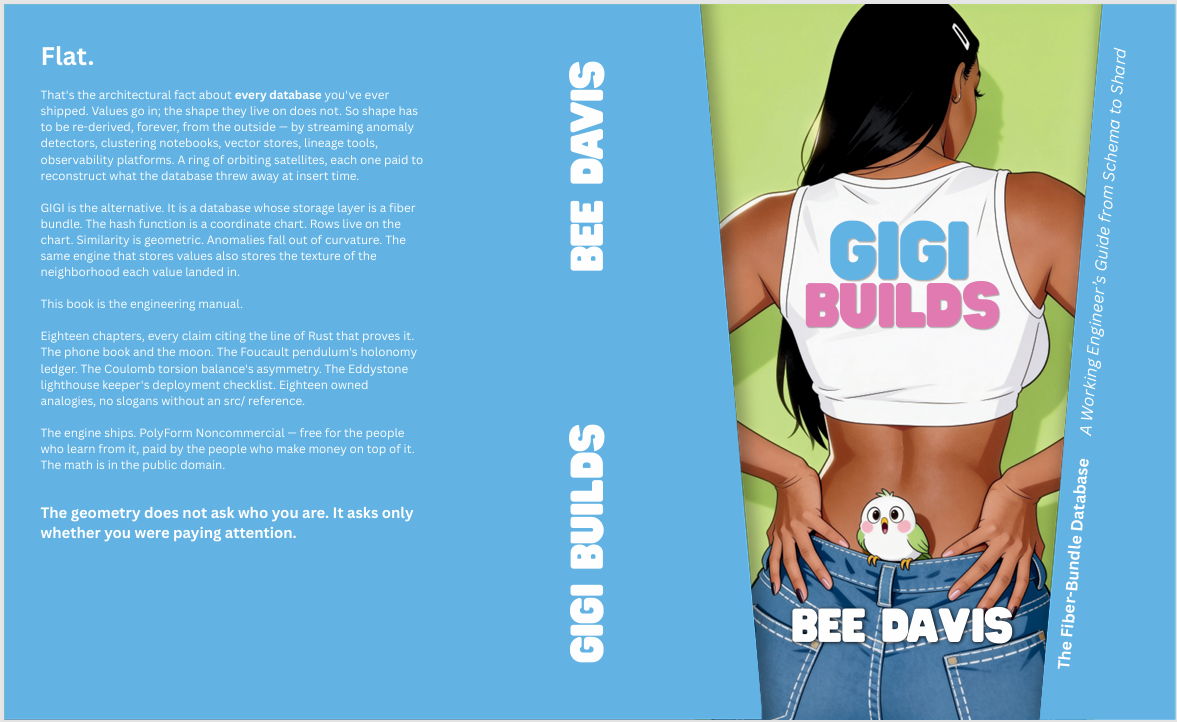
New · 2026 Cover of GIGI Builds by Bee Davis
Just published.

GIGI Builds

The Fiber-Bundle Database — A Working Engineer's Guide from Schema to Shard

A field manual for the fiber-bundle database engine at the center of every Davis Geometric platform. Ingest schema, GQL queries, bundle primitives, and the geometric operations — curvature, holonomy, transport, geodesic — that make cross-domain reasoning possible.

Written for engineers who want to use GIGI, not just read about it. Worked examples spanning plasma diagnostics, LLM inference, vulnerability research, GNC, and precision agriculture — same engine, same operations, different data.

Get the book on Amazon →

One Framework  ·  Cross-Domain Constraint Manifolds

When the Math
is Right,
Domains Become Details

The Davis Manifold — a Riemannian framework where cross-domain problems (plasma confinement, drug binding, portfolio regime detection, LLM inference) reduce to geodesic navigation on a shared constraint manifold. Nine research platforms, thirty provisional patents, ten published books. Independent research, open to collaboration.

9
Products
30
Patents
10
Books
1
Math
Bee Rosa Davis
Brown University (MS) · 27 Years Aerospace
Independent Researcher · Davis Geometric
Geometry Unifies
What Looks Different · Is the Same Problem

Many hard problems reduce to the same geometry. Protein folding, market regime detection, plasma confinement, neural network inference — all admit a manifold formulation where the "hard part" is curvature navigation. Domain expertise often obscures that shared structure; the Davis Manifold treats it as the primary object of study.

Nine Platforms, One Math

Each platform is a distinct research artifact — separate codebase, separate provisional patent family — but every one of them reduces to the same primitive: geodesic navigation on a constraint manifold, computed against the GIGI fiber-bundle database. Different data. Same engine.

Ψ
CHIHIRO
Plasma confinement geometry, MHD stability, and real-time fusion diagnostics under 10 ms. Curvature-tracked field topology on a Riemannian bundle — the primitive underlying the rest of the plasma-physics patent family. chihiro.sh →
Δ
MIRADOR
Manifold-Informed Rational Architecture for Drug-Organism Response. 10-layer therapeutic design pipeline: manifold encoding, curvature extraction, holonomy gates, binding geometry, ADMET, off-target, molecular generation, clinical scoring. Zero fitted parameters. usemirador.sh →
Σ
PRISM
Financial transaction matching and market-regime detection via non-invertible geometric embeddings on fiber-bundle manifolds. 99.97% match rate on production reconciliation workloads; regime shifts read as holonomy jumps rather than statistical breakpoints. useprism.sh →
Γ
GIGI
The fiber-bundle database engine every other platform runs against. O(1) point queries, O(|result|) range queries, 54–84% compression — and the geometric primitives (curvature, holonomy, transport, geodesic) that make everything else possible. /gigi →
Ω
MARCELLA
Geometric language model built on the Davis-Lie-Riemann metric. Rank-32 gauge connections and proprioceptive gain gates instead of standard attention. v6 hit perplexity 37.11 — a 3.85× advantage over a vanilla transformer at equivalent parameter count. /marcella →
Λ
SCJ
Shadow Clone Jutsu. Vulnerability research by shape, not spelling. Feed it one known bug; it surfaces every other function in the codebase that shares its geometric signature. Confirmed bug PRs against NASA flight software, Hyper-V, OpenSSL, and Linux ksmbd. /scj →
Π
ICARUS
Integrated Curvature-Aware Routing & Uncertainty Substrate. The entire GNC stack — state estimation, trajectory planning, fault detection, envelope awareness — expressed as GQL queries against GIGI. Confidence is a first-class quantity 1/(1+K). /icarus →
Θ
KRAKEN
Maritime multi-modal threat detection. ε-bounded translation, pullback Riemannian geometry, shrinkage-Mahalanobis signature genomes, CVaR tail-risk fusion. Blind-test demonstrator with Merkle-linked audit replay. /kraken →
Φ
DEMETER
Differential Equation Manifold for Earth Telemetry. 500,000+ daily farm data points collapsed into three answers: what to do today, what's about to break, whether you're on-season. No local parameter estimation — all constants transferred from published physical data. demeter.sh →

Many classical heuristics — Monte Carlo, gradient descent, constraint propagation, MCTS — can be recovered as limiting cases of the same curvature-guided scheduling, when specific geometric weight components go to zero.

The Davis Manifold

Many constrained decision problems admit a manifold structure — not as metaphor, but as literal Riemannian geometry with metric tensor, connection, and holonomy. When they do, the Davis Manifold theory provides a coordinate-free language that makes the "hard parts" visible as curvature, and the solution path apparent as a geodesic.

The Core Insight
$$V(x) = \frac{K_{\text{loc}}(x) + \displaystyle\sum_{y \sim x} K_{\text{loc}}(y)}{\left|\mathcal{A}(x)\right|}$$
Information Value: identifies where to invest compute for maximum global constraint reduction. Works identically across all domains — the only thing that changes is what $x$ represents.
Symbol Breakdown
V(x)Information Value at point x — how much solving here helps everywhere
KlocLocal curvature — how "bent" or constrained this spot is
y ~ xPoints y that neighbor x — connected decisions
|A(x)|Available actions at x — how many choices remain
In Plain English

Imagine you're solving a jigsaw puzzle. This formula tells you which piece to try next. It looks at how constrained a spot is (few pieces fit there) plus how constrained its neighbors are, divided by how many options you have. High score = solve this first because it will make everything else easier. The magic: this same formula works for drug molecules, plasma control, financial portfolios — anything.

Derives From
C = τ / KThe Capacity Principle

V(x) is an instantiation of the framework's capacity principle: capacity (C) equals tolerance (τ) divided by curvature (K). The information value at any point is exactly what remains when you divide how much variation the system can tolerate by how curved (constrained) that region is. Full derivation in the Davis Manifold paper.

The Energy Functional
$$E[\gamma] = \lambda_1 \int_\gamma ds + \lambda_2 \int_\gamma K(s)\, ds + \lambda_3 \int_\gamma \left\| \mathrm{Hol}_\gamma(s) - I \right\| ds$$
Path length + curvature load + holonomy deficit. The geodesic of this functional is the optimal traversal through any constraint space.
Symbol Breakdown
E[γ]Total energy cost of path γ — what we minimize
λ1,2,3Tuning weights — how much each factor matters
∫ dsPath length — total distance traveled
K(s)Curvature at point s — how "hard" that spot is
HolγHolonomy — accumulated "twist" along the path
IIdentity — the "no twist" reference state
In Plain English

Think of navigating a city. The first term is distance. The second is "avoid traffic" — don't go through congested areas. The third is "stay oriented" — don't take so many turns you get lost. The best route minimizes all three, weighted by what matters to you. The path that minimizes this energy is the optimal solution to any problem — finding a drug, stabilizing plasma, optimizing a portfolio. Same equation, different interpretations of "distance" and "twist."

Certified By
S + d² = 1The Sameness Identity

Any geodesic satisfying E[γ] = minimum also satisfies the identity S + d² = 1: sameness (S) plus squared deviation (d²) equals unity. Every optimal path carries this identity as an on-the-wire certificate — the same identity, checked the same way, across every platform. Derivation in the Field Equations paper.

σ
Saturation
Boundary curvature — how constrained is this point? High saturation = forced decisions = resolve early.
ρ
Scarcity
Fiber dimension — how rare is this resource? Low scarcity = bottleneck = prioritize before starvation.
κ
Coupling
Connection rigidity — how tightly linked to neighbors? High coupling = cascading effects = resolve for maximum propagation.

Not Theory. Deployed Systems.

Not proposals or prototypes — production research platforms, each with measurable performance against domain-leading baselines. Nothing here is a promise; every number below has a paper trail behind it, linked from the platform documentation.

Sample Performance Gains
Transaction Matching (PRISM)99.97%
Language Model (MARCELLA)3.85×
Plasma Diagnostics (CHIHIRO)<10ms
Vulnerability Recall (SCJ)3+ NASA PRs
Data Compression (GIGI)54-84%
Benchmarks measured against domain-leading baselines. Full methodology in each platform's documentation.
Intellectual Property
U.S. Patents (Pending)30
Research Platforms9
Published Books10
Peer-Reviewed Papers12
DOI-Registered Preprints25+
AI & LLM
6 patents
Plasma Physics
5 patents
Drug Discovery
5 patents
Cybersecurity
5 patents
Autonomous & GNC
5 patents
Finance
4 patents

DEMETER (precision agriculture) is the newest platform and its provisional filings are in progress.

Different Domains, Same Geometry

"You can't solve plasma confinement with the same math as drug binding."

Often the objection is right about the values and wrong about the calculus. Plasma confinement and drug binding have wildly different curvature values, and wildly different geodesic paths — but the curvature is computed the same way, the geodesic is minimized against the same variational principle, and the fiber-bundle representation is the same. Much of what looks like domain-specific complexity is coordinate choice; the hard part — navigating a constraint manifold efficiently — is shared.

Domain-Specific
Deep expertise, bespoke solvers, hand-tuned heuristics. Ships fast for known problems; slow to transfer when the problem shifts or crosses fields. Each new domain restarts from the ground.
Geometric
One substrate, one query language, one identity to certify optimality. New domains reduce to ingesting new data into the same bundle schema. Cross-domain transfer is a query, not a rewrite.
Bee Rosa Davis

Bee Rosa Davis

MS Digital Forensics, Brown University
27 years aerospace & security engineering
ORCID: 0009-0009-8034-4308
Independent researcher who stopped asking "how do we solve this problem?" and started asking "what shape is this problem?" The Davis Manifold is the answer. Nine products, thirty patents, ten books later — still finding new applications of the same math. Overall Mother of the House of Diwa.
The full story →
Foundational Papers
The Davis Manifold — The framework that started it all
The Field Equations of Semantic Coherence — LLM inference as geometry
Hidden Variable — From NASA to algorithmic justice
The Geometry of Sameness — ML as Riemannian geometry
The Geometry of Medicine — Health as geometric coherence
The Geometry of Fuel — From inference to physics