Side B / An independent mathematical exploration
The monument as
its own instrument.
How do you keep a pyramid aligned as it rises?
Every new layer needs a reference. If it inherits the errors of the layer below, small deviations can travel upward. If it is checked against a maintained reference, the errors behave differently. I explore what that difference can tell us about measurement—and what it leaves open about ancient construction.
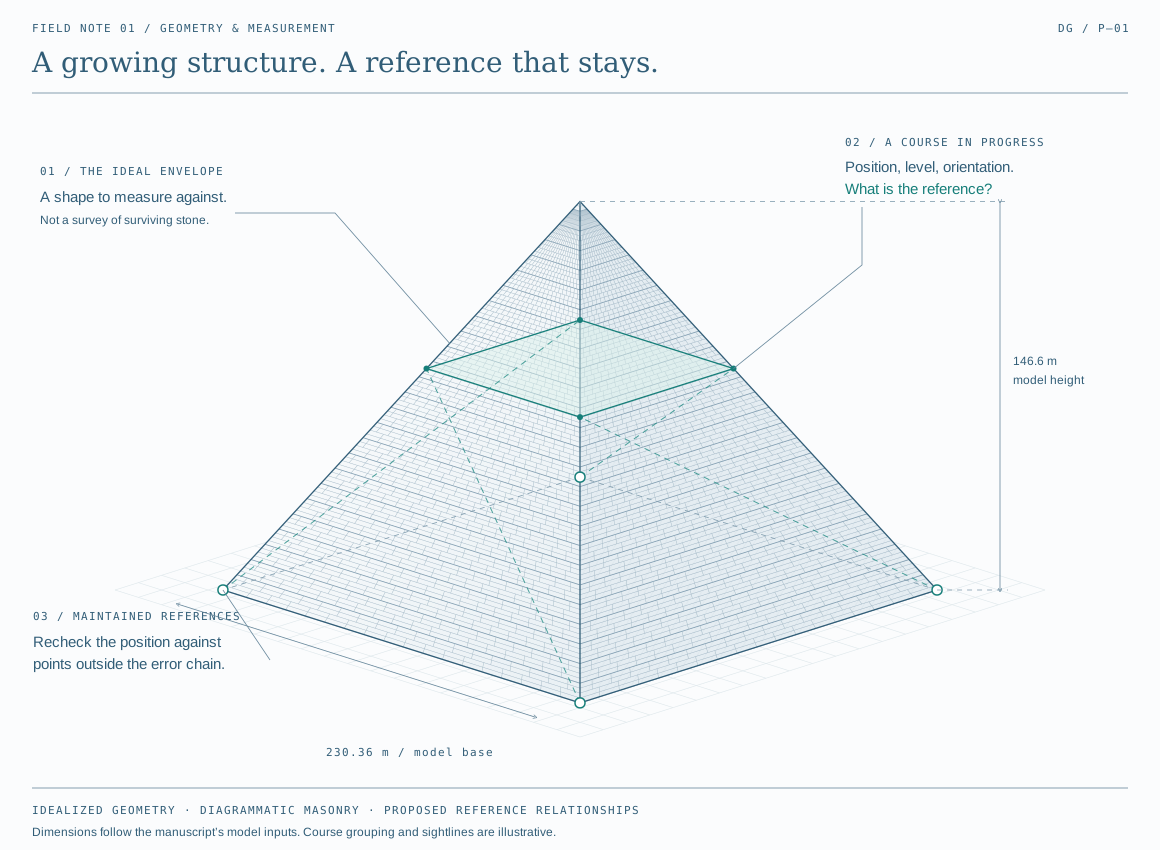
01 / The question behind the drawing
Built from the bottom.
Measured from where?
A layer of stone can be placed above another without using that lower layer as its only measuring reference. That distinction—between the order of construction and the organization of measurement—is the starting point of this work.
My manuscript studies a chain of inherited placement errors and compares it with reference-based descriptions. The interesting question is how the connections between measurements change the error budget.
Think of copying a line by tracing the previous copy. A slight shift becomes part of the next starting point. Now imagine checking every copy against the original. The checking can still be noisy, and the original can itself be misplaced, but the error is no longer inherited in the same way.
This page makes that comparison explicit in a small computational model. It is a study of possible measurement processes, not a determination of which process ancient builders used.
02 / A controlled computational experiment
The same errors. Different references.
Both models receive the same sequence of placement noise. Change the bias or the uncertainty of the reference, then build them layer by layer. The side-to-side displacement is greatly enlarged so you can see it.
A / Inherited referenceEach layer starts from the last.
B / Maintained referenceEach layer is checked against a datum.
Lateral offsets ×300 · idealized vertical geometry · both views use the same scale
Inherited reference / signed offset
Maintained reference / signed offset
Follow the centerline.
One realization · offset in millimetres · actual values, without magnification
A new explanatory model for this companion: one-dimensional translation only, 203 idealized courses and 202 transfers. It does not simulate rotation, stone mechanics, leveling, actual survey-network adjustment, or the history of a monument. Noise and reference uncertainty are standard deviations, not maximum errors or measured ancient tool capabilities.
03 / What the model actually says
A little algebra explains the difference.
Let eₖ be the sideways offset after transfer k, measured in millimetres. Each new observation has independent noise εₖ with mean zero and variance σ². The constant b is a repeated bias. The maintained reference has an offset d, drawn once per realization with mean zero and variance τ², independently of the placement noise.
A / Carry the error forward
eₖ = eₖ₋₁ + b + εₖ
Starting with e₀ = 0, the mean offset is kb and the variance is kσ². The root-mean-square offset is:
RMSₖ = √(kσ² + k²b²)
Independent random errors grow in spread as √k. A repeated bias accumulates as k.
B / Refer back to a datum
eₖ = d + b + εₖ
For k ≥ 1, the mean offset is b and the variance across realizations is σ² + τ². The root-mean-square offset is:
RMSₖ = √(σ² + τ² + b²)
The previous layer’s error does not propagate here. The reference error remains: shared dependence is not the same as perfect accuracy.
The RMS values are exact consequences of these assumptions. The animated trace is one seeded Gaussian realization; it is not an average and need not increase smoothly. Both models use identical placement draws, so the comparison isolates how those draws enter the recurrence.
Definitions, units & edge cases
- Course
- A horizontal layer. The model starts at an idealized base course; adding the other 202 courses requires 202 transfers.
- Datum
- A maintained reference for position. Here it is modeled as one shared offset, not as a perfect point or a solved survey network.
- Bias
- A systematic offset repeated in each observation. Averaging independent random noise does not remove it.
- RMS
- Root mean square: √E[e²], combining spread and mean offset. It is neither a maximum nor a confidence interval.
- At zero transfers
- Both offsets are defined to be zero at the idealized starting course. The datum offset enters when the reference is first used.
- Zero noise
- The chain becomes kb. The reference-based model becomes d + b. Set all three controls to zero and both remain exactly aligned.
04 / A hypothesis to investigate
Could a structure help measure itself?
The manuscript proposes studying already established parts of a monument as a network of reference points. Multiple observations might constrain a new course’s position without simply inheriting the last course’s error.
That is a question about information: which points are observed, how their uncertainty is shared, and whether the geometry gives enough independent constraints to estimate a position. A network must be analyzed with its correlations and reference errors intact.
The experiment above uses a simplified maintained datum. It does not establish the performance of a real reference network, nor show that a particular ancient instrument or construction method was impossible.
To investigate the historical hypothesis, the next step is to compare explicit surveying procedures with archaeological evidence, source measurements and realistic instrument models. Correlated errors, calibration, feedback and uncertainty in reconstructed dimensions all matter.
| Layer | What is available here | What it supports |
|---|---|---|
| Mathematical model | Two recurrences and their stated noise assumptions | Conditional error-growth formulas |
| Computational illustration | Seeded paths and downloadable values | Reproducible examples of those formulas |
| Historical interpretation | A proposed reference-network explanation | A hypothesis requiring archaeological and metrological evaluation |
05 / Working record
Read the argument. Inspect the assumptions.
The original manuscript, On the Infeasibility of Sequential Pyramidal Construction at Old Kingdom Precision, develops a broader treatment of translation, angular error and construction precision. This companion presents a narrower, conditional comparison. The manuscript’s stronger claims about historical feasibility are not established by the animation.
Independent research · Mathematical exploration. The newer collaboration draft seeks archaeological and cultural expertise. No peer-review status or historical reconstruction is claimed here.