Reading & connections
One LinkedIn post. Several more math books.
I saw a post about the Jacobian on LinkedIn and had one of those wait, that looks familiar moments.
Basem Rajjoub was showing a straight grid mapped into a curved one. Take a tiny step in the original grid: where does it land in the new description? Put those directions into a little matrix and you have the Jacobian.
Of course my brain immediately went to the Davis Manifold and the geometry of sameness. Two descriptions. The same underlying thing. A translation between them. What did the translation preserve?
I wasn’t looking to jump into the comments. I wanted to file it away. This is exactly the kind of connection I want to keep track of: an established piece of mathematics that gives me another way to think about a question I’m already working on.
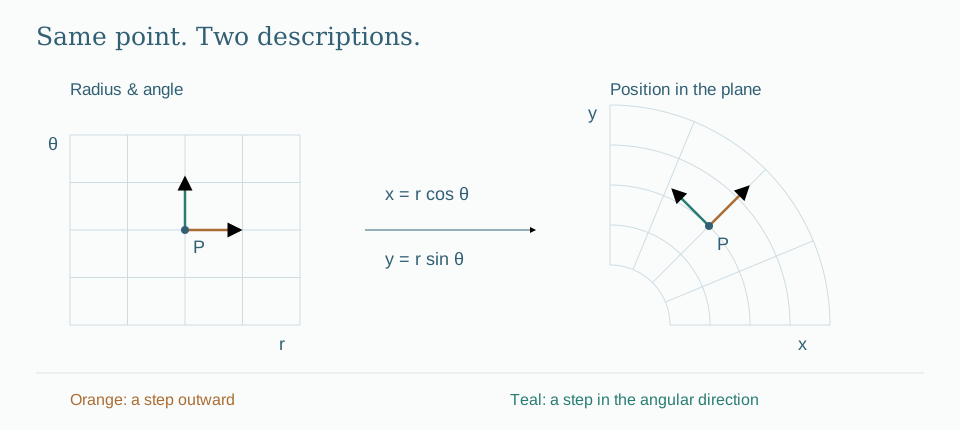
A translator needs to tell you what changed.
Imagine describing where you are by saying “two blocks east, one block north.” Now imagine describing the same place by its distance and direction from home. You haven’t moved. The description has.
But the numbers behave differently. A small change in direction moves you much farther if you are a long way from home. That is the part I keep coming back to: changing the description also changes how we should interpret a numerical step.
The Jacobian describes that local change. My questions go on from there: which relationships does a representation keep, what gets distorted, and when does that distortion matter to a computation?
In my manifold work, the connection is quite concrete: the construction uses JᵀJ to carry Euclidean length measurements back through a map. The broader connection to The Geometry of Sameness is something I want to work through carefully. Recognizing a familiar idea is the beginning of the interesting part.
It also made me think about GIGI. I want a place to record these relationships, with the passages and assumptions attached, so that “this reminds me of that” can grow into something another person can actually inspect. We’ve been discussing a research relationship registry for exactly that purpose.
The LinkedIn post that started this
Basem Rajjoub’s post on the Jacobian, saved from LinkedIn. This is the screenshot I brought to my notes; the original post’s direct URL isn’t recorded here.
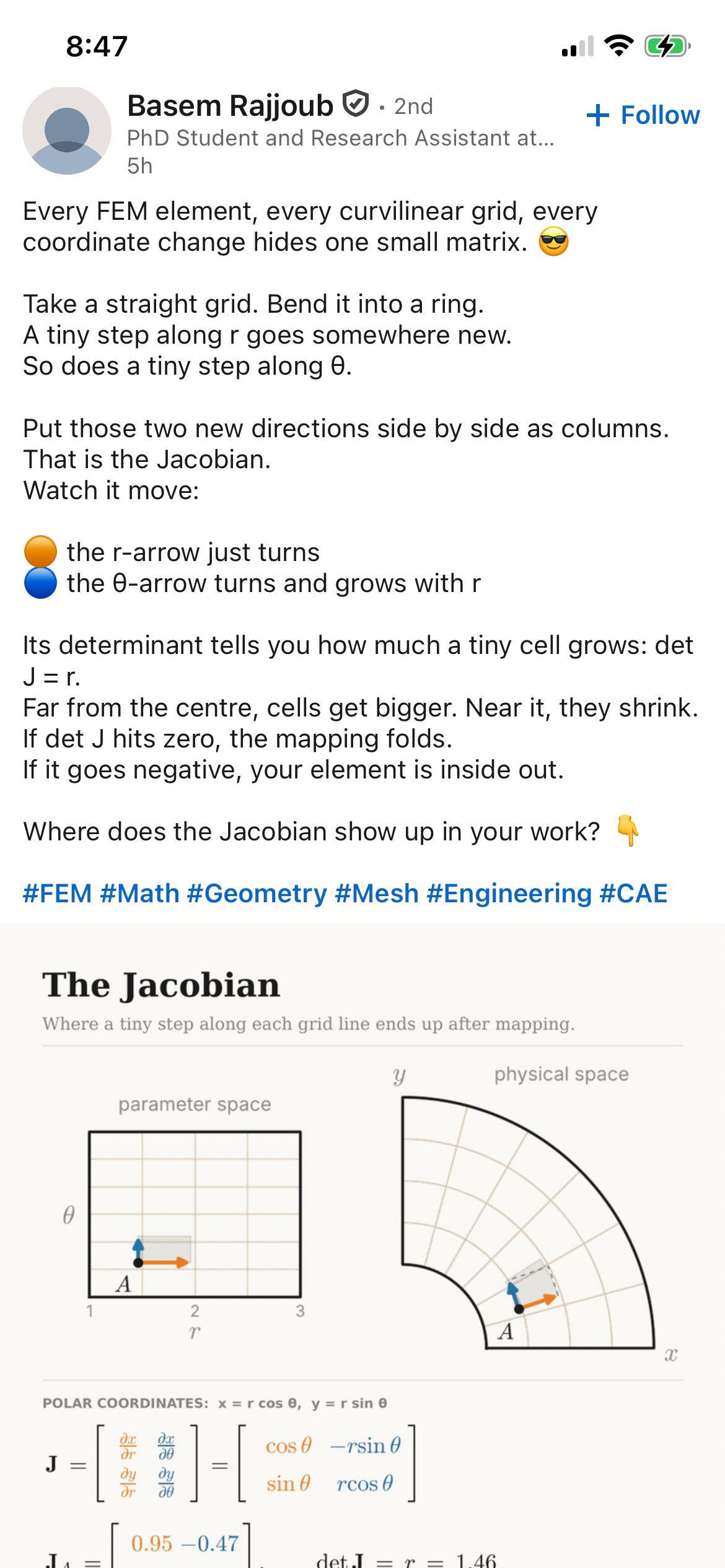
One technical detail I’d keep separate: a zero determinant signals a singular derivative; it does not by itself establish a fold. In polar coordinates, the origin is where the angular description degenerates.
Meanwhile, Delone has my attention.
I’m still working through Delone and Zhitomirsky in Zadachnik. I love the Russian geometry tradition. A problem can fit into one sentence and still give you so much to think about.
Take Problem 160: stand outside a circle and draw a line through it so that the outside part is twice the inside part. It sounds so simple. Then you start moving the point and realize that the circle eventually runs out of room. There is a precise boundary, and figuring out why it is there is the whole pleasure of the problem.
That’s what I want from the blog: enough of a story that you can walk in without a mathematics degree, and enough mathematics that the explanation holds up when you look closely.
And yes, there is a Soviet math handbook in the mail.
I have a 1972 copy of Vygodsky’s Handbook of Higher Mathematics coming, and I am so excited. Apparently this is what gets me excited now. A very large book of mathematics.
I’ve already started looking through a digital copy of a later edition. I want to use the physical book as something I can wander through: follow one idea, find another, leave a bookmark, come back with a better question.
Then I asked what else I should hunt down. Including books from other mathematical traditions. And now there is a whole reading list.
Japanese temple geometry. The Nine Chapters from China. Hilbert and Cohn-Vossen. Needham’s visual books. Medieval Islamic mathematics. Chern. I love all of it. I haven’t read those books yet; that’s the adventure ahead.
I’m putting the list here so I can keep track of what I’m actually reading, what is on its way, and what I want to get to. And so there is somewhere for the little connections to live before they become a paper, a worked problem, or just a really good afternoon.
More soon.
Bee