Diwali · Heritage & mathematics
A little light. A lot of history.
Happy Diwali! Today I’m celebrating a little light, a lot of history, and the many places that can meet in one person.
My mother is from Trinidad and Tobago, and roughly a third of my DNA ancestry is South Asian. I love being mixed. I love having more than one place to look when I ask where I come from, and more than one tradition to learn from as I figure out who I am becoming.
And yes, I have managed to bring mathematics into a Diwali celebration. You knew I would. But first, the light.
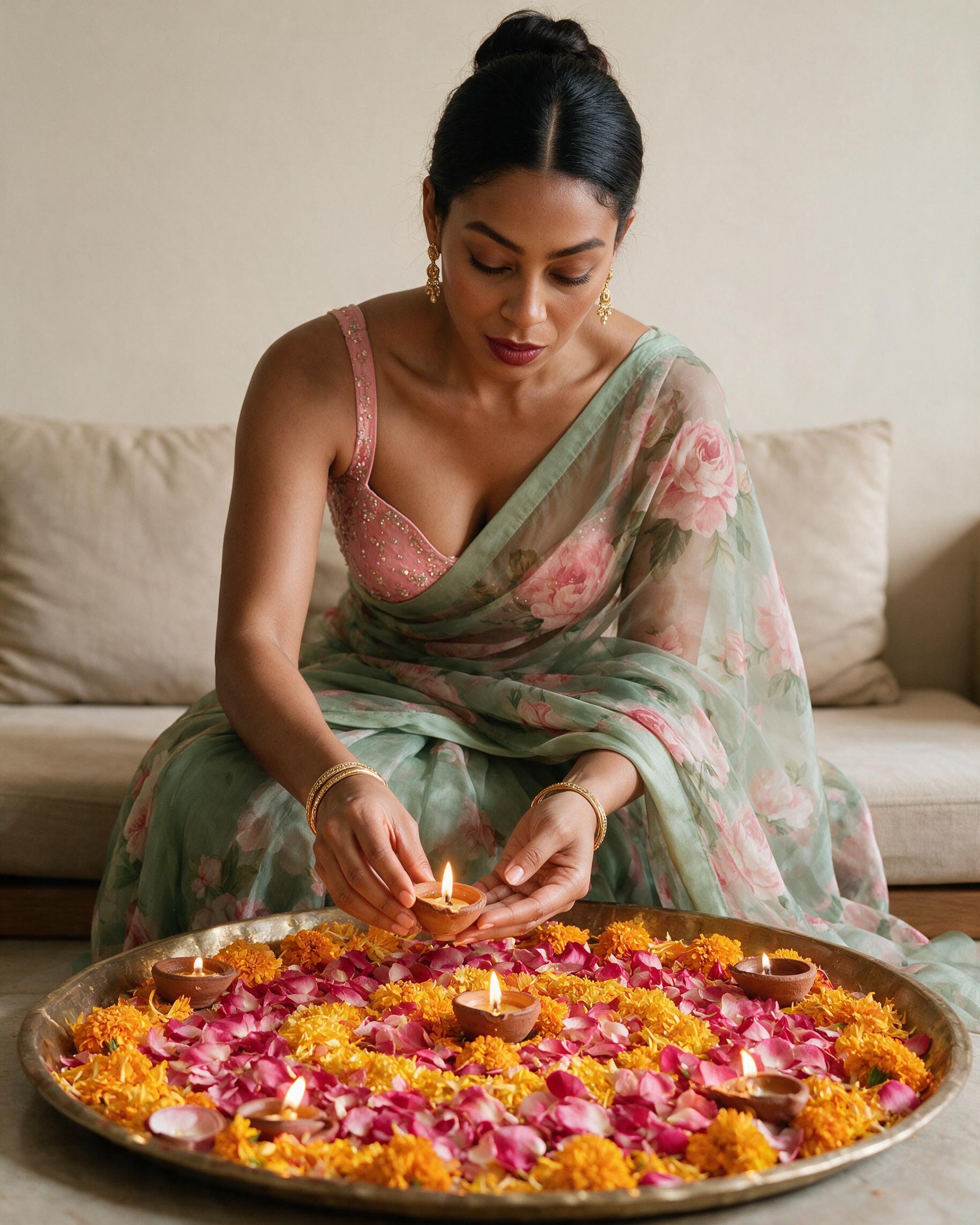
A light that traveled.
In Trinidad and Tobago, you will often see the festival written as Divali. Today, November 8, is its official celebration in 2026. I find something beautiful in the fact that a tradition can travel across an ocean, take root in another place, and become part of that country’s shared life.
That journey has a history worth remembering. The first Indian indentured laborers arrived in Trinidad aboard the Fatel Razack in May 1845. They came into a colonial labor system, carrying languages, beliefs, skills, and relationships that would help shape the country. Celebration can hold gratitude for what people preserved and respect for what they endured.
When I think about my mother’s homeland, I think about how much history a place can hold. For me, being mixed means making room for those different histories without feeling that I have to choose one and put the others away. I can be curious about all of them. I can keep learning. There is joy in that.
The image of a small lamp feels especially right today. Light over darkness, knowledge over ignorance: those are enormous ideas to hold in something small enough to fit in your hands. I like that scale. You can begin with a little light, close to you, and share it.
Of course I brought some mathematics.
I spend so much time thinking about geometry that I sometimes forget to stop and appreciate the people who made whole new ways of thinking possible. Diwali feels like a lovely occasion to celebrate Indian mathematics, and to put a few names and ideas where more people can find them.
Start with the Śulbasūtras, ancient texts concerned with geometric constructions for ritual altars. Here is mathematics with a rope in its hands: making squares, laying out lengths, and changing a shape while preserving its area. I love how physical that is. A construction has to become something you can actually lay out.
One question is easy to picture. Take a square and ask for a new square with twice its area. Doubling the side would give you four times the area. Instead, use the original square’s diagonal as the new side. That length is √2 times the original side. A deceptively small question opens a door into irrational numbers, measurement, and approximation.
The Śulbasūtra tradition also records a striking approximation to √2: 577/408 ≈ 1.414215686. The actual value begins 1.414213562. Think about the care behind getting those numbers so close. This is exactly the kind of thing that makes me want to clear my desk, find the original text, and work through it myself.
Then there is Brahmagupta. In the seventh century, he set out arithmetic rules involving zero and negative numbers, using fortunes and debts to explain positive and negative quantities. That is such a good bridge between a familiar experience and an abstract idea. A debt is something you can understand before you have the formal language for a negative number.
I’m fascinated by that act of giving an idea a usable mathematical description. Once you can represent it and specify how it behaves, you can start calculating with it. Suddenly the language has room for something it could not handle as easily before. That question of representation is very close to the questions I keep asking in my own work.
And I have to include Madhava of Sangamagrama and the Kerala mathematical tradition. Their work on infinite series includes ways of approaching π and evaluating trigonometric functions. In modern notation, one of those relationships is:
π/4 = 1 − 1/3 + 1/5 − 1/7 + …
You can follow the idea without knowing calculus: keep adding and subtracting smaller pieces, and the running total approaches a particular value. This series is slow, which makes Madhava’s work on correction terms especially interesting. How do you improve an approximation when you have only carried out a finite calculation? That remains a very recognizable engineering question.
These are people I want to spend more time reading. Their questions have texture: ropes, areas, debts, circles, and the work of getting a calculation closer to its target. I love mathematics that lets you see the question before it asks you to learn the notation.
More room at the table.
I’m still working through Delone in Zadachnik, and my reading list keeps getting longer. Apparently celebrating a holiday is also an opportunity for me to discover several more things I want to study. This should surprise absolutely no one.
But I’m grateful for that curiosity. Learning across mathematical traditions makes the subject feel bigger and more human to me. There are so many ways a person can arrive at a difficult question, and so many lives behind the ideas we now meet as a line in a textbook.
Today, I’m celebrating my mother’s homeland, my South Asian ancestry, and the joy of having all these parts of myself in the same room. I’m celebrating the people who carried traditions forward and the people who gave us new ways to think. And I’m wishing a little more light, understanding, and kindness for all of us.
Happy Diwali. Happy Divali. I hope there is something beautiful in your day.
With love,
Bee