Books · Expanded second edition
Fuel is back. I kept following the question.

Okay. The Geometry of Fuel is back. And before we get into the equations, look at that cover. The fire. The color. I love it.
The back begins: “A machine flagged her body as an anomaly. She wanted to know what it had actually measured.” That question belongs to my life. It followed me into NASA telemetry, into the way computers describe the world, and eventually into experiments about energy. I did not sit down one day with a plan to connect all of those things. I kept following the question.
This expanded second edition lets you follow it with me. There are beautiful technical drawings, calculations you can work through, and the beginnings of the questions that became Helike. There is also a forthcoming hardcover-only chapter I especially want to tell you about: “Thank You, Mr. Perelman.”
And there is my life between the calculations. The new preface talks about being a researcher and still working restaurant shifts. The early experiments happened at my desk, late at night, with a dog at my feet. Those things are happening in the same life. The book comes from that life.
Coming to the hardcover only
Thank You, Mr. Perelman.
“I did not come to Russian geometry in chronological order. I came through Perelman.”
That is how the chapter opens. I admired what he had done with the Poincaré conjecture, but I wanted to understand how it worked. How could changing the way a space measures distance help reveal what kind of space it was? What did that change have to preserve?
Then I found myself reading and translating old Soviet geometry problems. Delone and Zhitomirsky. A square inside a triangle. A square inside a slice of a circle. Much smaller questions, but they made me slow down and look at what a construction actually keeps intact.
Here is one I love. Keep a triangle’s base and height the same, but move its top corner sideways within the width of the base. The square fitted against that base keeps the same size. Its position changes. So a record of the base and height can tell you how big the square is, but cannot tell you where to put it. Two perfectly reasonable questions. Different information required to answer them.
That is the kind of connection I want you to see. It starts with something you can draw and follows it into what a computer must remember. Later in the chapter, GIGI starts with two specified operations and builds their multiplication structure. The example distinguishes a 120-element system from the identity system even though a simpler summary makes both look trivial. Keeping the order of operations matters.
The chapter also follows a Ricci-flow calculation—an evolution of the distance-measuring rule—and an exact correspondence with a connection-energy calculation for a specified family of geometries. The further lattice bridge is still open. I wanted the chapter to show what the investigation achieved and where the next question begins.
My Zadachnik reading blog is part of this story. Reading, translating, drawing, trying the problem myself, and then realizing it has followed me back into my own work. This chapter is my thank-you for that.
Hardcover preview: “Thank You, Mr. Perelman” is a forthcoming companion chapter for the hardcover only. It is not yet included in the 413-page hardcover PDF linked above and is not planned for the paperback.
Before she had a name.
If you have met Helike on this site, Fuel lets you follow the questions that led toward her. The early work asked what the shape of a collection of measurements could tell me about a field. The question became more precise: when I change the field a little, how does its energy bend?
Think of tapping a bell. Its sound contains patterns of motion, called modes. A mode is a whole pattern, not one point on the bell. In the classical field model I studied, I was looking for an exact pattern too: one that the energy’s second-derivative operator—the Hessian—sends back as a multiple of itself. The multiplier tells us how sharply energy bends along that pattern, for a fixed way of measuring its size.
Helike is the explicit twisting pattern I found. The Floor Theorem establishes that her value is the lowest across every symmetry sector of the Berger-field problem for the certified squashing range, 2.75 through 10. Here that value is negative: energy bends downward in her direction. The bell helps explain a mode; the theorem concerns the curvature of a classical energy model.
That is a beautiful development to be able to trace through this book. An observation at a screen becomes a more exact question, then an explicit field and a theorem with a proof. Near the end of “The First Door,” I look back at that route and explain how following Perelman’s work led me toward the Hessian and Helike. It is a classical result with its own scope; the quantum mass-gap question remains a further problem.
Read that passage in Fuel, hardcover pp. 158–159 →
Meet Helike and explore the Floor Theorem →
One what? And which way?
One of the later chapters begins with me mopping the floor at the restaurant.
Tell me there is one mop and I know what you mean. Tell me to move it “one,” and I need more information. One inch? One metre? Toward the door? Toward my feet? The number has stayed the same. The instruction is incomplete.
That very ordinary question opens into the mathematics. A distance needs a direction before it tells us where to go. A final position does not tell us the route we took. Two descriptions can refer to the same object while keeping different information about it.
I wanted the new edition to make those steps easier to follow. You get the everyday question, the construction, the calculation, and the GIGI readback. You can see where I supplied the inputs and what the engine actually returned. The restaurant-floor chapter starts here.
The earlier NASA work gets that closer treatment too. I returned to the recovered AMC code—the adaptive data representation I developed around telemetry—and put it into controlled comparisons with GIGI. Making a record smaller is useful. Keeping the information that lets you recognize an alarm is another requirement. The expanded examples let you inspect both.
If we are talking about fuel, follow the whole bill.
Here is a drawing I love because you can understand the question before reading an equation.
Pump water into a higher tank. Let it come back down through a turbine. Electricity comes out. Wonderful. But how much electricity went in to lift the water? Did we include the pump’s losses? Has the apparatus really returned to its starting condition, or is the motor still warm?
In the book’s constructed example, 2.600 kilojoules go in and 1.400 come out. After the stored energy returns to its starting value, the remaining 1.200 is loss. Those are worked-example values, not readings from a machine I built. They make the accounting visible: the exciting part of a cycle is not the whole cycle.
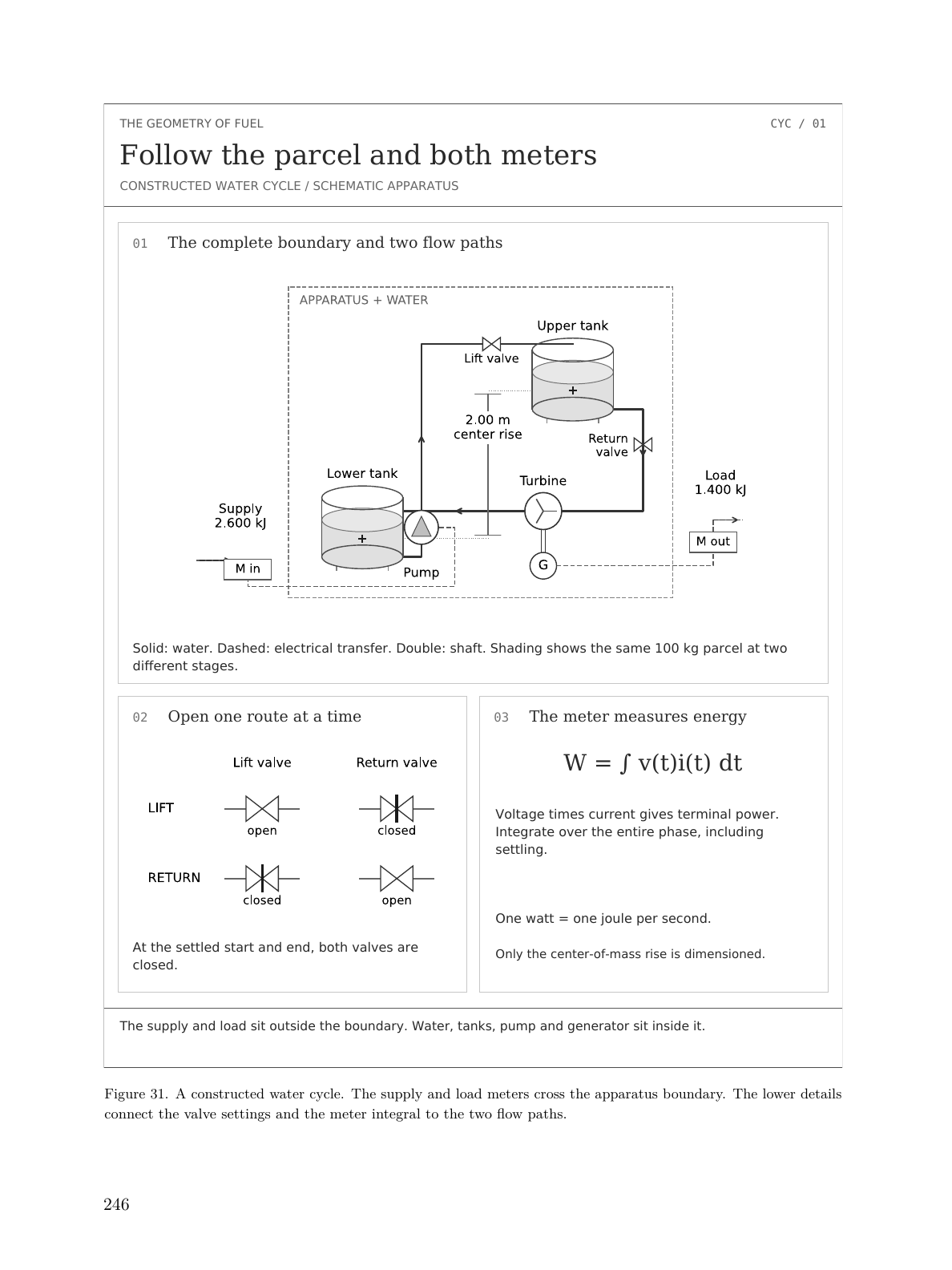
The same question follows me back into the experiments. If a result changes, did the physical system change? Did I change the way I weighted the measurements? Did I change the question? The new chapters slow down at those distinctions and work through them.
I wanted you to be able to see the mathematics.
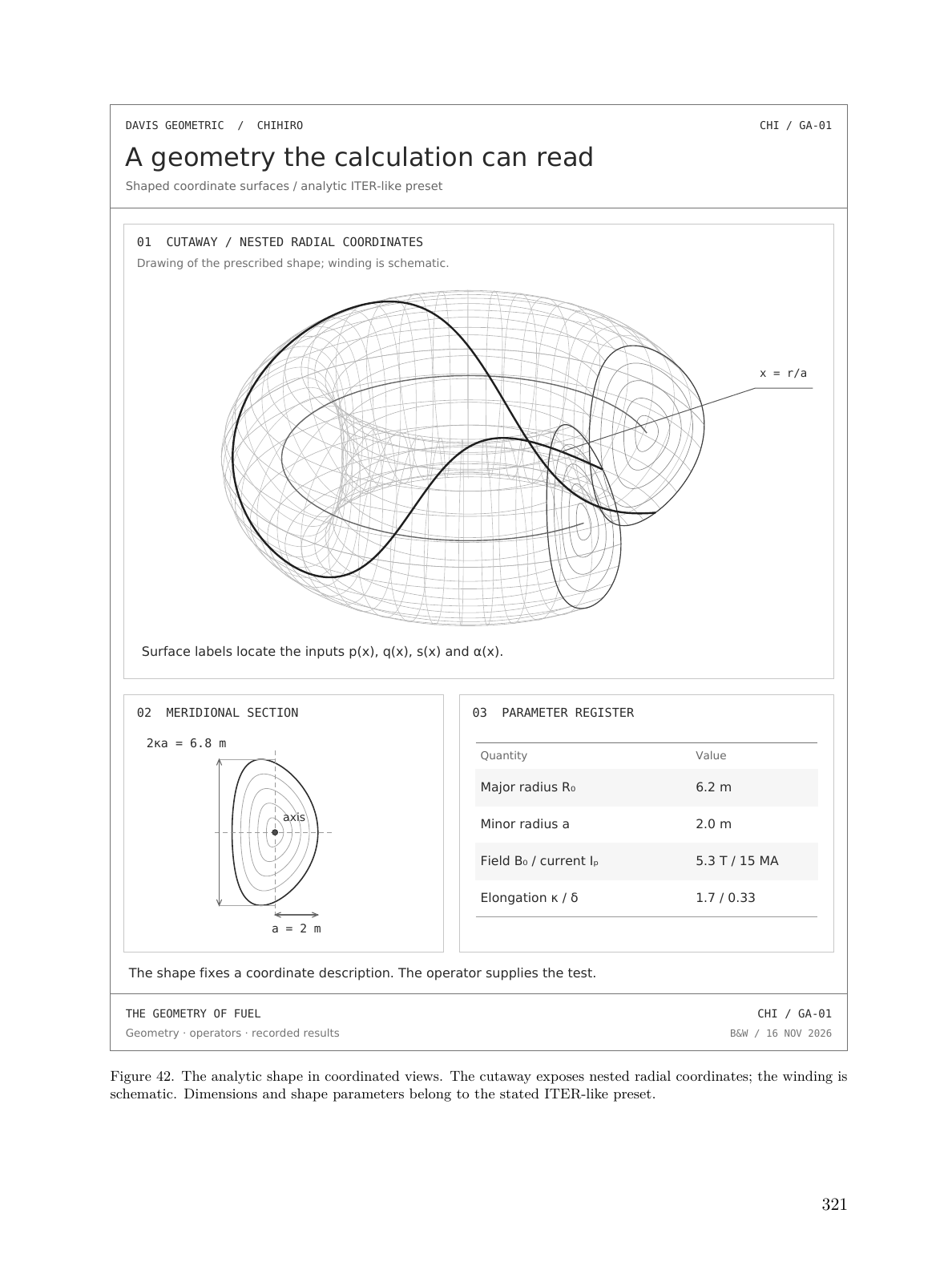
The expanded hardcover gives the technical drawings room. Look at this CHIHIRO cutaway. The nested surfaces locate the inputs to a shaped plasma model. You can inspect the shape, then follow how it enters the calculation. The picture describes an analytic model; the subsequent stability calculations have their own assumptions and tests.
Imagine a small disturbance inside that model. Does it settle, or does it have a way to grow? The chapter follows that question through pressure settings, changes of shape, and numerical resolution. It includes the saved results and the corrected calculations. I want somebody else to be able to change an input and ask a better question.
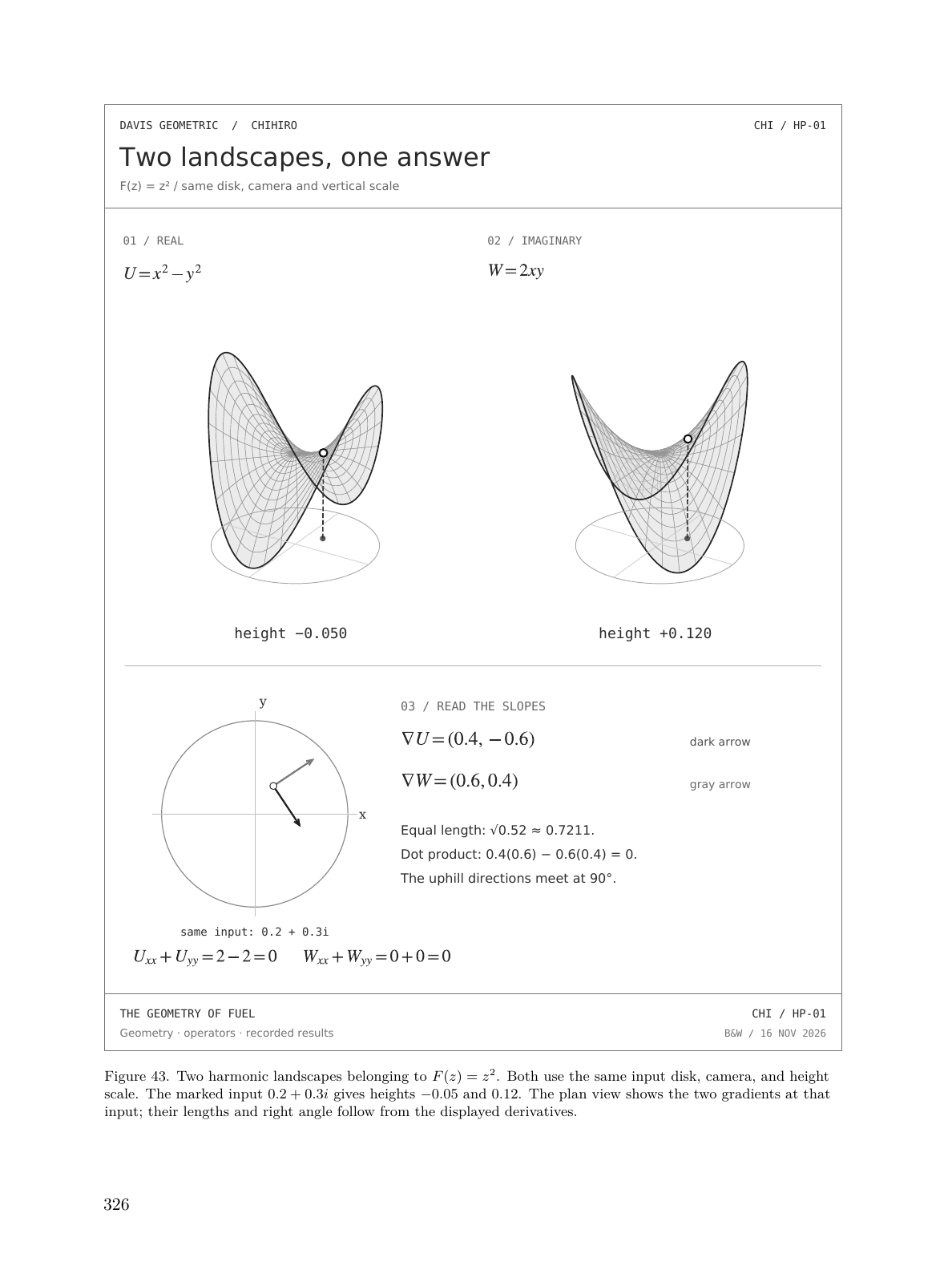
And those two saddle-shaped landscapes? They are two parts of one complex function. At an interior point, each surface has the balancing property called harmonic: its height equals the average around a small surrounding circle. Their slopes are also linked. In this example the two uphill directions have equal lengths and meet at right angles, except where both vanish.
I love when a drawing lets you see something that an equation has been saying all along. Then you can read the equation with a picture in your head.
The route can leave something behind.
The new material follows measurements into relativity, too: which observer, which clock, which event? A new set of coordinates can make the numbers look different without changing the underlying situation. The book works through the distinction between a different description and genuine curvature.
That leads to another favorite drawing. Move a pointer around a triangular route on a globe. At each spot, imagine a tiny flat plane touching the surface; carry the pointer without turning it within that plane. It comes back to the same place facing a different way. The location has returned. The orientation has kept something from the journey.
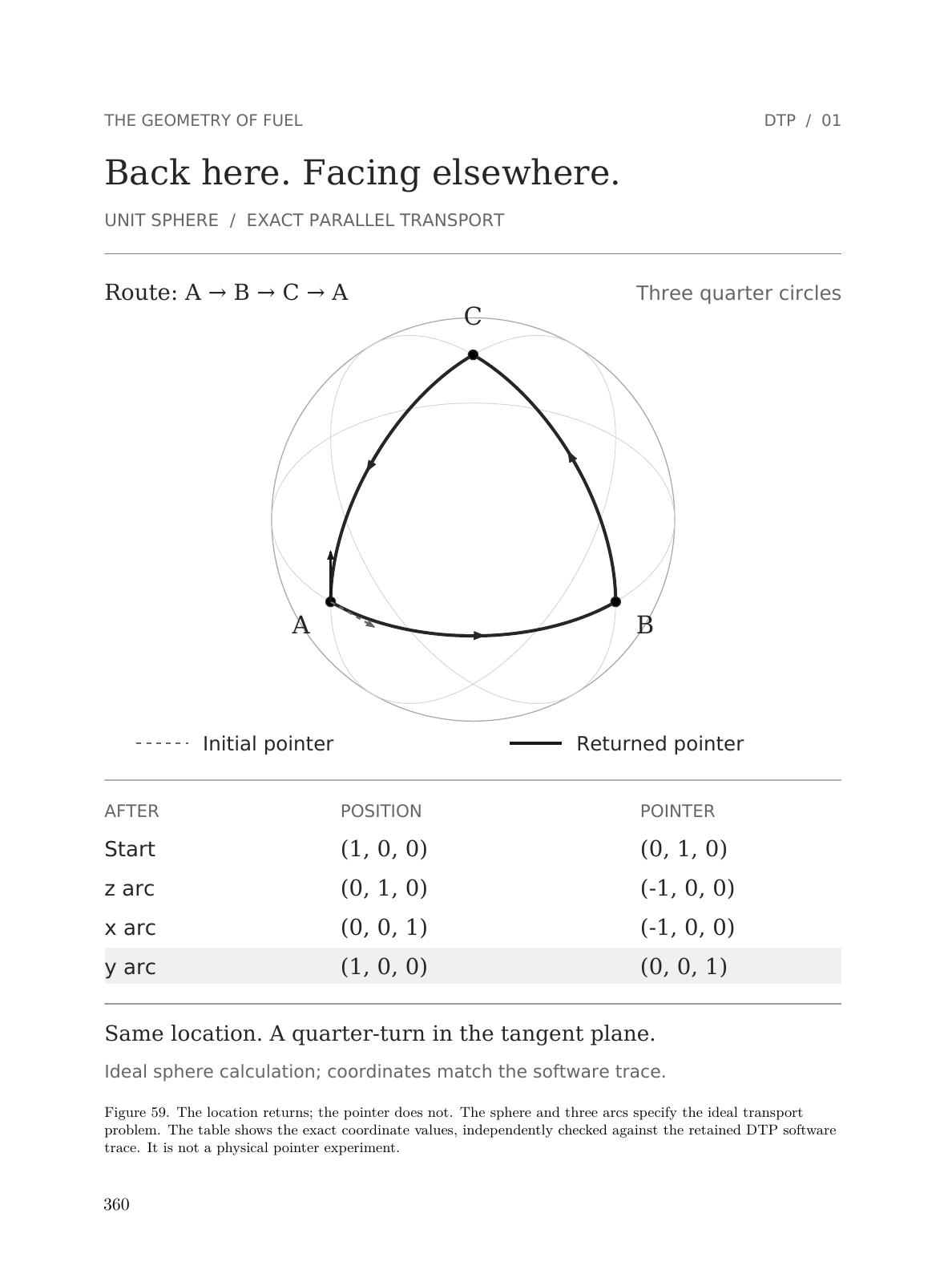
This is part of the route toward the processor I want to build. DTP already gives me a software setting where I can define operations and check their results. The material model is a separate investigation; connecting them in a physical device is still engineering work ahead. The expanded edition finally gives that ambition a chapter of its own.
There is more to show, and more to ask.
I returned to Fuel because the questions kept growing. Perelman’s work sent me back to the geometry. The old problem books gave me constructions I could hold in my head. GIGI gave me a way to make an idea answer back. Helike emerged from following the energy carefully enough to find an exact pattern.
I want the book to let you feel some of that. The pleasure of a drawing suddenly making sense. An ordinary question following you home. The moment you realize that two things you have been thinking about separately belong in the same conversation.
So, yes. I am excited. Open a drawing. Follow a calculation. Tell me where it takes you. I have been living with these questions for a long time, and I would love for you to spend a little time with them too.
The cover is reproduced in full from the supplied second-edition artwork. The four interior illustrations are unaltered pages from the corrected expanded second-edition hardcover, dated 26 November 2026. Page references above use that edition; the paperback has different pagination. The forthcoming hardcover-only Perelman chapter is previewed separately above.