Approximation: inspect the error function
Move from endpoint interpolation to the complete error curve, a refinement law, and the distinction between upper and lower bounds.
01 / Work through the construction
Start here / a worked example
How far does a straight line miss a parabola?
Join two values you can calculate.
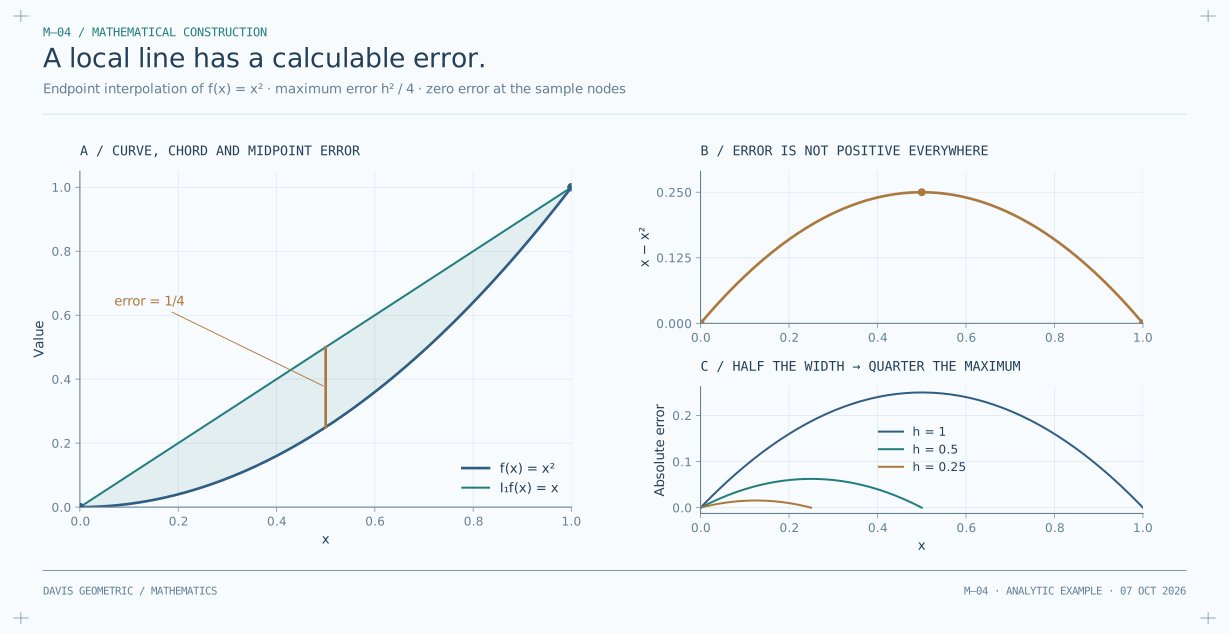
Take f(x) = x² between 0 and 1. Its endpoint values are 0 and 1. The straight line joining them is y = x: the linear interpolant.
Measure the miss halfway across.
At x = 1/2, the line gives 1/2 and the parabola gives 1/4. The error is 1/4. More generally, x − x² = 1/4 − (x − 1/2)², so 1/4 is the largest error on this interval. At both endpoints, the error is zero.
Make the interval smaller.
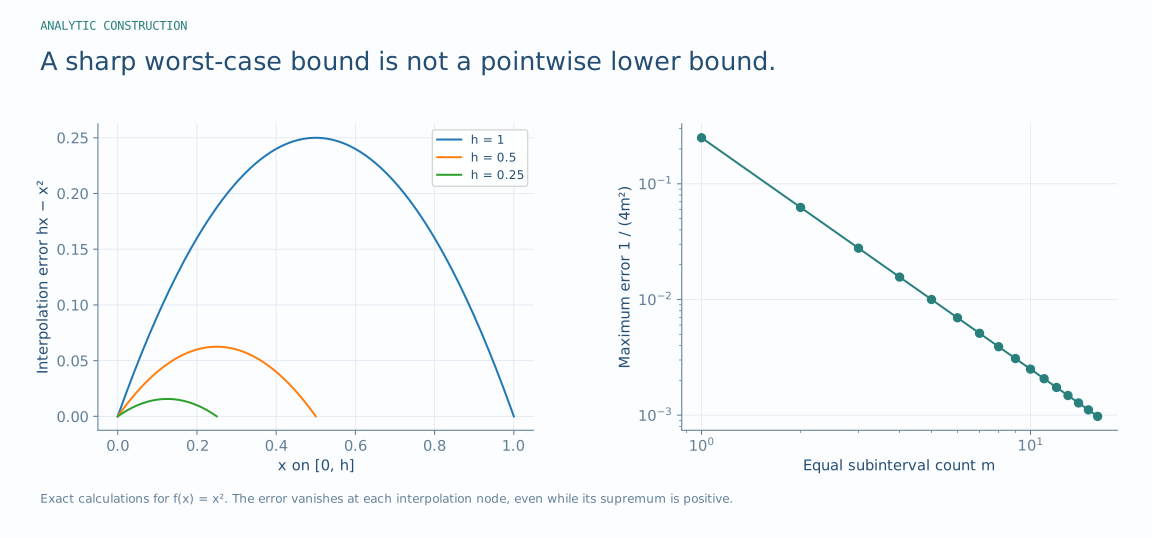
On [0, h], the joining line is hx and the maximum error is h²/4. Halving the interval divides this error by four. The second derivative of x² is 2, so this exactly meets the bound h² × 2/8.
The research asks which versions of this relationship survive for more complex models. “The worst error is at most this much” and “every point must have at least this much error” are very different claims.
Words for this step Derivative / Hessian · Linear interpolant · Supremum norm, ‖f‖∞ · Bound / asymptotic limit
02 / A complementary view
03 / What to check when applying the idea
Identify the state space, the equivalence rule, the distance or observable, and the assumptions used by the argument. Then ask which part is an identity, which part is a model choice, and which part needs an empirical test. The worked constructions illustrate the stated mathematics; they are not evidence that every dataset admits the same geometry.
Use the linked proof review to distinguish the retained conditional statements from the broader manuscript claims requiring correction. Original manuscript titles identify sources and do not override the narrower conclusions on the current research pages.
Sources, versions & further reading
Additional diagnostic plates are analytic constructions or descriptive re-plots of the saved record, as labeled. They do not introduce new experimental validation.