Connected partitions: inspect what changes
Enumerate the admissible partitions, add one edge, and follow the inclusion argument that proves monotonicity.
01 / Work through the construction
Start here / a worked example
Three objects can have different ways to stay together.
Connect three labeled dots in a chain.
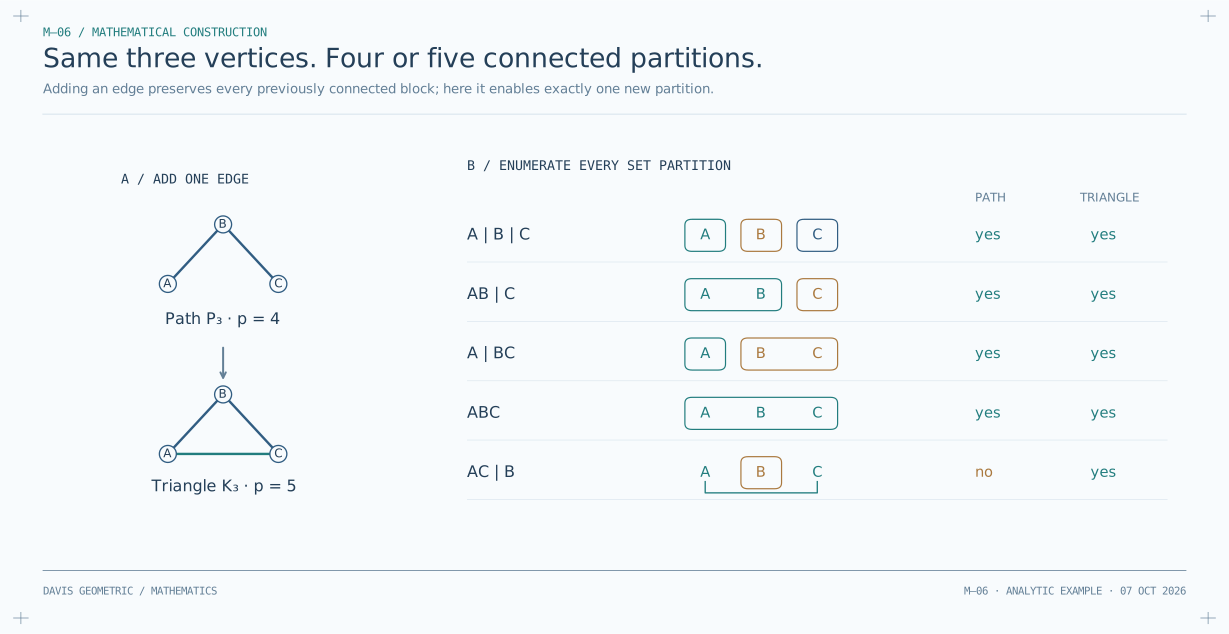
Draw A—B—C. Divide the vertices into groups, requiring every group to stay connected using edges inside that group. The four allowed divisions are shown in the plate.
Add the missing edge.
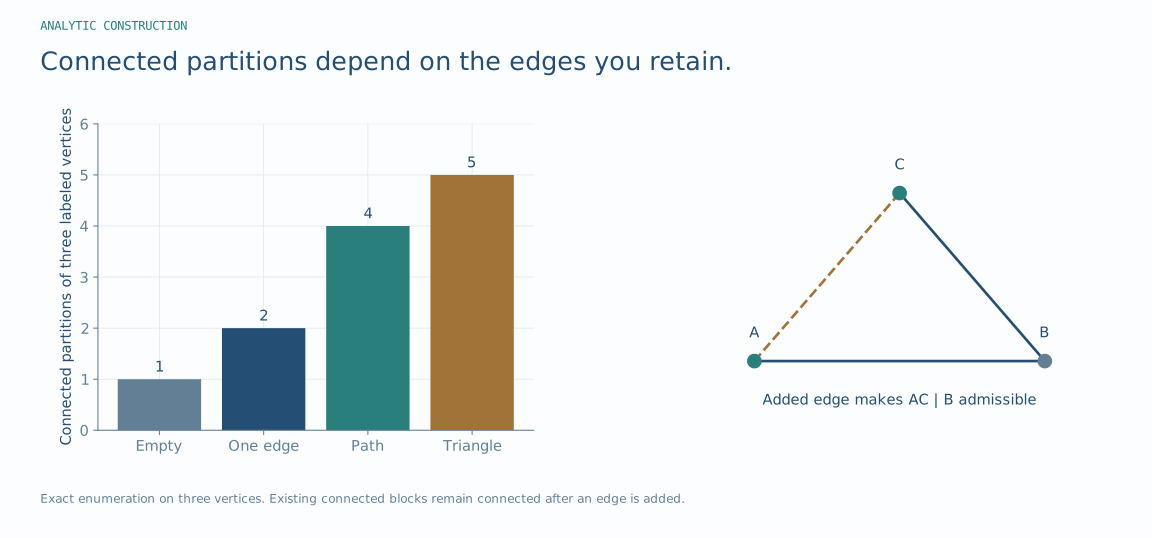
Join A directly to C to make a triangle. The old four divisions still work, and one new division becomes possible: AC | B. The number of vertices remains three, but the connected-partition count rises from four to five.
Turn the example into a proof.
Adding an edge cannot disconnect any group that was already connected. Every old connected partition therefore remains valid. The count can stay the same or increase, but cannot decrease.
This is the precise meaning of the monotonicity statement below. The counting system keeps the relationships as well as the positive count; it does not require ordinary arithmetic to abandon zero.
Words for this step Graph / spanning subgraph · Connected partition · Injection / monotonicity · Bell number
02 / A complementary view
03 / What to check when applying the idea
Identify the state space, the equivalence rule, the distance or observable, and the assumptions used by the argument. Then ask which part is an identity, which part is a model choice, and which part needs an empirical test. The worked constructions illustrate the stated mathematics; they are not evidence that every dataset admits the same geometry.
Use the linked proof review to distinguish the retained conditional statements from the broader manuscript claims requiring correction. Original manuscript titles identify sources and do not override the narrower conclusions on the current research pages.
Sources, versions & further reading
Additional diagnostic plates are analytic constructions or descriptive re-plots of the saved record, as labeled. They do not introduce new experimental validation.