Transport: local curvature and global topology
Follow a transported tangent direction, then compare spherical loop geometry with a flat connection on a circle.
01 / Work through the construction
Start here / a worked example
Return to the same place. Check the direction.
Begin with a flat sheet of paper.
Slide a small arrow around a triangle without rotating it. Back at the start, it points in its original direction. The location and direction have both returned.
Repeat on a sphere.
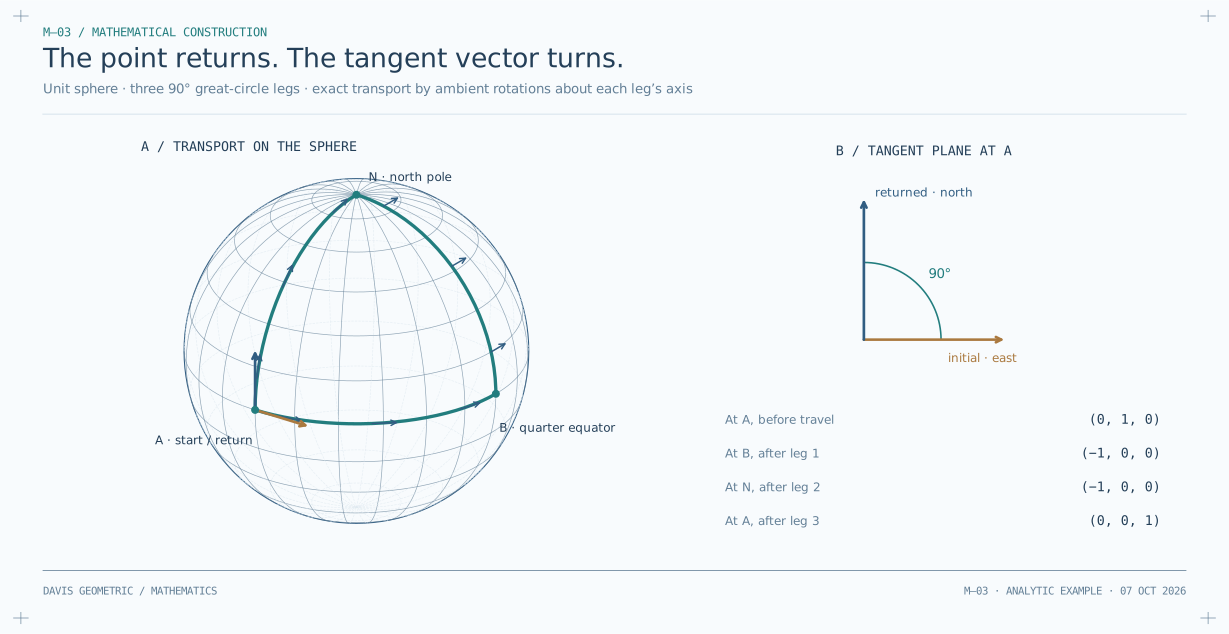
Use the unit sphere. Start on the equator, travel east through 90° of longitude, go north to the pole, and follow a meridian back to the start. Carry a tangent arrow using parallel transport: do not turn it within the surface’s local tangent plane.
For this particular loop, an initially east-pointing arrow comes back pointing north. The 90° change is holonomy. The blueprint tracks the vectors along each leg; this is a computed geometric example, not a compass-needle experiment.
Separate local geometry from global topology.
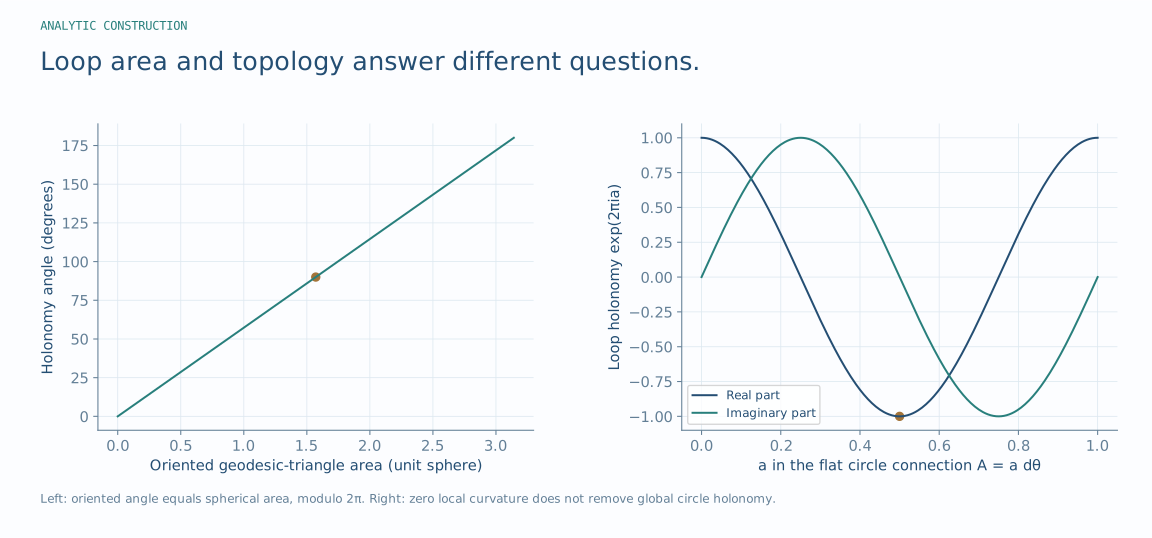
A connection specifies the transport rule. Its curvature describes the effect of small loops. On a space with holes, even a flat connection can retain a change around a large loop. That is why the formal statement needs a topological condition as well as zero curvature.
Words for this step Parallel transport · Holonomy · Connection · Simply connected / homotopy
02 / A complementary view
03 / What to check when applying the idea
Identify the state space, the equivalence rule, the distance or observable, and the assumptions used by the argument. Then ask which part is an identity, which part is a model choice, and which part needs an empirical test. The worked constructions illustrate the stated mathematics; they are not evidence that every dataset admits the same geometry.
Use the linked proof review to distinguish the retained conditional statements from the broader manuscript claims requiring correction. Original manuscript titles identify sources and do not override the narrower conclusions on the current research pages.
Sources, versions & further reading
Additional diagnostic plates are analytic constructions or descriptive re-plots of the saved record, as labeled. They do not introduce new experimental validation.