Double covers: what survives the quotient?
Follow the arrow-to-axis map and test which quantities assign the same value to opposite arrows.
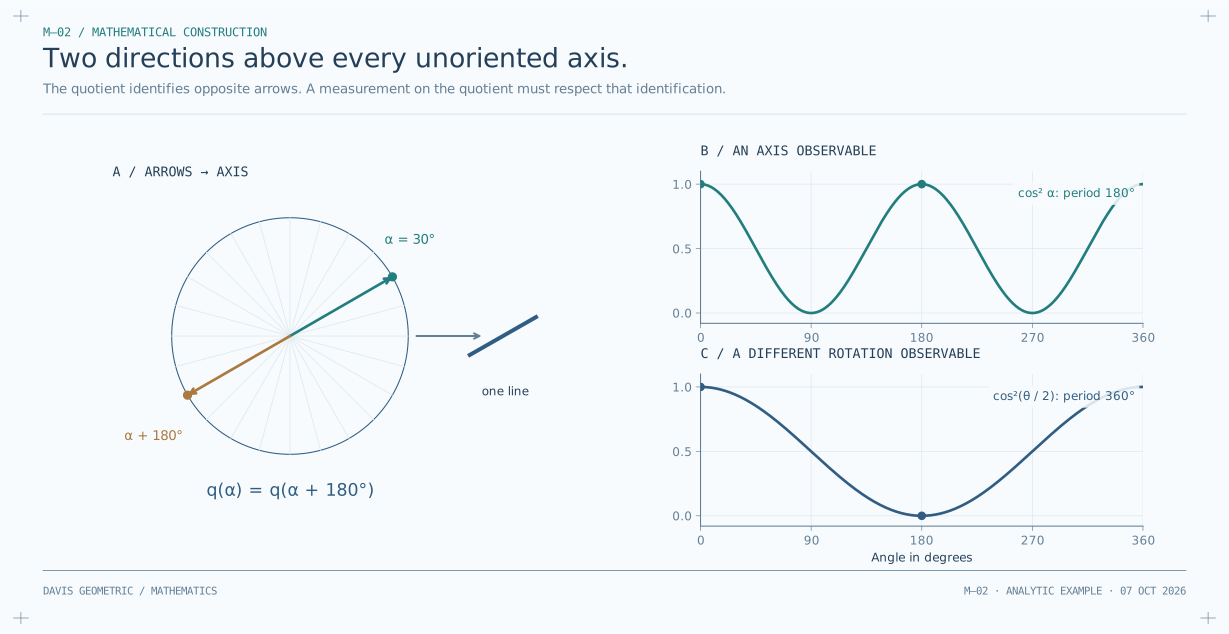
01 / Work through the construction
Start here / a worked example
An arrow and a line do not distinguish the same things.
Turn an arrow halfway around.
An arrow pointing northeast becomes an arrow pointing southwest after a 180° turn. They point in different directions. A full 360° turn restores the original arrow.
Now erase the arrowhead.
The northeast–southwest line is unchanged by that same 180° turn. Each unoriented line corresponds to two opposite arrows. Sending an arrow to its line is a double cover.
Check what a measurement can tell apart.
If your measurement is supposed to depend only on the line, opposite arrows must give the same answer. A measurement that changes when the arrow reverses needs the extra directional information.
The paper also studies half-angle overlaps. For θ = 60°, cos²(θ/2) = 3/4 and sin²(θ/2) = 1/4. They add to one. This trigonometric identity is exact, but the overlap is not automatically an observable on the arrow-to-line quotient.
Words for this step Quotient · Double cover · Observable · S¹, ℝP¹ and eⁱᵅ
02 / A complementary view
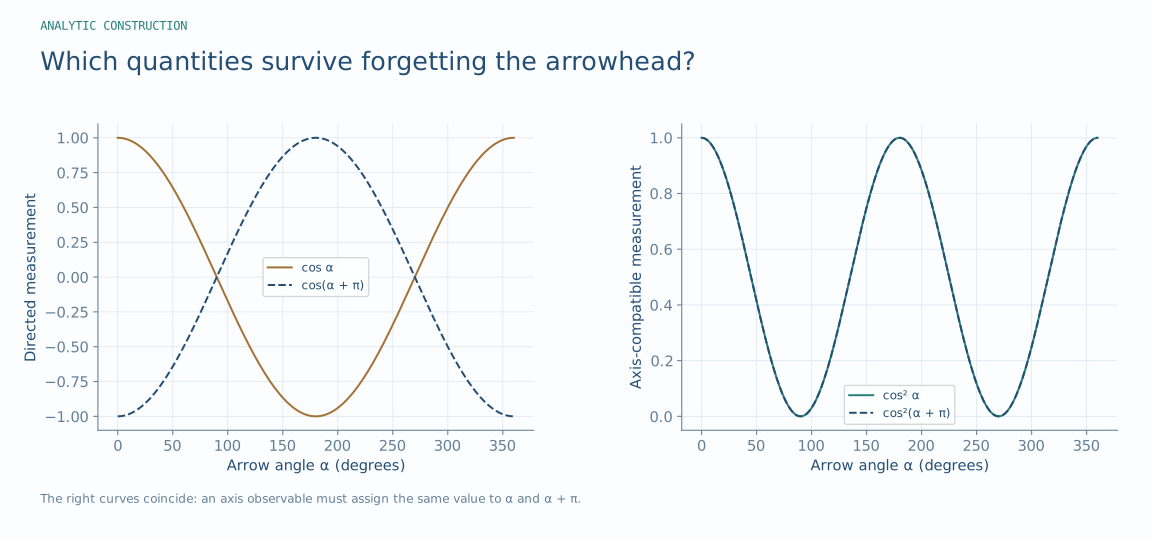
03 / What to check when applying the idea
Identify the state space, the equivalence rule, the distance or observable, and the assumptions used by the argument. Then ask which part is an identity, which part is a model choice, and which part needs an empirical test. The worked constructions illustrate the stated mathematics; they are not evidence that every dataset admits the same geometry.
Use the linked proof review to distinguish the retained conditional statements from the broader manuscript claims requiring correction. Original manuscript titles identify sources and do not override the narrower conclusions on the current research pages.
Sources, versions & further reading
Additional diagnostic plates are analytic constructions or descriptive re-plots of the saved record, as labeled. They do not introduce new experimental validation.