MIRADOR / the interfaces between molecular and clinical scales
Research settingIndependent
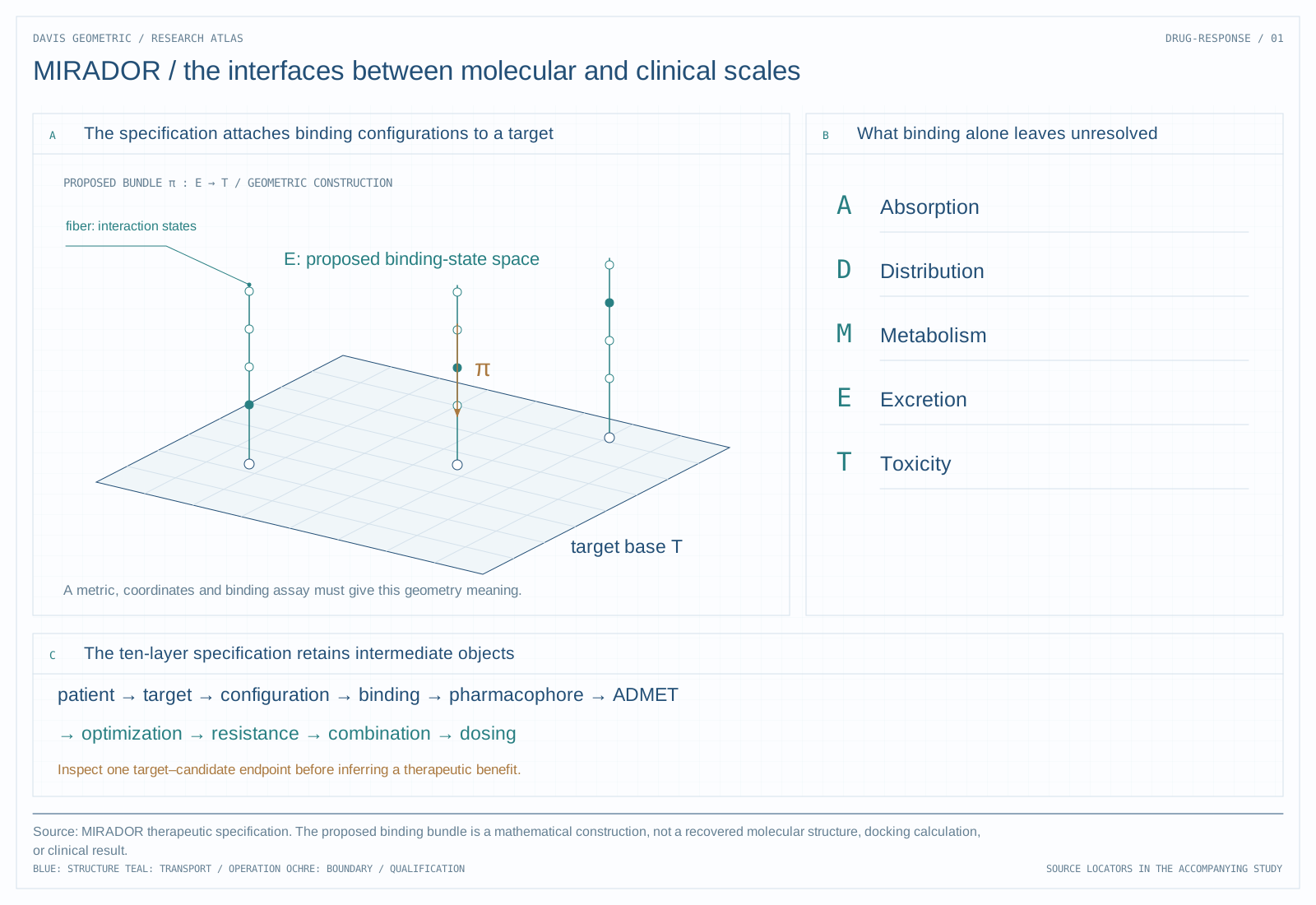
MIRADOR’s therapeutic-geometry specification decomposes drug–organism response into a pipeline of linked representations. The research ambition is to retain context as a candidate moves from molecular structure to binding, disposition, and response.
From the research record
Inspect the work
Original figures, recorded values, and explicit model details. Each exhibit identifies its source and what the comparison means.
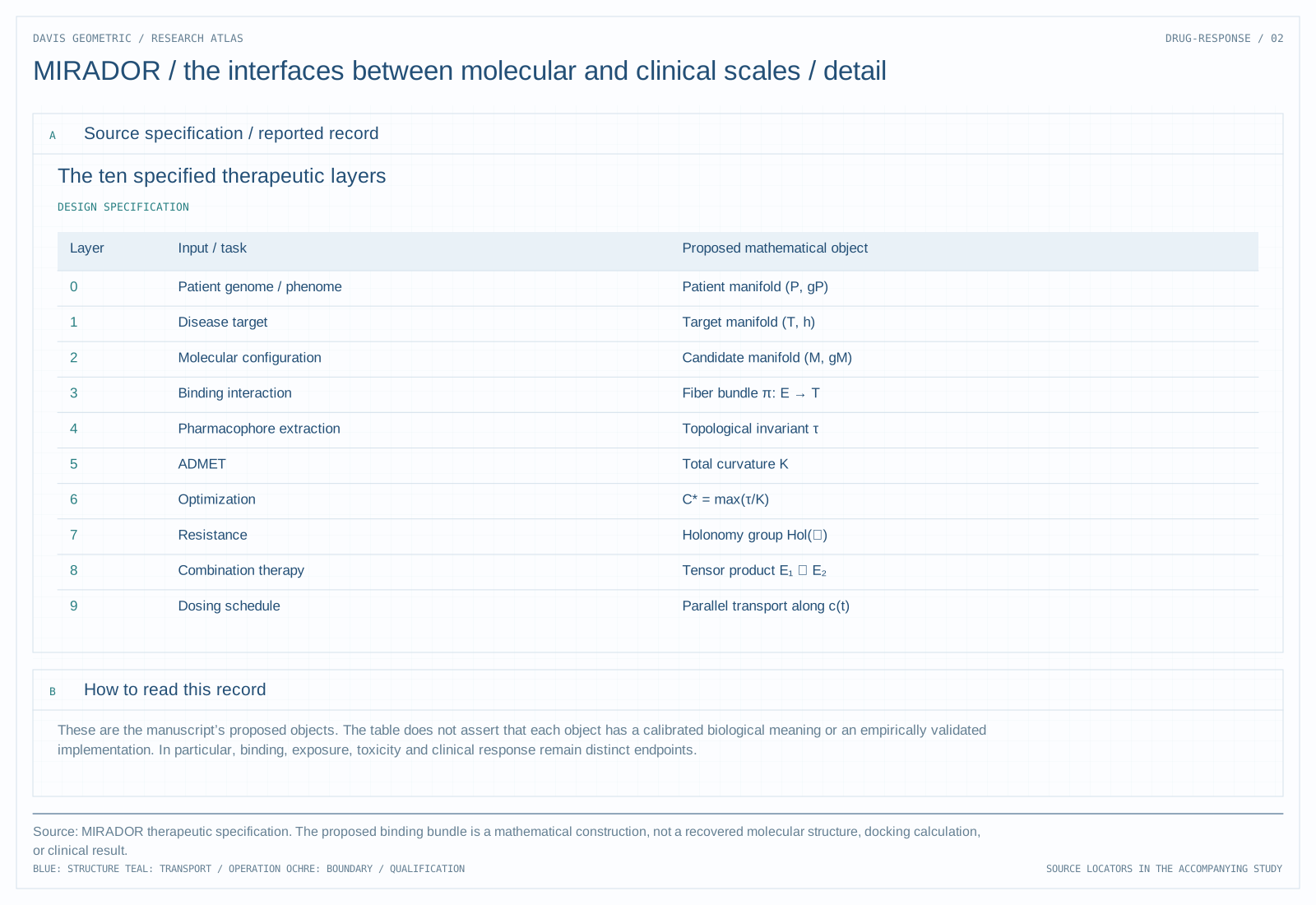
The ten specified therapeutic layers
Scroll horizontally to inspect the full table →
| Layer | Input / task | Proposed mathematical object |
|---|---|---|
| 0 | Patient genome / phenome | Patient manifold (P, gP) |
| 1 | Disease target | Target manifold (T, h) |
| 2 | Molecular configuration | Candidate manifold (M, gM) |
| 3 | Binding interaction | Fiber bundle π: E → T |
| 4 | Pharmacophore extraction | Topological invariant τ |
| 5 | ADMET | Total curvature K |
| 6 | Optimization | C* = max(τ/K) |
| 7 | Resistance | Holonomy group Hol(∇) |
| 8 | Combination therapy | Tensor product E₁ ⊗ E₂ |
| 9 | Dosing schedule | Parallel transport along c(t) |
These are the manuscript’s proposed objects. The table does not assert that each object has a calibrated biological meaning or an empirically validated implementation. In particular, binding, exposure, toxicity and clinical response remain distinct endpoints.
MIRADOR_SPEC.md · Version 0.2, Architecture Overview: layers 0–9
Read the technical figure
Source: MIRADOR therapeutic specification. The proposed binding bundle is a mathematical construction, not a recovered molecular structure, docking calculation, or clinical result.
Source: MIRADOR therapeutic specification. The proposed binding bundle is a mathematical construction, not a recovered molecular structure, docking calculation, or clinical result.
Supporting detail
The pipeline makes its intermediate objects explicit
The reviewed specification separates patient state, disease target, molecular configuration, binding interaction, pharmacophore structure, ADMET, optimization, resistance, combination therapy, and dosing. Each stage is assigned a mathematical object and a proposed set of checks.
This decomposition matters because a favorable binding geometry does not settle exposure or toxicity. A molecular candidate can look promising at one stage and fail at another. Retaining the intermediate states makes it possible to locate which assumption led to the recommendation.
Two MIRADOR lines should not be collapsed
The therapeutic pipeline and the earlier mirror-manifold immune-design paper share a name and geometric motivation, but they do not report the same experiment. The immune paper develops conditional panel-coverage arguments. The broader therapeutic specification proposes an architecture spanning multiple biological processes.
The historical binding-affinity headline lacks an inspectable linked benchmark in the reviewed site record. It is therefore omitted here. The existence of a ten-layer design does not establish improved hit rate, personalized treatment selection, or successful molecular generation.
Sources, scope, and next question
Therapeutic-design specification and project material; proposed layers are not evidence of clinical efficacy.
The representative empirical unit should be one completed target–candidate study with a named dataset, held-out chemistry, assay endpoint, and comparison. That is the scale at which one can learn whether the retained geometric context improves a biological prediction.
Additional source versions reviewed
-
mirador/MIRADOR_SPEC.mdLocal project manuscript or report · not republished here