Fluid regularity / finite computation and the missing bound
Research settingIndependent
The fluid-dynamics manuscript interprets vortex stretching through a geometric energy cost. Its proposed route to regularity depends on controlling that cost strongly enough to control the fluid solution.
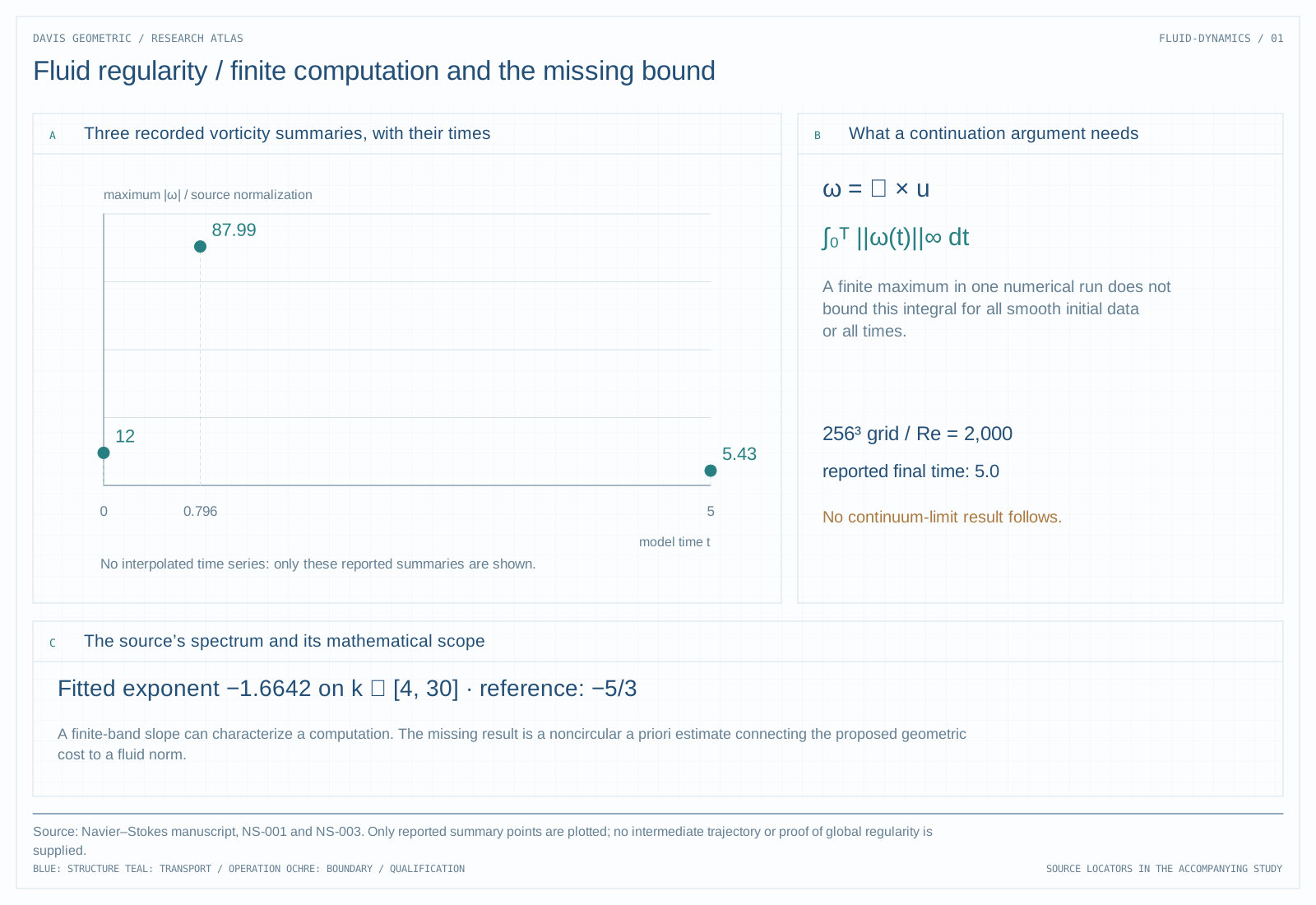
From the research record
Inspect the work
Original figures, recorded values, and explicit model details. Each exhibit identifies its source and what the comparison means.
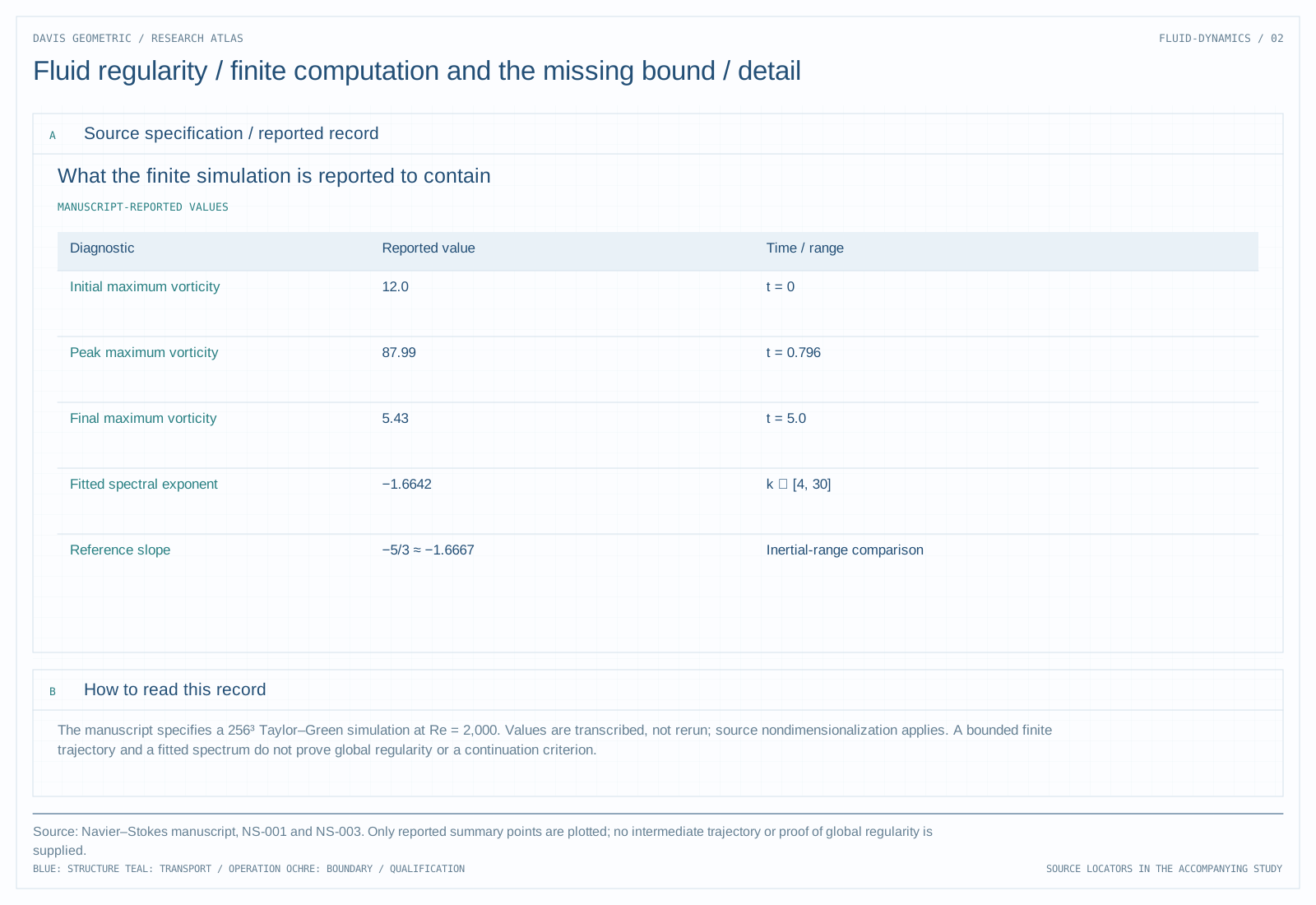
What the finite simulation is reported to contain
Scroll horizontally to inspect the full table →
| Diagnostic | Reported value | Time / range |
|---|---|---|
| Initial maximum vorticity | 12.0 | t = 0 |
| Peak maximum vorticity | 87.99 | t = 0.796 |
| Final maximum vorticity | 5.43 | t = 5.0 |
| Fitted spectral exponent | −1.6642 | k ∈ [4, 30] |
| Reference slope | −5/3 ≈ −1.6667 | Inertial-range comparison |
The manuscript specifies a 256³ Taylor–Green simulation at Re = 2,000. Values are transcribed, not rerun; source nondimensionalization applies. A bounded finite trajectory and a fitted spectrum do not prove global regularity or a continuation criterion.
davis_navier_stokes.tex · Experimental Verification NS-001 and NS-003 tables
Read the technical figure
Source: Navier–Stokes manuscript, NS-001 and NS-003. Only reported summary points are plotted; no intermediate trajectory or proof of global regularity is supplied.
Source: Navier–Stokes manuscript, NS-001 and NS-003. Only reported summary points are plotted; no intermediate trajectory or proof of global regularity is supplied.
Supporting detail
The proposed bridge to regularity
The reviewed manuscript treats the energy cascade as flow on a configuration manifold and introduces a geometric “mass gap” intended to measure the cost of vortex stretching. Its central implication is that a bound on this quantity should yield a bound on vorticity.
That implication carries the proof burden. A named geometric quantity must be bounded by estimates available from the Navier–Stokes equations, and the resulting vorticity control must be strong enough for the stated continuation criterion. Relabeling a possible singularity as an infinite geometric cost does not rule it out.
What the finite calculations can contribute
The local manuscript reports a spectrum close to a k⁻⁵ᐟ³ law and a finite 256³ simulation at Reynolds number 2,000 in which vorticity peaks and then decreases. These are manuscript-reported computations, not rerun results in this website revision.
A finite simulated trajectory can test a diagnostic and illustrate a mechanism. It cannot establish control for all smooth initial data, all later times, or the continuum limit. In particular, observing a bounded maximum during a run is not a global bound on the time integral required by a vorticity continuation argument.
Sources, scope, and next question
Theoretical manuscript with reported finite simulations; global regularity is not established by the reviewed record.
The mathematical next step is to isolate the precise a priori estimate linking the proposed geometric cost to a standard fluid norm, with constants and hypotheses. That estimate—not a visually stable flow—is the missing bridge to a regularity theorem.
Additional source versions reviewed
-
helicity/theory/davis_navier_stokes.texLocal project manuscript or report · not republished here