CALCIFER / geometry, periodicity, and temperature
Research settingIndependent
CALCIFER organizes horizon calculations through a “curvature cost” built from metric components. The interesting question is which parts of the temperature formula follow from geometry and which physical identifications enter along the way.
From the research record
Inspect the work
Original figures, recorded values, and explicit model details. Each exhibit identifies its source and what the comparison means.
Metric inputs and the temperature formula
Scroll horizontally to inspect the full table →
| Spacetime / chart | Lapse α | Radial spatial coefficient | K = √γ / α | Surface gravity κ |
|---|---|---|---|---|
| Schwarzschild exterior | √(1 − rs/r) | γrr = (1 − rs/r)⁻¹ | (1 − rs/r)⁻¹ | c⁴ / (4GM) |
| De Sitter static patch | √(1 − r²/RH²) | γrr = (1 − r²/RH²)⁻¹ | (1 − r²/RH²)⁻¹ | c² / RH |
| Rindler wedge, α > 0 | 1 + gz/c² | γzz = 1 | (1 + gz/c²)⁻¹ | g |
All three temperature expressions use T = ℏκ / (2πckB). The Rindler row follows the manuscript’s explicit flat-spatial metric, not its overbroad earlier statement that f = h for every nonrotating case. K and c/K depend on coordinates; locally measured light speed remains c. This table organizes assumptions, not a quantum-free derivation.
thermal_geometry_paper_v2.tex · Unification table and explicit Rindler metric
Read the technical figure
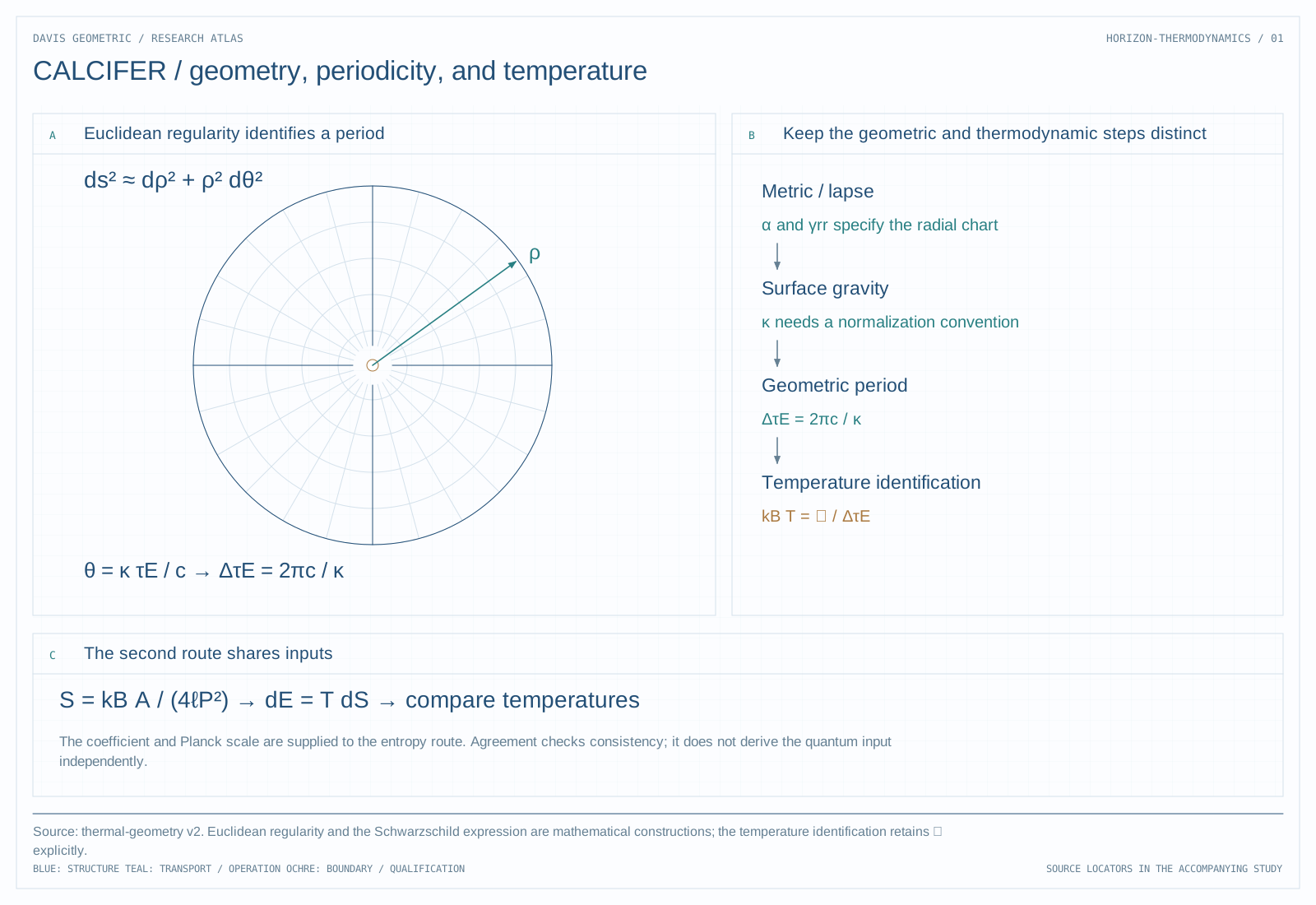
Source: thermal-geometry v2. Euclidean regularity and the Schwarzschild expression are mathematical constructions; the temperature identification retains ℏ explicitly.
Source: thermal-geometry v2. Euclidean regularity and the Schwarzschild expression are mathematical constructions; the temperature identification retains ℏ explicitly.
Supporting detail
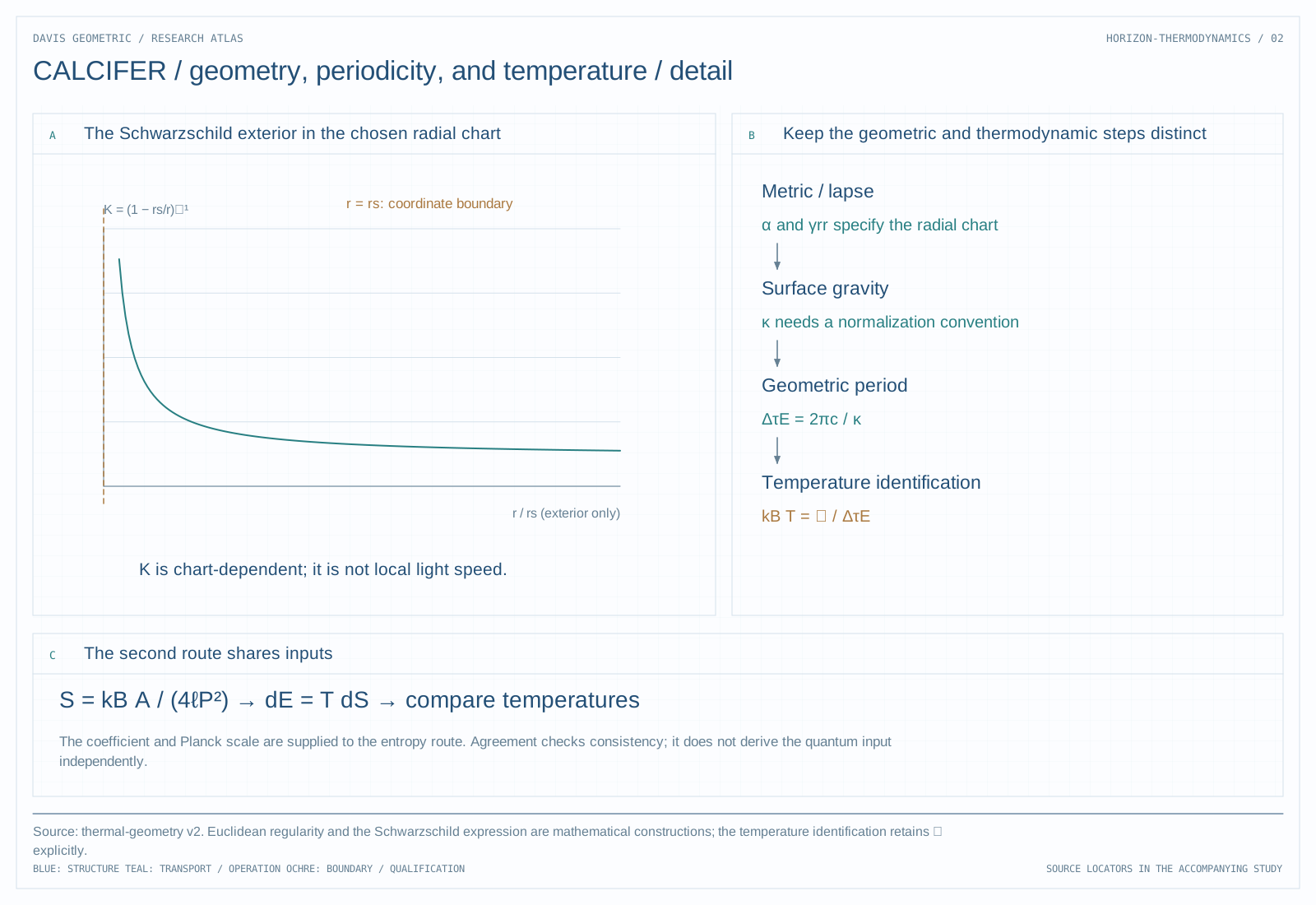
A coordinate-dependent field and a physical temperature
The reviewed manuscript defines K = √γrr / α using the spatial metric coefficient and ADM lapse. It studies expressions for this field, surface gravity, and temperature in Schwarzschild, Kerr, Reissner–Nordström, de Sitter, and Rindler settings. K depends on the chosen foliation; the temperature claim requires an appropriately specified surface gravity and normalization.
The proposed chain links the regularity period of a Euclidean horizon to T = ℏκ/(2πckB). The geometric period and the thermodynamic interpretation of that period are distinct steps. Planck’s constant still enters the temperature relation.
Where the quarter factor enters
An earlier README attributes the entropy coefficient 1/4 to four causal domains. The later website account instead says it is fixed by consistency with the first law, rather than independently derived. This change matters: choosing the entropy coefficient to reproduce a known temperature is a consistency calculation, not an independent prediction of that coefficient.
The local tests compare formula routes across masses and spacetime examples. Agreement is useful for catching algebra or implementation mistakes. If the routes share the same thermodynamic input, their agreement does not establish that the input has been derived twice independently.
Sources, scope, and next question
Local derivation manuscript and consistency tests; different source versions make different normalization claims.
The representative paper needs a dependency diagram for each route: metric and normalization, regularity condition, quantum scale, entropy assumption, and first-law identification. That would expose precisely what the framework adds beyond a re-expression of the familiar result.
Additional source versions reviewed
-
calcifer/README.mdLocal project manuscript or report · not republished here -
calcifer/thermal_geometry_paper_v2.texLocal project manuscript or report · not republished here