Mirror manifolds / path coverage and uncertainty
Research settingIndependent
The original MIRADOR immune-design manuscript asks how a panel of receptors could cover a family of anticipated antigenic trajectories. It explicitly presents a conceptual construction rather than a neutralization or clinical study.
From the research record
Inspect the work
Original figures, recorded values, and explicit model details. Each exhibit identifies its source and what the comparison means.
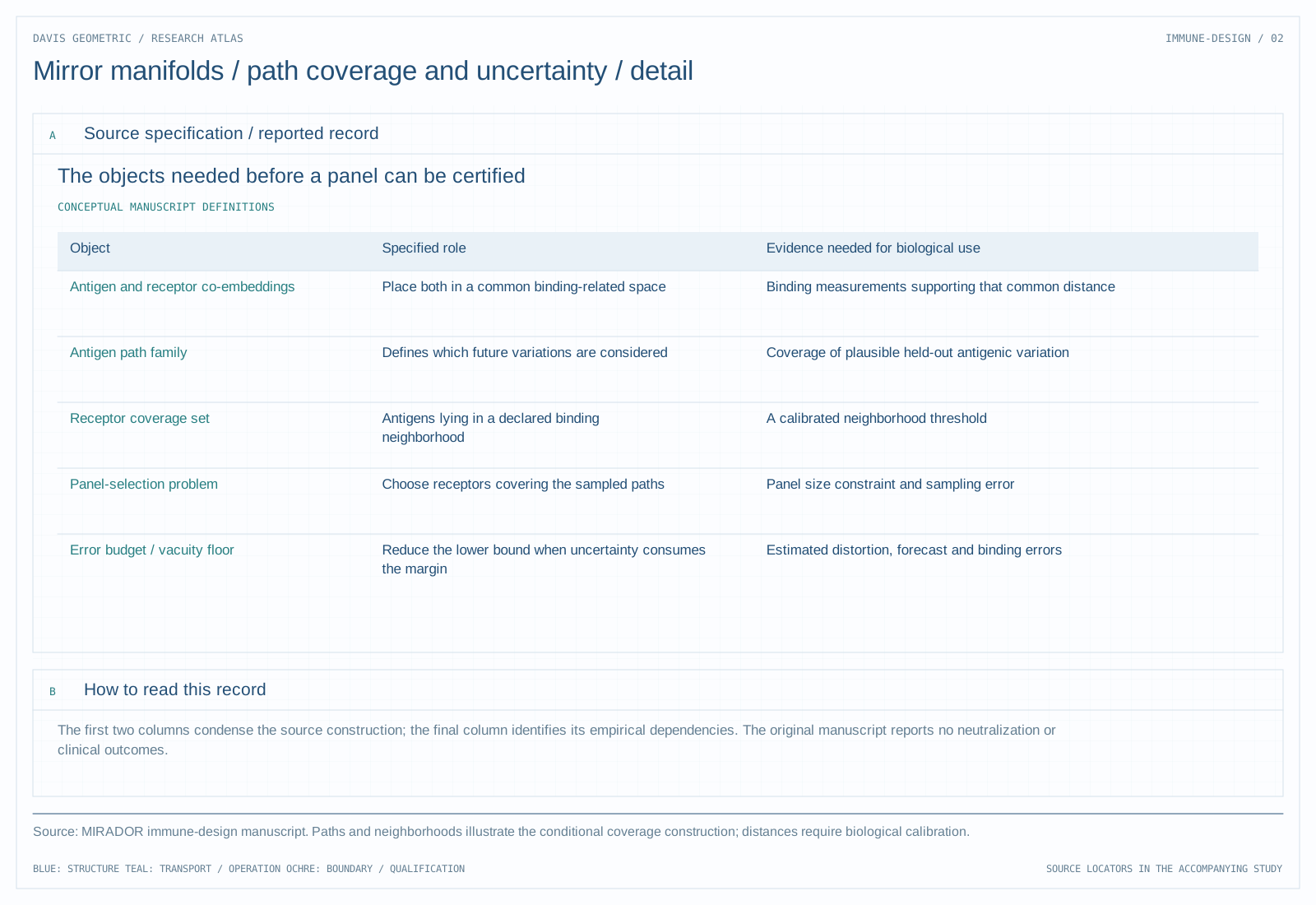
The objects needed before a panel can be certified
Scroll horizontally to inspect the full table →
| Object | Specified role | Evidence needed for biological use |
|---|---|---|
| Antigen and receptor co-embeddings | Place both in a common binding-related space | Binding measurements supporting that common distance |
| Antigen path family | Defines which future variations are considered | Coverage of plausible held-out antigenic variation |
| Receptor coverage set | Antigens lying in a declared binding neighborhood | A calibrated neighborhood threshold |
| Panel-selection problem | Choose receptors covering the sampled paths | Panel size constraint and sampling error |
| Error budget / vacuity floor | Reduce the lower bound when uncertainty consumes the margin | Estimated distortion, forecast and binding errors |
The first two columns condense the source construction; the final column identifies its empirical dependencies. The original manuscript reports no neutralization or clinical outcomes.
mirador.tex · Conceptual overview; coverage construction and vacuity floor
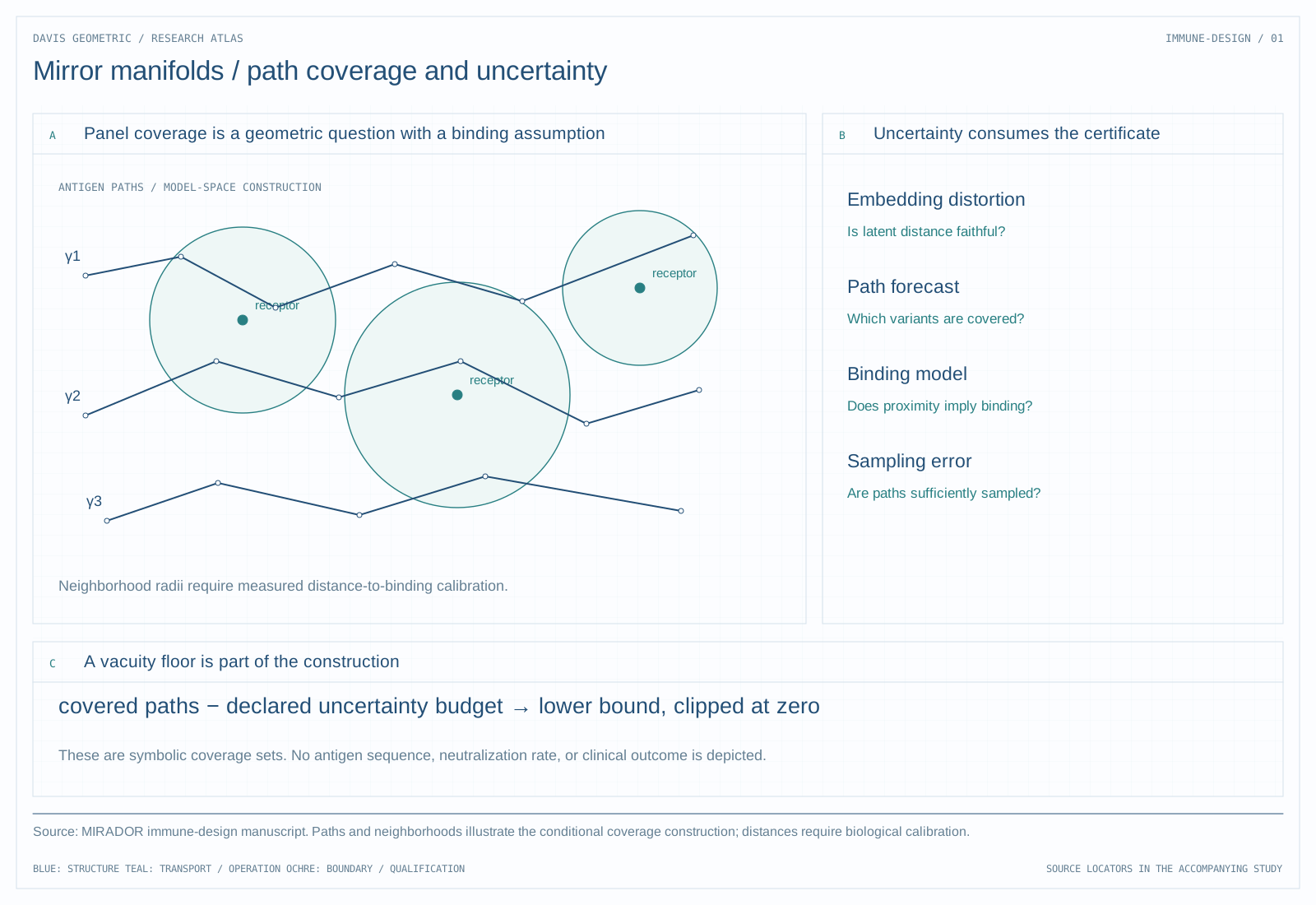
Read the technical figure
Source: MIRADOR immune-design manuscript. Paths and neighborhoods illustrate the conditional coverage construction; distances require biological calibration.
Source: MIRADOR immune-design manuscript. Paths and neighborhoods illustrate the conditional coverage construction; distances require biological calibration.
Supporting detail
Two spaces joined by a binding model
The construction maps antigens and receptors into a shared space intended to reflect binding free energy. This is more demanding than embedding sequences by similarity: two similar sequences need not have the binding relationship that the design procedure requires.
The paper calls the coupled construction “mirror manifolds.” Its maps must distinguish a receptor that is mismatched to one antigen from a receptor that is ineffective more broadly. The geometry’s biological meaning is an assumption to calibrate, not something supplied by the manifold terminology.
A set-cover problem with an uncertainty budget
Given anticipated path families and a specified binding neighborhood, panel selection becomes a coverage problem. The manuscript reverses the usual error-budget framing: instead of only bounding failure, it seeks a lower bound on covered paths under the model.
The construction includes a vacuity floor. When uncertainty in the embedding, forecast, or binding relation consumes the margin, the claimed lower bound returns to zero. A conditional certificate is useful only if the empirical quantities used in that budget are supported.
What the paper does not report
The manuscript states that it contains no empirical performance, neutralization results, or clinical outcomes. Its contribution is the formal organization of the design question and its assumptions. A coverage certificate in the model should not be presented as an effective vaccine or antibody panel.
Sources, scope, and next question
Theoretical manuscript: co-embedding assumptions, a panel-selection problem, and conditional error bounds.
The next bridge is measured binding and neutralization evidence sufficient to calibrate the co-embedding and its error budget. Panel coverage should then be assessed on held-out antigenic variation, with abstentions preserved.
- MIRADOR app.
- MIRADOR: Manifold of Immune Receptors And Drift-Optimized Responses : Geometry-First Co-Embedding for Vaccine and Antibody Design.
Additional source versions reviewed
-
mirador/theory/mirador.texLocal project manuscript or report · not republished here