OSHUN: measurements, retained populations, and error
Research settingIndependent
OSHUN is a research program for textured-hair formulation: measure the fiber an ingredient encounters, preserve that context with the experimental response, and make predictions only where the model has support. Its current study and interactive ingredient checker investigate that architecture using public human-skin permeability data, while specifying the hair measurements needed for the next stage.
From the research record
Inspect the work
Original figures, recorded values, and explicit model details. Each exhibit identifies its source and what the comparison means.
Prediction error alongside the changing sample
Scroll horizontally to inspect the full table →
| Fit / conditioning | Measurements retained | Dropped | Context cells | RMSE (log Kp) | R² |
|---|---|---|---|---|---|
| No conditioning | 534 | 0 | 1 | 1.2583 | 0.0210 |
| Refit here | 534 | 0 | 1 | 1.1454 | 0.1887 |
| + vehicle | 441 | 93 | 8 | 1.1038 | 0.2737 |
| + full protocol | 311 | 223 | 15 | 0.9912 | 0.3727 |
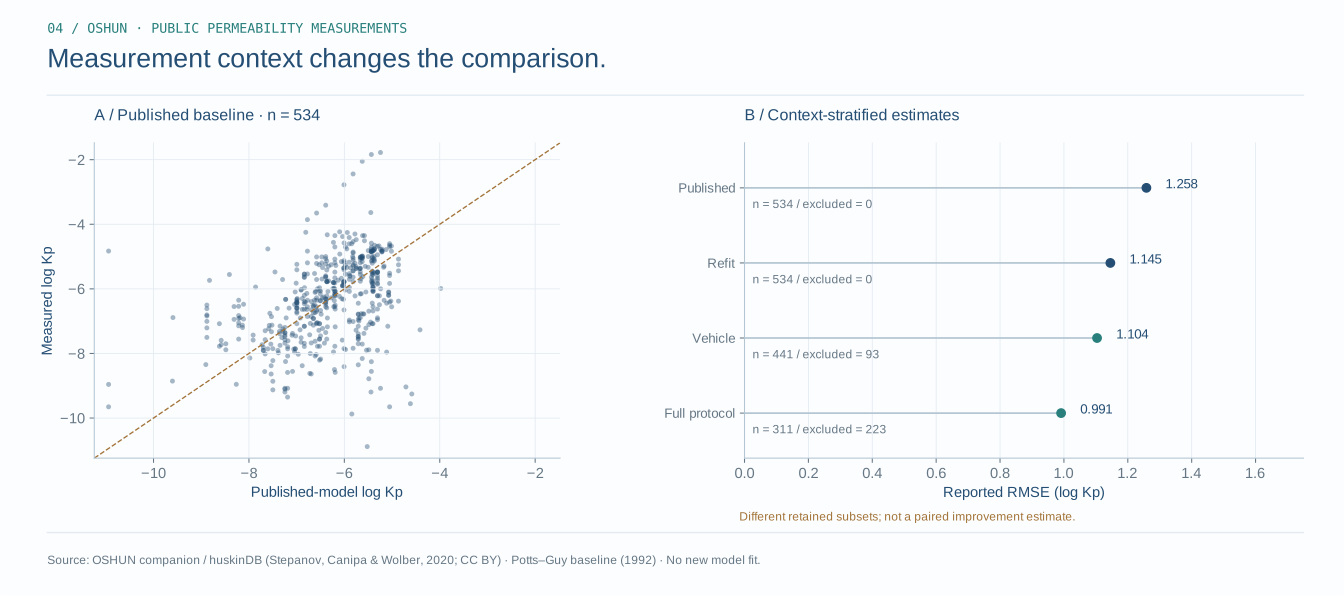
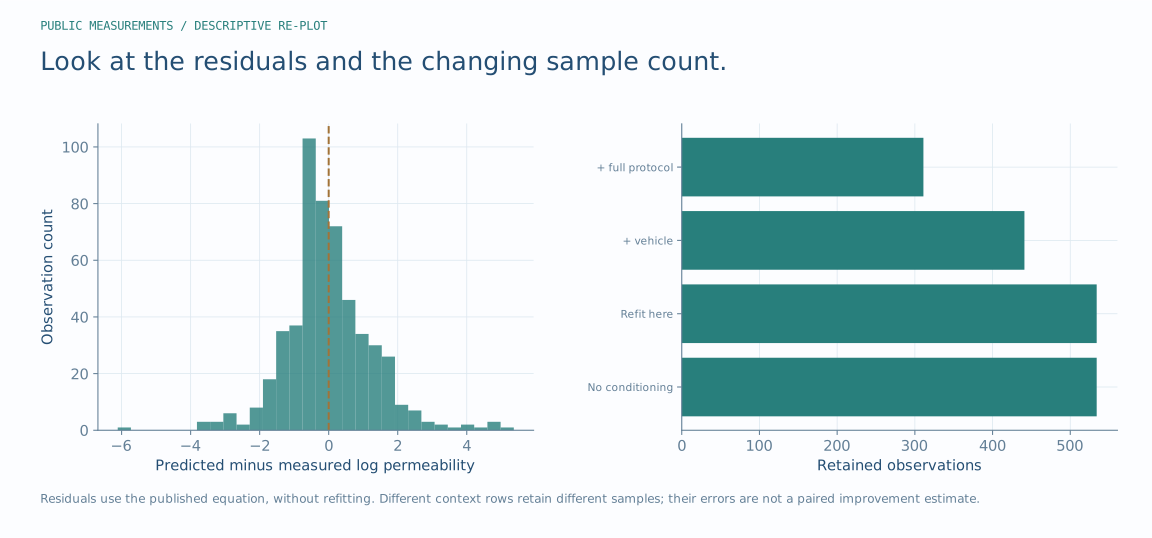
The first row applies the published Potts–Guy equation; subsequent rows refit with leave-one-out evaluation. Full conditioning retains 311 of 534 measurements. Because the populations differ, the lower RMSE is not a paired estimate of improvement on the same cases.
Inside the full-protocol strata
Scroll horizontally to inspect the full table →
| Body site / layer / vehicle | n | RMSE (log Kp) | R² |
|---|---|---|---|
| abdomen | epidermis | unspecified | 75 | 1.1558 | 0.0229 |
| abdomen | epidermis | PBS | 37 | 0.8826 | 0.4683 |
| abdomen | epidermis, dermis | unspecified | 28 | 0.9255 | -0.1202 |
| abdomen | dermis | unspecified | 24 | 1.3003 | 0.2924 |
| thigh | epidermis, dermis | unspecified | 22 | 1.2689 | 0.2932 |
| unspecified | epidermis | unspecified | 21 | 0.4399 | 0.8374 |
Selected strata retained in the companion data, not all 15 cells. Negative R² values remain visible; conditioning does not make every subgroup predictable.
Read the technical figure
Public measurements and recorded error estimates with retained subset sizes. These are not paired gains on one unchanged population.
Public measurements and recorded error estimates with retained subset sizes. These are not paired gains on one unchanged population.
Supporting detail
The formulation question behind the project
Choosing a conditioning agent is not only a question about the molecule. It is also a question about the surface it encounters, the surrounding formulation and the outcome being measured. OSHUN asks how to keep those relationships available to the model rather than reducing an ingredient to one prediction that is reused for every substrate.
For textured hair, the proposed inputs are physical measurements such as cross-sectional ellipticity, twist density, fiber diameter and cuticle scale density. These describe geometry and surface structure directly. The proposed model would use those measurements rather than demographic categories or self-reported curl types.
The project has three connected parts: a study of what experimental context changes in an existing dataset, an ingredient checker that exposes the limits of prediction, and a controlled-panel design for collecting the missing hair data. The formulation goal motivates all three, but permeability is only one endpoint; it does not by itself measure curl definition, breakage, moisture retention or finished-product performance.
Keep each measurement attached to its experiment
The study ingests 550 usable huskinDB records, of which 534 fall within its declared modeling domain. Each record preserves the compound, molecular descriptors, measured permeability, body site, skin layer, donor solution and source reference. Repeated observations remain distinct records in GIGI rather than being averaged into a single value for the compound.
The conditioning experiment keeps the two-descriptor regression family fixed and changes which recorded context the fit may use. The published Potts–Guy equation gives an RMSE of 1.26 log units on the 534 in-domain rows; a global refit gives 1.15. Fits within donor-solution groups give 1.10, and full body-site, layer and solution groups give about 0.99.
The retained population changes: donor-solution fits cover 441 records, and full-protocol fits cover 311. The decrease therefore cannot be read as a like-for-like improvement on all 534 measurements. Some groups perform poorly, and the study reports those results. Its useful lesson is to preserve and inspect context—not that adding context guarantees a better prediction.
What the ingredient checker actually does
In the companion, a reader selects ingredients or loads a preset curl-cream ingredient list. For eligible compounds, the browser compares the Potts–Guy equation with an inverse-distance-weighted neighbor estimate drawn from the measured skin records. Opening a result exposes its descriptors, neighboring measurements and arithmetic.
The checker separates two reasons to decline a prediction. A defined molecule can fall outside the declared molecular-weight or partition-coefficient range. A polymer, hydrolysate or mixture may instead lack the single molecular structure the model requires. The first is a coverage problem; the second calls for a different representation, not merely another coefficient.
The paper’s separate 29-ingredient deck yields 12 refusals: eight ingredients without a single defined structure and four outside the descriptor range. That is 41.4% of the study deck, not a measured failure rate for a finished curl cream. The browser preset is a smaller selection, and its refusal count is computed from the ingredients selected.
A returned value is a skin-permeability estimate within this demonstration. It is not a recommendation to use the ingredient, a safety assessment or a prediction of how well a hair product will work. The useful output is an inspectable estimate—or a specific explanation of what the model cannot represent.
A confidence idea that did not earn its place
The study also asked whether dispersion across a compound’s repeated measurements could rank its prediction error. The proposed section-curvature statistic is used here as a finite-sample dispersion measure, not as a demonstrated differential-geometric invariant. Its signal weakened and then reversed as the test required more repeated measurements.
Those repeats came from different laboratories and protocols. Their variation can reflect laboratory disagreement rather than a controlled change in substrate. The proposed confidence signal was not validated on this dataset; the failed test is one reason the next experiment needs a controlled panel.
The hair-fiber experiment the program calls for
The proposed panel uses one laboratory and one protocol, with donor fibers deliberately spanning measured geometry. It records continuous covariates, including ellipticity, twist density, diameter, cross-sectional area, cuticle scale density and water content. Humidity is controlled, and prior chemical treatment is recorded as an exclusion criterion.
Each ingredient would be measured across donor substrates so that response could be compared as geometry changes. The primary comparison uses the same rows for a fixed-descriptor model with and without measured geometry; no sparse group may be dropped to make the conditioned result look better. A randomly permuted geometry label is the negative control.
The panel also tests whether refused queries really have higher errors and whether the failed dispersion-based confidence signal becomes useful under controlled measurements. These are specified experiments still to be run. They make the route from a skin-data feasibility study to textured-hair research explicit.
Sources, scope, and next question
Independent research: a feasibility study, an interactive ingredient checker and a proposed controlled hair-fiber panel. The measured results concern human skin; hair-response and finished-product performance remain untested.
Run a single-protocol pilot to estimate the variance needed for the panel’s power calculation, then compare conditioned and unconditioned models on identical hair-fiber measurements. Keep ingredient response separate from the later product-performance endpoints a formulator would need.