MARCELLA / source-backed composition and its gate
Research settingIndependent
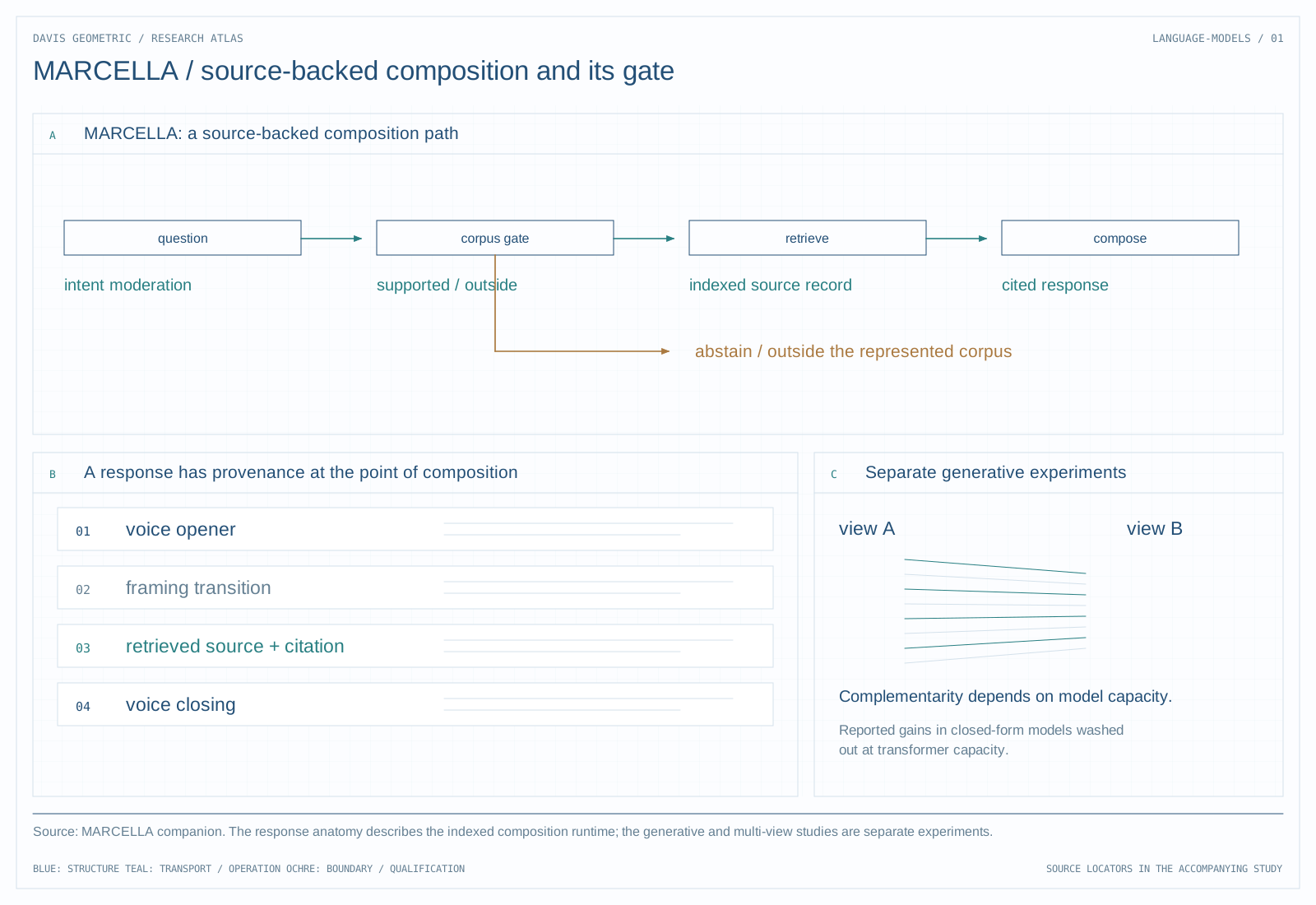
MARCELLA is several related experiments rather than one model with one benchmark. The current companion distinguishes a reply-composition runtime over GIGI from a separate line of generative language-model research.
From the research record
Inspect the work
Original figures, recorded values, and explicit model details. Each exhibit identifies its source and what the comparison means.
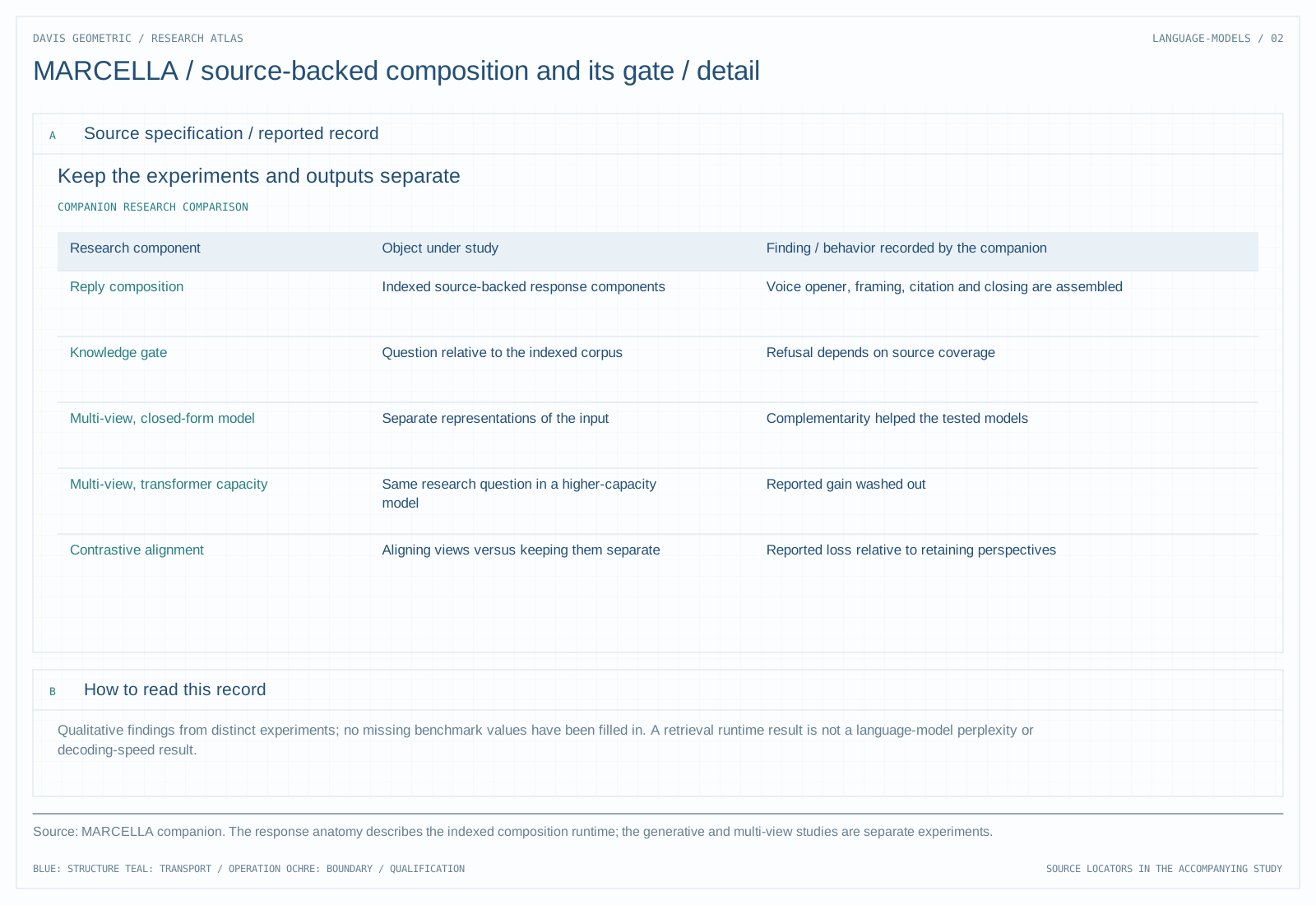
Keep the experiments and outputs separate
Scroll horizontally to inspect the full table →
| Research component | Object under study | Finding / behavior recorded by the companion |
|---|---|---|
| Reply composition | Indexed source-backed response components | Voice opener, framing, citation and closing are assembled |
| Knowledge gate | Question relative to the indexed corpus | Refusal depends on source coverage |
| Multi-view, closed-form model | Separate representations of the input | Complementarity helped the tested models |
| Multi-view, transformer capacity | Same research question in a higher-capacity model | Reported gain washed out |
| Contrastive alignment | Aligning views versus keeping them separate | Reported loss relative to retaining perspectives |
Qualitative findings from distinct experiments; no missing benchmark values have been filled in. A retrieval runtime result is not a language-model perplexity or decoding-speed result.
Read the technical figure
Source: MARCELLA companion. The response anatomy describes the indexed composition runtime; the generative and multi-view studies are separate experiments.
Source: MARCELLA companion. The response anatomy describes the indexed composition runtime; the generative and multi-view studies are separate experiments.
Supporting detail
A response assembled from an indexed substrate
The companion describes replies composed from a voice opener, a framing transition, a cited source, and a closing. These components are retrieved from indexed bundles. An external language-model moderator gates intent at the entrance, while the described reply path assembles source-backed content rather than freely generating the answer.
The knowledge gate measures whether a question falls within the represented corpus. This is a concrete abstention mechanism: deciding when the system has a source to answer from. A distance threshold in one corpus should not be read as a universal boundary between knowledge and ignorance.
The generative experiments ask a different question
The same page records a from-scratch generative model, voice adaptation, and multi-view representations. It reports that multi-view complementarity helped the tested closed-form models but washed out at transformer capacity; it also reports that contrastive alignment lost to retaining separate perspectives. These negative findings explain why retrieval and generation should not share a single success headline.
Older catalog entries also cover speculative decoding, cache retention, attention spectra, and context. They change different parts of a language system. A perplexity result for one model cannot establish a decoding speedup or a cache-compression result for another.
Sources, scope, and next question
Versioned project descriptions and reported measurements; results from different runtimes are not pooled.
Choose the artifact being evaluated before choosing the metric: source fidelity and refusal behavior for the composition runtime, held-out likelihood for a generative model, or latency and acceptance rate for speculative decoding.
- Marcella project material.
- Pure-Fiber Language Modeling: Sequence Prediction by Geometric Query on a Real Fiber Bundle.
- Geometric Token Transport: Riemannian Parallel Transport as Sequential State Accumulation in Neural Sequence Processing.
- The Field Equations of Semantic Coherence: A Geometric Theory of Meaning, Curvature, and Reasoning in Transformer Architectures.
- The Davis Conjecture on Semantic Coherence: Context Windows as Holonomy Horizons in Functorial Transformers.
- The Geometry of Generative Reasoning: Gauge-Theoretic Transformers as Realizations of Semantic Sameness.
- Spectral Geometry of Transformer Cognition: Heat Kernel Analysis Reveals Functional Organization in Language Models.
- Davis Cache: O(1) Reasoning State Preservation via Topological Residue.