HERALD / geometric drift on an availability clock
Research settingIndependent
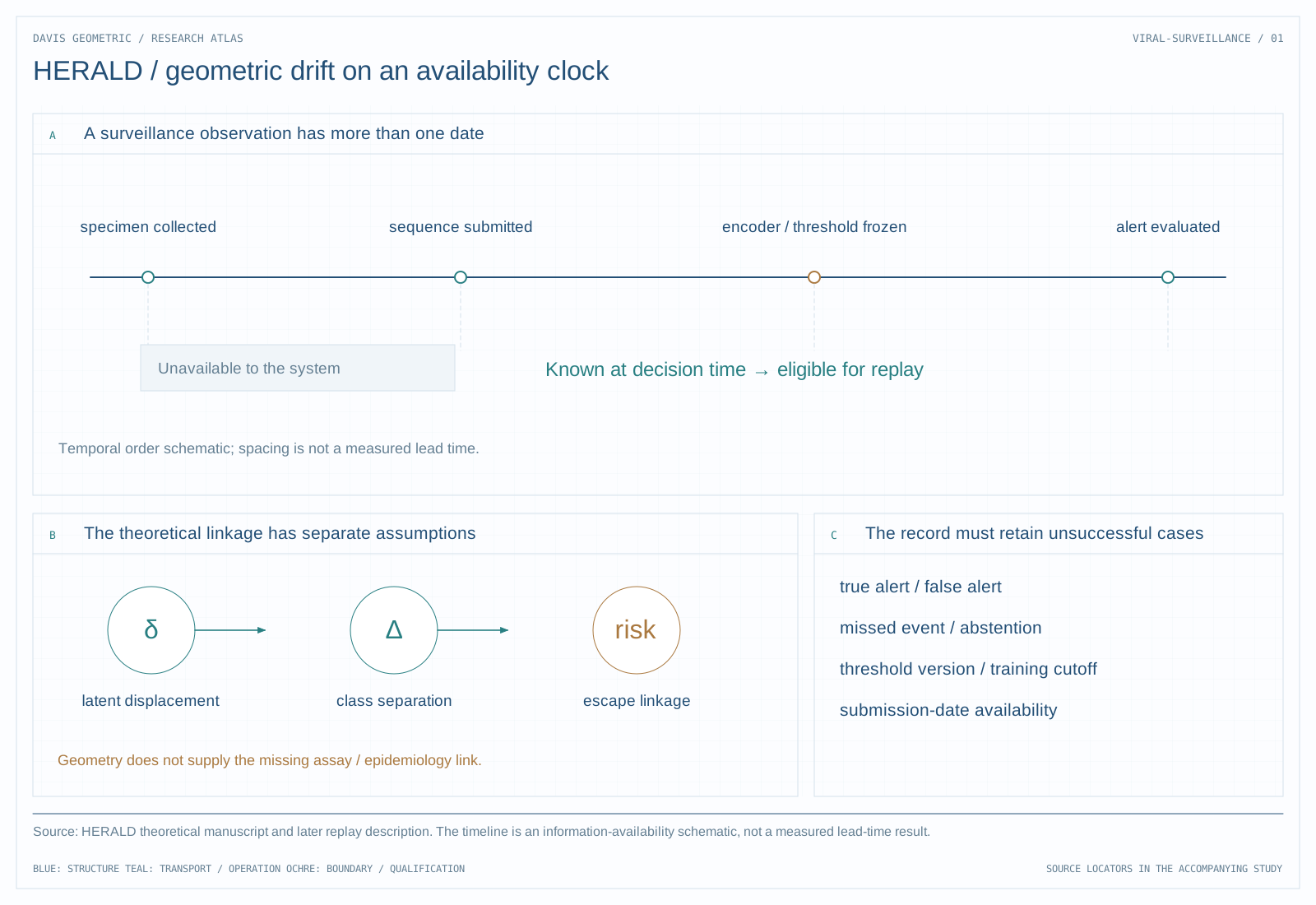
HERALD began as a theoretical surveillance framework linking an antigenically meaningful representation to a drift statistic and a conditional dominance-risk bound. Later project descriptions discuss retrospective replays; those are separate records.
From the research record
Inspect the work
Original figures, recorded values, and explicit model details. Each exhibit identifies its source and what the comparison means.
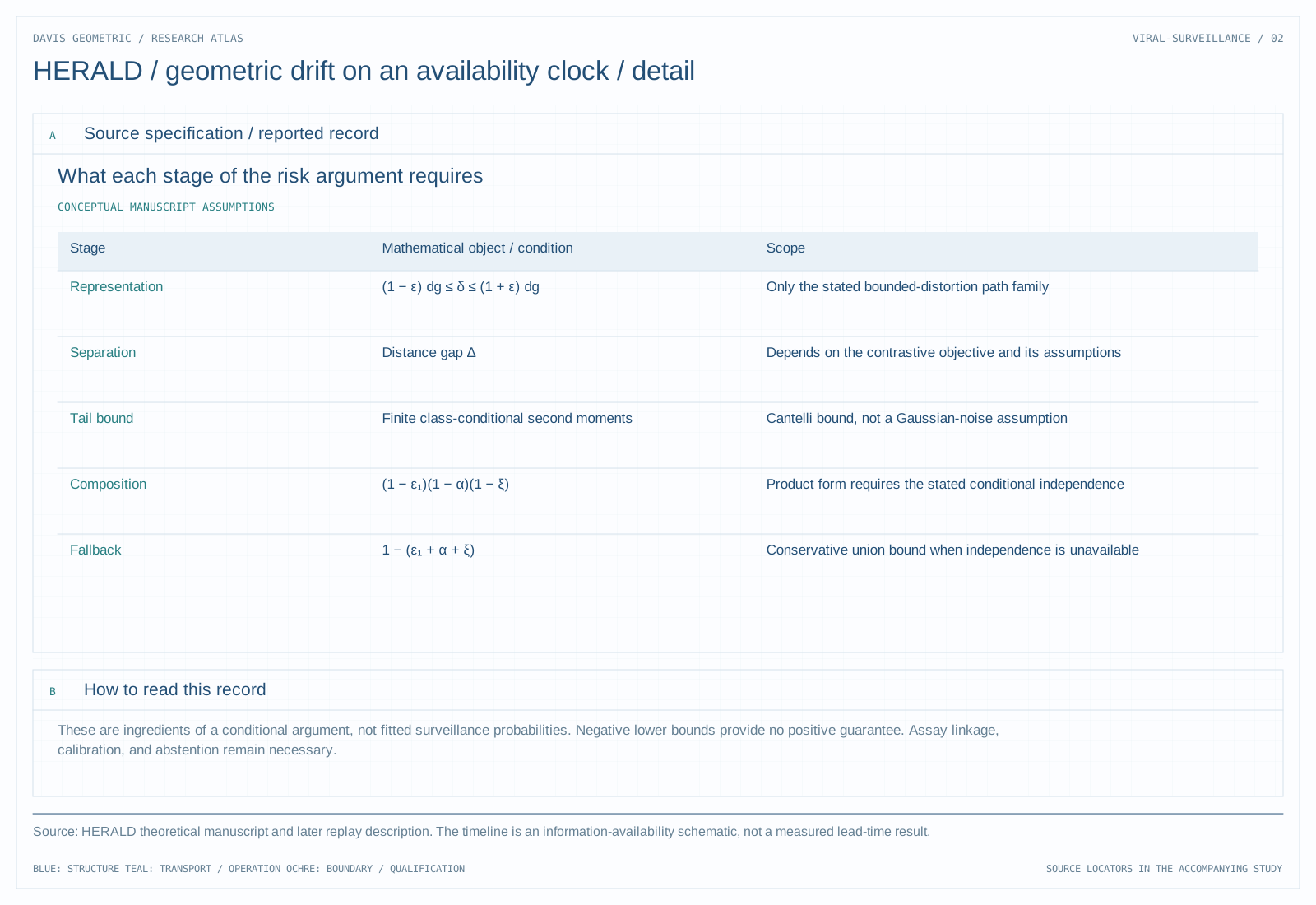
What each stage of the risk argument requires
Scroll horizontally to inspect the full table →
| Stage | Mathematical object / condition | Scope |
|---|---|---|
| Representation | (1 − ε) dg ≤ δ ≤ (1 + ε) dg | Only the stated bounded-distortion path family |
| Separation | Distance gap Δ | Depends on the contrastive objective and its assumptions |
| Tail bound | Finite class-conditional second moments | Cantelli bound, not a Gaussian-noise assumption |
| Composition | (1 − ε₁)(1 − α)(1 − ξ) | Product form requires the stated conditional independence |
| Fallback | 1 − (ε₁ + α + ξ) | Conservative union bound when independence is unavailable |
These are ingredients of a conditional argument, not fitted surveillance probabilities. Negative lower bounds provide no positive guarantee. Assay linkage, calibration, and abstention remain necessary.
herald.tex · Bounded-distortion assumption, Cantelli proposition, compositional error budget
Read the technical figure
Source: HERALD theoretical manuscript and later replay description. The timeline is an information-availability schematic, not a measured lead-time result.
Source: HERALD theoretical manuscript and later replay description. The timeline is an information-availability schematic, not a measured lead-time result.
Supporting detail
The chain of claims in the theoretical paper
The reviewed manuscript proposes a pullback metric, regularization of the learned representation, and bounded distortion between latent displacement and functional distance. It then combines drift signals through a probability-integral-transform scheme and connects a contrastive margin to separation.
A further step uses a finite-second-moment probability bound to relate separation to immune-escape risk. The end-to-end dominance bound is conditional on all of these links, including calibration and coverage. Detecting a sequence change and predicting epidemiological dominance are not the same event.
A replay needs its own clock
Later summaries describe an encoder frozen on escape data and a weekly sequence replay. An early-looking alert in such a reconstruction depends on when sequences and labels were available to the system, not only on the specimens’ collection dates.
The original conceptual manuscript explicitly reports no retrospective or prospective performance, latency, or calibration. Its DOI should not be used as if it validates a later “days before naming” headline. A retrospective alert also needs false-alert and missed-event accounting.
Sources, scope, and next question
Conceptual manuscript plus later project summaries; the theoretical paper itself reports no surveillance performance.
The next representative record should identify the exact replay version, freeze the encoder and thresholds, and retain submission-date availability. That would make the timing claim inspectable without turning hindsight into a prospective result.
Additional source versions reviewed
-
mirador/theory/herald.texLocal project manuscript or report · not republished here -
parallax/README.mdLocal project manuscript or report · not republished here