What the advisory sees—and which check sees it.
Research settingMach IndustriesCollaboration with Dr. Ryan Rapetti
Follow the model envelope, error budget, and sampling criterion through one saved ascent scenario. Then remove parts of the check and inspect how the classifications change.
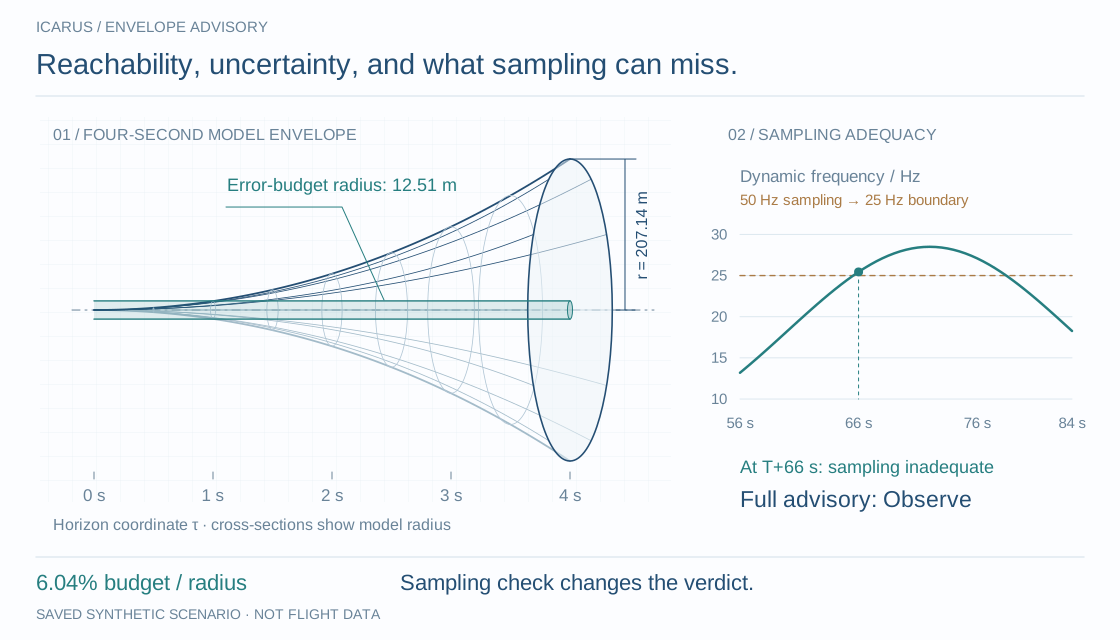
1. Read the four-second construction
The companion’s radius model combines an acceleration term, a jerk term, and a bias allowance, then applies the sampling-dependent inflation factor. At the illustrated instant the acceleration input is 23.44 m/s², the jerk input is 1.5 m/s³, and the bias allowance is zero. The envelope’s end radius is the saved value 207.142 m; the intermediate sections are reconstructed from the displayed model.
The shaded central band depicts the saved error-budget radius, 12.5109 m. It is not a calibrated probability region. The model uses axial thrust acceleration as control authority; treating the rendering as an established lateral maneuvering volume would exceed that assumption.
- Horizon τ
- Time ahead of the current scenario instant, from zero to four seconds.
- Reachable radius
- The output of the stated scalar radius model, rather than a flight-validated reachability calculation.
- Error budget
- The companion’s combination of geometric, link, and other declared error terms, including its inflation penalty.
2. Follow the independent sampling check
The scenario supplies a navigation rate of 50 Hz and an estimated dynamic frequency. Its implemented rule flags inadequate sampling when the former is less than twice the latter. At T+66 s the saved dynamic frequency is 25.445 Hz, above the resulting 25 Hz boundary.
This is a check against an assumed frequency input. It is not a proof that the implementation observes every real disturbance or that passing it guarantees a reliable navigation solution. The full advisory returns Observe immediately when this condition is true, even if the error-budget ratio remains below its ordinary thresholds.
3. Remove one mechanism at a time
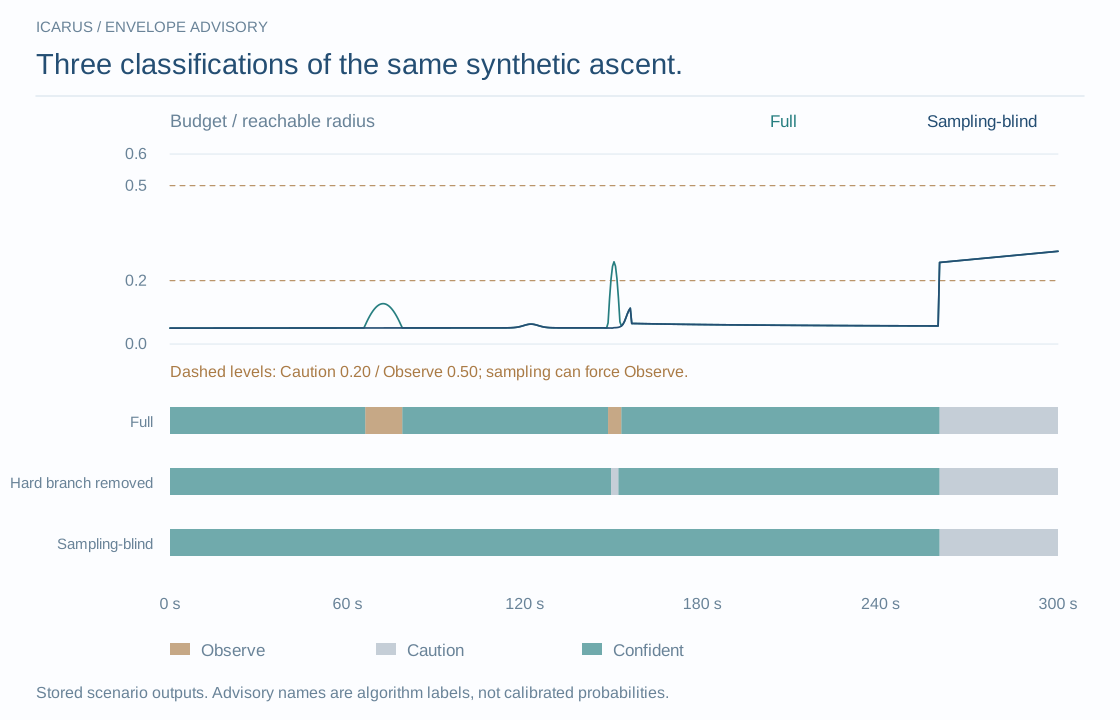
| Configuration | Radius / m | Budget / m | Budget / radius | Advisory label |
|---|---|---|---|---|
| Full advisory | 207.142 | 12.5109 | 6.04% | Observe |
| Hard branch removed; inflation retained | 207.142 | 12.5109 | 6.04% | Confident |
| Sampling check disabled | 203.52 | 10.3067 | 5.06% | Confident |
The first ablation preserves the sampling-related inflation in both the radius and the budget but removes the immediate Observe branch. The second disables the sampling check entirely. This comparison separates the branch’s contribution from the budget penalty. The names of the levels are labels chosen by the implementation; none is a flight-readiness certification.
4. Separate recorded output from scenario choices
The companion identifies advisory levels, radii, budgets, and ablation outputs as results from its compiled library. The vehicle profile, dynamic frequencies, ground-link errors, navigation-error trajectory, filter-confidence trajectory, and residual-monitor model are chosen scenario ingredients. This page extracts the embedded record and redraws it; it does not rerun the compiled library.
The saved advisory first changes at 66.0 s. The chosen 25 m residual monitor crosses at 74.5 s, giving an 8.5 s gap for this setup. That gap depends on the error-accumulation model, threshold, and scenario. It is not a general advance-warning guarantee or a comparison against a named flight navigation system.
The companion describes a passive F Prime component with no actuation output ports. That architectural claim belongs to its implementation record; a diagram here does not independently verify the generated component or demonstrate operational safety.
5. Continue the research
The next evaluation needs independent reconstruction of the library outputs, physically justified control-authority and disturbance models, and a defined task with false-alert, missed-event, delay, and calibration measurements. Testing sensor loss, time misalignment, bias, and model mismatch would assess whether the advisory helps beyond the selected scenario.