Permeability: measurements, context & residuals
Inspect the baseline equation, the individual-observation residuals, and the sample counts behind the context-stratified comparison.
01 / Specify the baseline
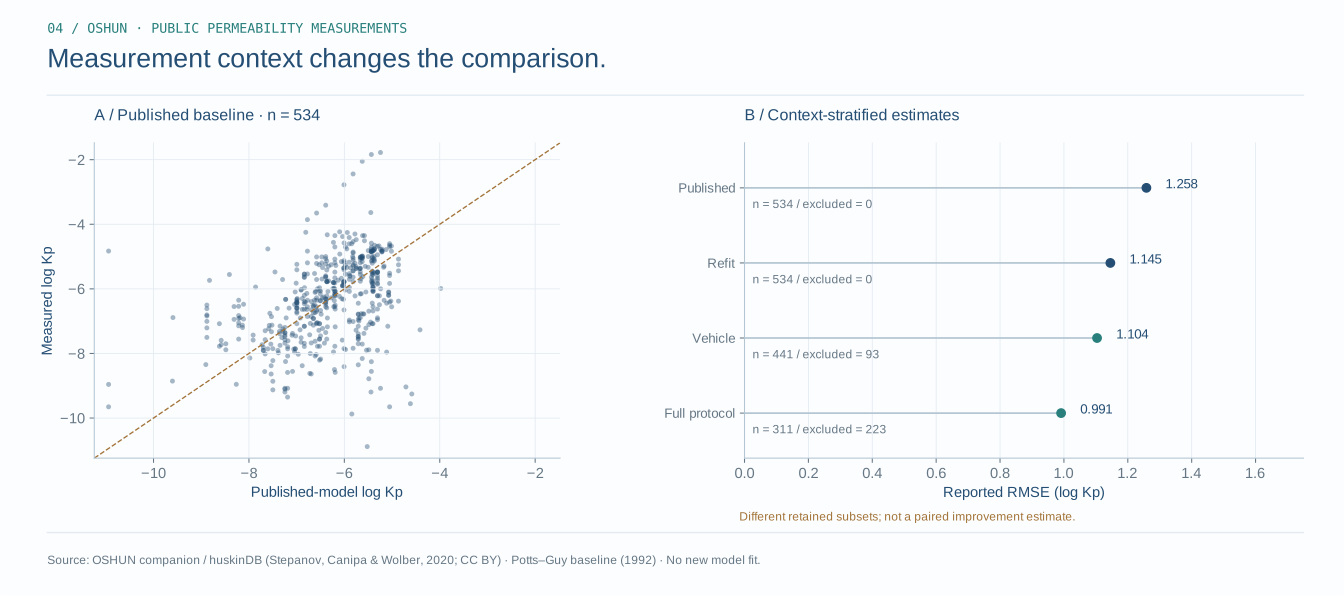
The plate compares public skin-permeability observations with the published Potts–Guy equation applied without refitting. Each point is an observation, not necessarily a unique chemical or an independent experimental system. Molecular properties and experimental context answer different questions.
02 / Compare errors together with sample counts
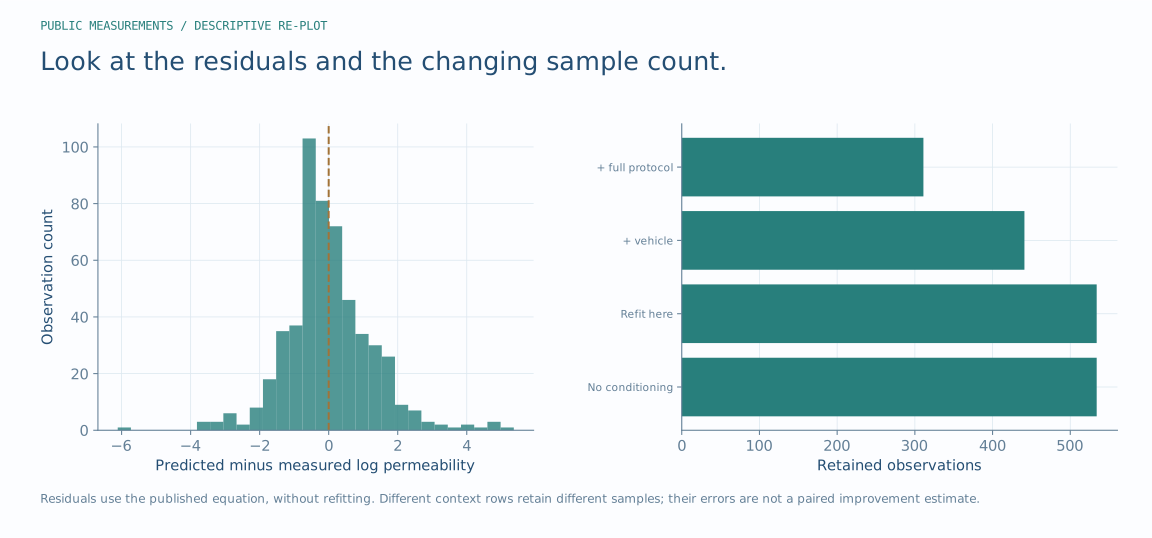
| Context | Retained n | Dropped n | Reported RMSE | Reported R² |
|---|---|---|---|---|
| No conditioning | 534 | 0 | 1.25825 | 0.0210113 |
| Refit here | 534 | 0 | 1.14544 | 0.18869 |
| + vehicle | 441 | 93 | 1.10375 | 0.273706 |
| + full protocol | 311 | 223 | 0.991193 | 0.372731 |
The apparent reduction in error across rows is not a paired improvement estimate because the evaluated samples change. A fair generalization test would fix the comparison population or explicitly analyze the selection mechanism, then separate fitting from held-out evaluation.
03 / Preserve the unsuccessful analysis
| Minimum group count | Sections | Correlation | One-tailed permutation p |
|---|---|---|---|
| 3 | 41 | 0.189373 | 0.114844 |
| 4 | 32 | 0.158358 | 0.188391 |
| 5 | 22 | -0.0931677 | 0.664417 |
| 6 | 22 | -0.0931677 | 0.664417 |
These exploratory summaries do not establish dose-response efficacy, and skin measurements do not by themselves validate transfer to hair substrates. The relevant endpoints, substrates, and protocols must remain explicit.
Sources, versions & further reading
Additional diagnostic plates are analytic constructions or descriptive re-plots of the saved record, as labeled. They do not introduce new experimental validation.