Algorithms & computing / GIGI / GEODESIC / DHOOM
GIGI: storing observations together with the structure used to query them
GIGI makes geometric operations part of a database interface. Its documentation gives a concrete path from defining a bundle and inserting measurements to querying records, inspecting variability, and comparing transported states.
Research settingIndependent
TL;DR
In brief
The question
What changes when a database stores records together with the structure used to query them and returns geometric readings alongside every answer?
What the work does
GIGI, a Rust engine served by one binary over a REST API, with a query language (GQL v2.2) whose verbs cover storage, reads, joins, aggregation, curvature, transport, spectral and topological diagnostics.
What is still open
Measured ingest, update, memory and query costs against conventional engines with the same semantics, and whether the geometric readings change any task outcome.
Available recordDocumented database interface and companion applications; operation semantics must be distinguished from performance and scientific interpretation.
From the research record
Inspect the work
Original figures, recorded values, and explicit model details. Each exhibit identifies its source and what the comparison means.
Queries a reader can inspect in the reference
Scroll horizontally to inspect the full table →
| Operation | Source example | Documented output |
|---|---|---|
| PULLBACK | PULLBACK readings ALONG sensor_id ONTO sensors PRESERVE LEFT; | Joined records retaining unmatched left records |
| TRANSPORT | TRANSPORT corpus FROM (token_str='walk') TO (token_str='walked') ON FIBER (f4, f11, f12); | Rotation angle, 2 × 2 SO(2) matrix, raw displacements |
| HOLONOMY | HOLONOMY corpus ON FIBER (f11, f12) AROUND tense_label; | Group centroids, transport angles and total deficit |
Exact query examples, not freshly executed outputs. The implementation defines what these geometric operator names mean; a returned angle is not automatically a physical or linguistic invariant.
The research in context
Conventional databases separate data from the questions asked of it. A relational schema stores rows; properties such as variability within a group, clustering, or consistency between tables are computed afterward by separate tools. That separation keeps storage simple but means structural properties of the data are not part of a query’s answer. A second, independent layer is transport: moving records between services costs bandwidth, so compact encodings matter. GIGI addresses the first layer and the related DHOOM format the second. Evaluating either requires keeping storage semantics, query cost and wire size apart, because a gain in one does not imply a gain in the others.
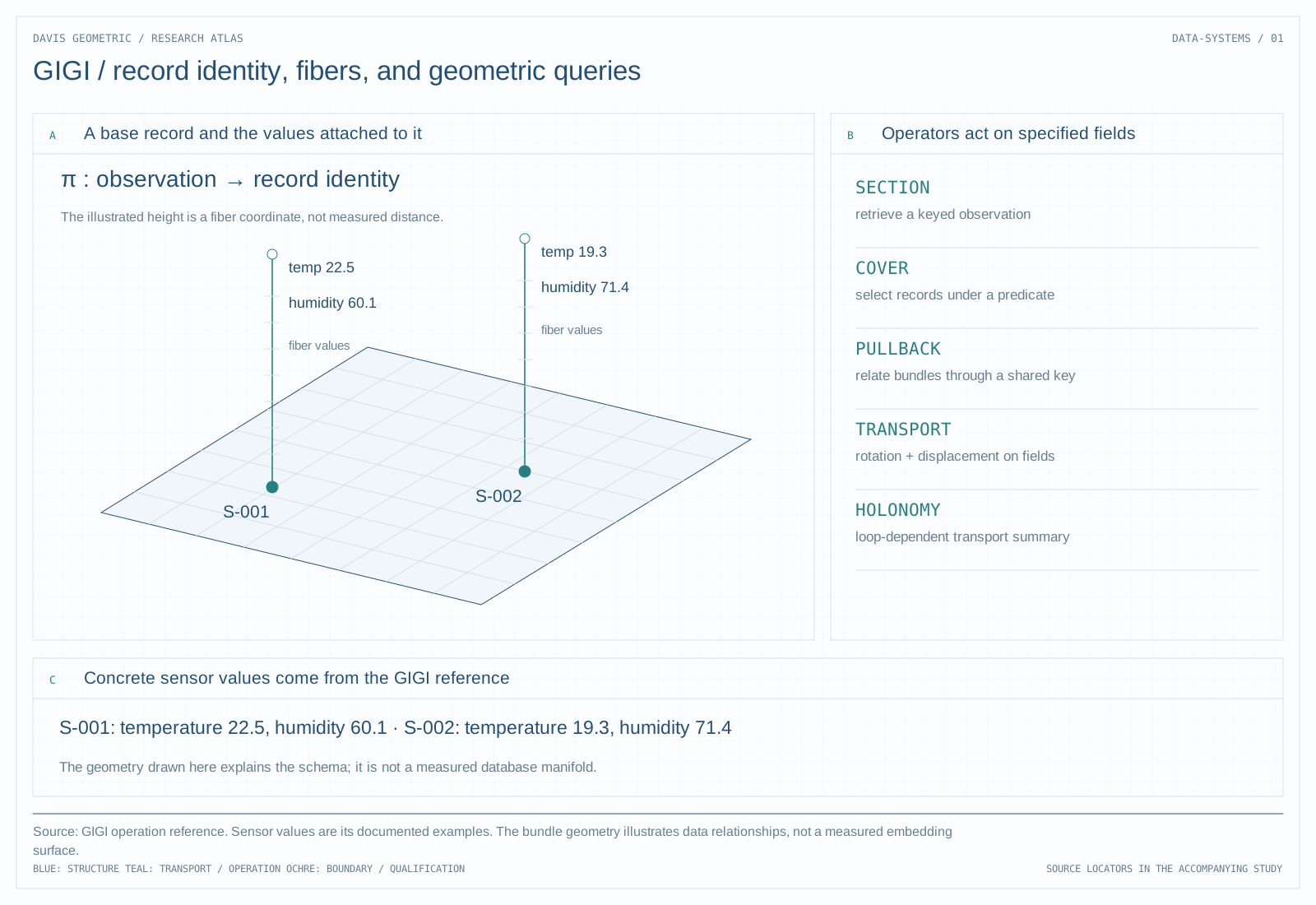
GIGI (Geometric Intrinsic Global Index) models a dataset as a fiber bundle: key fields form the base, and the remaining values form the fiber over each key. A single binary, gigi-stream, serves version 0.4.0 of a REST API on port 3142 together with GQL v2.2, a query language in which SECTION, COVER and PULLBACK take the place of SQL’s SELECT, WHERE and JOIN; a TRANSLATE SQL verb compiles SQL into GQL. The documentation lists transactions (ATLAS), schema migration (GAUGE … TRANSFORM), bulk ingest from CSV, JSONL or NPZ files, and diagnostics including RICCI, BETTI, SPECTRAL and a Čech-style CONSISTENCY check. Unauthenticated read queries run through a verb allowlist.
The documentation states costs per operation rather than benchmark results: a point read is listed as O(1) through a hash on the key, an indexed COVER as proportional to the matching bucket, a PULLBACK join as proportional to the left bundle, and INTEGRATE as proportional to the group size. These are design statements, not measured timings. EXPLAIN on a point read returns a per-field breakdown of the record’s curvature reading, loudest field first, alongside a classical z-score for cross-checking. In the September 2026 shortest-path study, GIGI stored weighted arcs and preserved graphs and their distances through storage and reload.
From a sensor record to a bundle
In the documented sensor example, an identifier locates a base point and temperature and humidity are values on the fiber. BUNDLE defines the structure, SECTION inserts or retrieves a record, COVER selects a subset, and INTEGRATE aggregates measurements. PULLBACK connects records through a shared key. The geometric vocabulary is attached to explicit data operations.
The interface also exposes CURVATURE, TRANSPORT, HOLONOMY, and SPECTRAL. For example, TRANSPORT reports a rotation and displacement between two records on selected fiber fields. A researcher can inspect a representation change through the same interface used to retrieve its underlying observations.
An operational definition is part of the result
The documented confidence score is 1/(1+K), where K is the selected variability or curvature reading. That is a defined score, not automatically a calibrated probability that an answer is correct. Likewise, a database operation named HOLONOMY needs its implemented transport rule and loop construction to be scientifically interpretable.
The documentation distinguishes executed operations from parsed but unavailable families and from features marked for a later deployment. This distinction is more informative than a universal claim that every geometric operation is already supported.
Three related systems, three different questions
GIGI is the storage and query substrate. The separate GEODESIC retrieval project investigates trajectories and indexing. DHOOM concerns structured serialization. A compact wire representation does not establish a faster query engine, and an indexed point read does not establish the cost of an arbitrary geometric query. The three projects share this catalog entry, but their mechanisms and evaluations remain distinct.
The next research step
A representative evaluation should follow a real query from ingestion through updates and reads, recording the meaning and cost of each geometric operator. The key comparison is whether retaining this structure changes a task outcome, not merely whether the vocabulary can be expressed in a query language.
Background mathematics and definitions
Describe the source record space, an encoder E, a decoder D, and a query Q. State whether round-trip equality means identical bytes or equal declared fields. For geometric queries, define the metric and its handling of categorical values before comparing indexes.
- r
- A versioned input record, including units and missing-value semantics.
- E and D
- The encoding and decoding transformations.
- Query equivalence
- Agreement of returned records under the same query meaning, not merely similar syntax.
Illustrative example
A temperature recorded as 20 °C and one recorded as 68 °F can describe the same physical state. Dropping the unit during serialization makes the numbers look different without preserving enough information to interpret that difference. This is a semantic round-trip problem, not a compression ratio.
This background example is separate from the source records and the main technical figure.
Source record
No new experiments are reported in this research note. Figure captions distinguish saved research records, source-model calculations, and explanatory diagrams.