Life sciences / MIRADOR / mirror manifolds
Mirror manifolds: conditional coverage of antigenic paths
The original MIRADOR immune-design manuscript asks how a panel of receptors could cover a family of anticipated antigenic trajectories. It explicitly presents a conceptual construction rather than a neutralization or clinical study.
Research settingIndependent
TL;DR
In brief
The question
If antigens and immune receptors are placed in one shared geometry, what can a coverage guarantee for a designed panel actually promise?
What the work does
The preprint builds a coupled antigen-receptor construction trained contrastively, derives a coverage bound on neutralization, inverts it into an empirical error budget, and states an existence theorem for the receptor geometry.
What is still open
Nothing is established biologically: the deposit reports no neutralization result and no clinical outcome, so the bound's empirical inputs remain uncalibrated.
Available recordTheoretical manuscript: co-embedding assumptions, a panel-selection problem, and conditional error bounds.
From the research record
Inspect the work
Original figures, recorded values, and explicit model details. Each exhibit identifies its source and what the comparison means.
The objects needed before a panel can be certified
Scroll horizontally to inspect the full table →
| Object | Specified role | Evidence needed for biological use |
|---|---|---|
| Antigen and receptor co-embeddings | Place both in a common binding-related space | Binding measurements supporting that common distance |
| Antigen path family | Defines which future variations are considered | Coverage of plausible held-out antigenic variation |
| Receptor coverage set | Antigens lying in a declared binding neighborhood | A calibrated neighborhood threshold |
| Panel-selection problem | Choose receptors covering the sampled paths | Panel size constraint and sampling error |
| Error budget / vacuity floor | Reduce the lower bound when uncertainty consumes the margin | Estimated distortion, forecast and binding errors |
The first two columns condense the source construction; the final column identifies its empirical dependencies. The original manuscript reports no neutralization or clinical outcomes.
mirador.tex · Conceptual overview; coverage construction and vacuity floor
The research in context
Viruses that circulate for long periods change the parts of their surface that immune systems recognize. A vaccine or therapeutic antibody chosen against last year's form can lose effect as that surface moves. Designers therefore want not a single best binder but a panel - a small set of antibodies or immunogens chosen so that whatever the virus does next, something in the set still engages it. The difficulty is that the space of future variants is not observed, and binding strength is not a simple function of sequence similarity: two nearly identical sequences can behave very differently against the same receptor.
The MIRADOR preprint, deposited in March 2026, treats this as a geometry problem. It pairs two constructions - a manifold carrying antigen variation under drift and a manifold of immune receptors - and couples them through a contrastive training objective, so that proximity in the joint geometry is meant to stand for a binding relationship rather than for sequence resemblance. On that object the manuscript states a coverage bound on neutralization and then inverts the usual error budget: instead of only bounding failure, it asks how high measured coverage would have to be before a panel could be certified. A separate theorem concerns whether the required receptor geometry exists. The deposit also carries a specification and validation code.
Read in its own terms, the chain has joints that can fail independently: whether distances in the co-embedding track a binding relation, whether the anticipated antigenic paths resemble what a virus actually does, and whether binding corresponds to neutralization in an assay. The record presents itself as the design-side counterpart to the author's HERALD surveillance work, and its keywords flag dual-use biosecurity. What it does not contain is a panel that was built and tested, a neutralization measurement, or a protection outcome. The certificate is conditional throughout: it says what follows if the empirical inputs hold, not that they hold.
Two spaces joined by a binding model
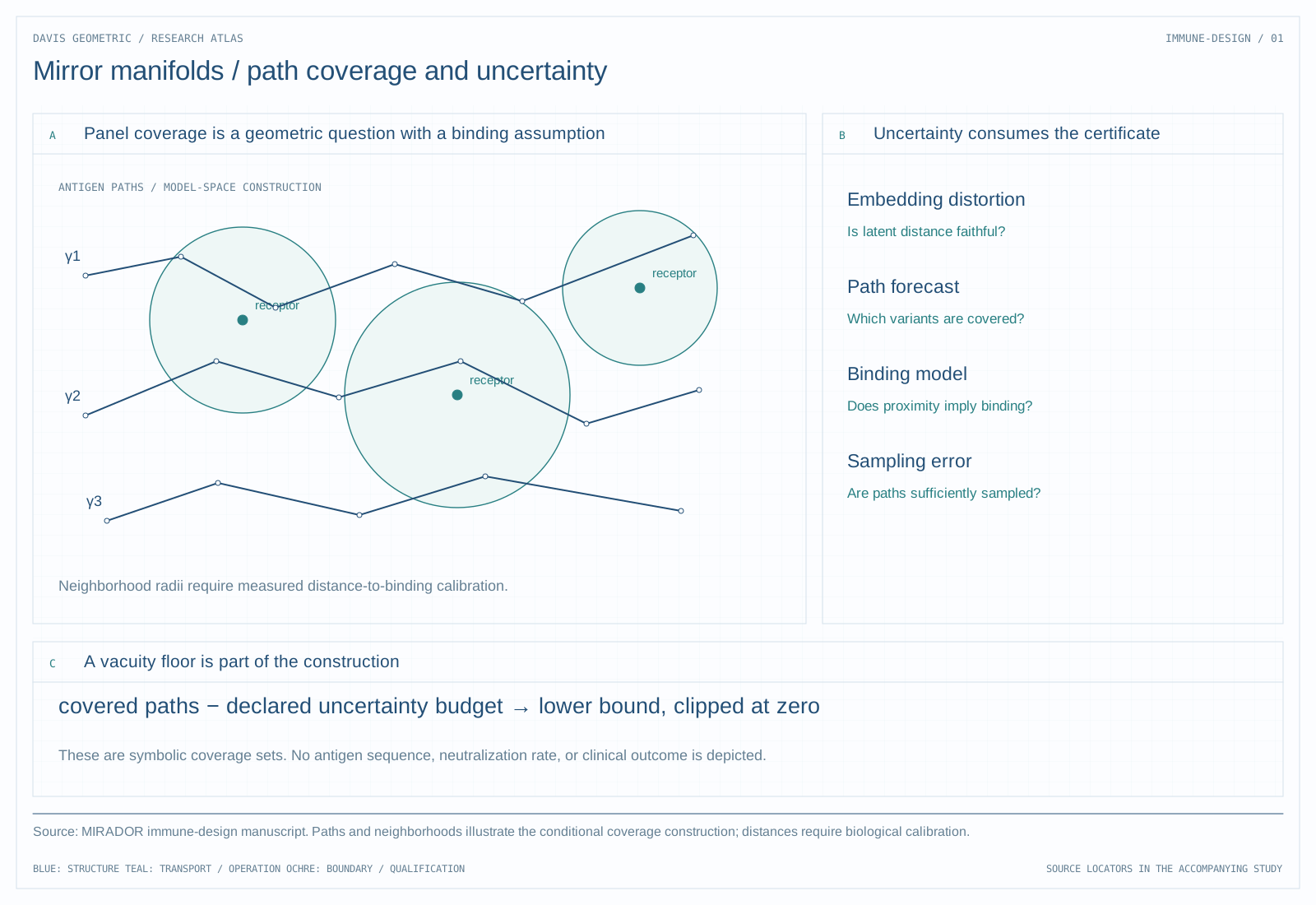
The construction maps antigens and receptors into a shared space intended to reflect binding free energy. This is more demanding than embedding sequences by similarity: two similar sequences need not have the binding relationship that the design procedure requires.
The paper calls the coupled construction “mirror manifolds.” Its maps must distinguish a receptor that is mismatched to one antigen from a receptor that is ineffective more broadly. The geometry’s biological meaning is an assumption to calibrate, not something supplied by the manifold terminology.
A set-cover problem with an uncertainty budget
Given anticipated path families and a specified binding neighborhood, panel selection becomes a coverage problem. The manuscript reverses the usual error-budget framing: instead of only bounding failure, it seeks a lower bound on covered paths under the model.
The construction includes a vacuity floor. When uncertainty in the embedding, forecast, or binding relation consumes the margin, the claimed lower bound returns to zero. A conditional certificate is useful only if the empirical quantities used in that budget are supported.
What the paper does not report
The manuscript states that it contains no empirical performance, neutralization results, or clinical outcomes. Its contribution is the formal organization of the design question and its assumptions. A coverage certificate in the model should not be presented as an effective vaccine or antibody panel.
The next research step
The next bridge is measured binding and neutralization evidence sufficient to calibrate the co-embedding and its error budget. Panel coverage should then be assessed on held-out antigenic variation, with abstentions preserved.
Background mathematics and definitions
Separate representation error, calibration error, and the model connecting binding to the target outcome. State how they enter a proposed coverage margin. A bound that exceeds the available margin is uninformative rather than a successful guarantee.
- Coverage
- The exact model-space or assay endpoint the panel is meant to cover.
- Calibration error
- Disagreement between predicted and measured quantities under the specified calibration.
- Vacuous bound
- A bound too weak to establish the desired statement.
Illustrative example
For an illustrative nominal margin of 0.3 and a justified error budget of 0.4, the lower margin is −0.1. The arithmetic supplies no positive-margin guarantee. Neither number is an estimate from the MIRADOR record; the example explains the logic of a conditional bound.
This background example is separate from the source records and the main technical figure.
Source record
- MIRADOR app.
- MIRADOR: Manifold of Immune Receptors And Drift-Optimized Responses : Geometry-First Co-Embedding for Vaccine and Antibody Design.
Additional source versions reviewed
-
mirador/theory/mirador.texLocal project manuscript or report · not republished here
No new experiments are reported in this research note. Figure captions distinguish saved research records, source-model calculations, and explanatory diagrams.