Mathematical foundations / Davis Manifold / Sameness / conjecture studies
Representation and sameness: what survives a translation?
The foundational program connects two ways of describing the same phenomenon: transformations that preserve identity, and geometry that measures meaningful change. The question is which relationships survive when one description is translated into another.
Research settingNASAFoundational origins
TL;DR
In brief
The question
When one description of a system is translated into another, which properties provably survive, and which proposed links to classical open problems actually follow?
What the work does
Deposited manuscripts on representation manifolds, translation–distance equivalence, double covers, holonomy and operator conjectures, plus a 2026 review running exact checks and constructing counterexamples against selected steps.
What is still open
Repaired statements with explicit hypotheses for the distortion, detector-transfer and energy-bound steps, and independent specialist review of the deposited arguments on major conjectures.
Available recordSource manuscripts, six teaching chapters, and an explicit mathematical review with corrections.
From the research record
Inspect the work
Original figures, recorded values, and explicit model details. Each exhibit identifies its source and what the comparison means.
A correction the mathematical review retains
Scroll horizontally to inspect the full table →
| Check / quantity | Recorded result | Interpretation |
|---|---|---|
| Supplied suite | 10 / 11 checks passed | Only the suite’s own finite tests |
| Test 9, original coordinates | Mean error 0.2952 | Synthetic regression |
| Test 9, rotated coordinates | Mean error 0.1425 | Same rotation-invariance check |
| Rotated / original error | 0.483 | The check failed; coordinate sensitivity remains |
The suite does not prove the proposed lower bound or a mass gap. Keeping the failed rotation check visible is part of the mathematical record.
The research in context
Many engineering systems compare records that arrive in different forms: a message converted between formats, a signal measured by two instruments, a state written in two coordinate systems. There are two natural ways to say that such records are the same: an explicit translation that maps one to the other, and a distance in a geometric space that is small when they agree. Whether these two notions give the same guarantees is not automatic. It depends on the precise space, metric, equivalence relation and the error allowed in each translation, and a small gap between them can change what a downstream detector concludes.
The deposited Davis Manifold paper (November 2025) proposes curved state spaces with bounded distortion along benign paths, margins and abstention bands, and divides detection failure into geometry, feature-linkage, calibration and abstention terms; it reports no performance metrics. The companion Geometry of Sameness constructs maps between translator-graph and manifold descriptions and proposes that error budgets transfer between them with first-order slack, assuming local translators can be linearized with bounded Jacobians. Later 2026 deposits extend the framework to the Hodge conjecture, the three- and smooth four-dimensional Poincaré conjectures, the Crouzeix conjecture, the invariant subspace problem, and a Non-Decoupling theorem about flat models of curved systems.
The site's review record, dated 7 October 2026, checks selected steps rather than whole manuscripts. It retains the component error-budget bound, checked over 6,561 exact rational input pairs, and the connected-partition counting results, where an independent enumerator agreed with the source algorithm on all 1,099 labeled graphs with one to five vertices. It also constructs counterexamples: on a flat torus, a family of connections with shrinking size keeps fixed curvature energy, refuting the general form of a lemma used in the energy-bound argument, and a supremum-norm interpolation bound cannot be promoted to a pointwise lower bound.
The engineering origin of the mathematical question
A translator can preserve an identifier while losing a distinction that matters to a decision. Conversely, two numerically different records can represent the same state after a unit conversion or a change of coordinates. The Davis Manifold and Geometry of Sameness work tries to make these equivalence choices explicit.
The aim is to connect implemented translations with distances and error budgets. Such a connection requires a stated domain, metric, equivalence relation, and distortion control. It is not supplied merely by calling a data representation a manifold.
A simple quotient exposes the proof obligation
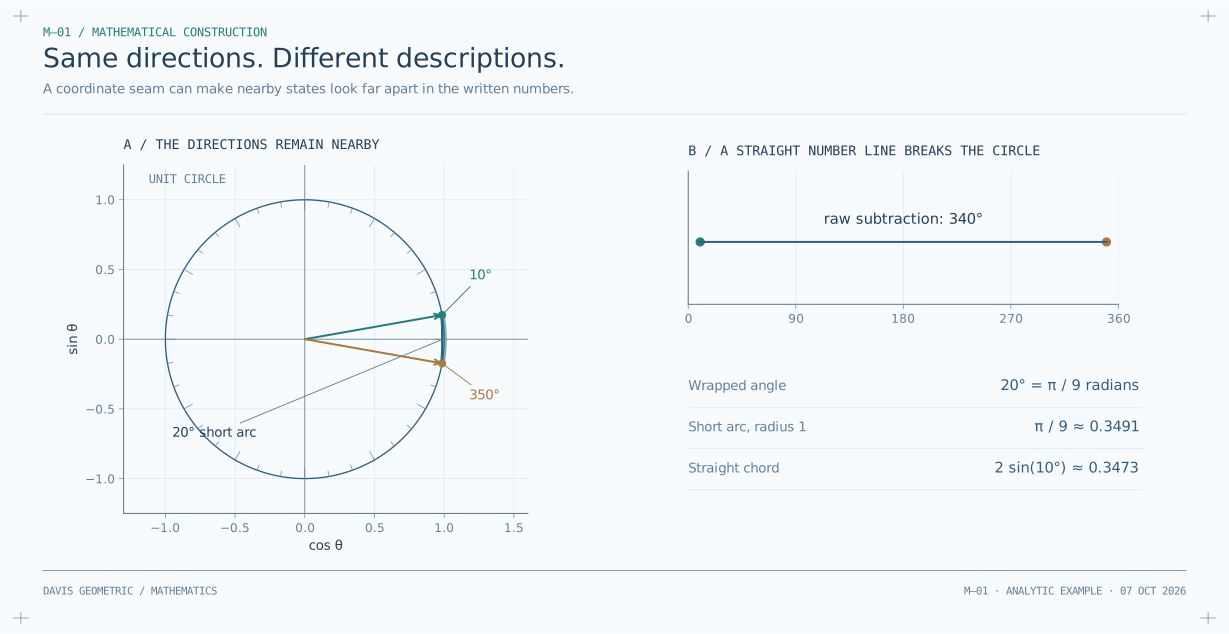
A directed arrow returns to its starting direction after 2π; an unoriented axis returns after π. The projection from arrows to axes identifies opposite directions. A quantity defined on the arrow space descends to the axis space only if it gives the same value to the directions being identified.
The current Math page develops this distinction alongside curvature and path dependence, approximation, probability lift, and connected counting. The geometric pigeonhole argument is another precisely scoped result: a finite metric cover forces a near-repeat among enough separated samples; an excursion-and-return needs an extra hypothesis.
The corrections belong to the research
The review records failed or incomplete steps in broader distortion, quotient-observable, energy, and pointwise approximation claims. The supplied approximation suite passed 10 of its 11 checks, with a rotation-invariance failure. Finite enumeration checks support particular graph statements rather than validating every manuscript.
The wider catalog retains proposed arguments about major mathematical problems as part of the research history. Inclusion does not certify their resolution. The precise statements and counterexamples in the review are the appropriate starting point for evaluating the current program.
The next research step
A useful next manuscript should isolate one translation-to-geometry result with its exact hypotheses and a worked implementation. That provides a reviewable contribution without asking a reader to accept every proposed cross-domain extension.
Background mathematics and definitions
Specify a set X, an equivalence relation, the quotient map q, and the observables or distances of interest. An observable descends to the quotient only if it is constant on equivalence classes. More general manifold and operator claims require their own hypotheses.
- Equivalence relation
- A reflexive, symmetric, and transitive rule identifying descriptions.
- Quotient
- The space of equivalence classes under that rule.
- Proof obligation
- A specific implication that still needs justification under stated hypotheses.
Illustrative example
An arrow at angle α and one at α+π define the same unoriented axis. The function cos α changes sign under this identification, so it does not define an axis observable. The function cos²α is unchanged and does descend. This exact example motivates the broader representation question.
This background example is separate from the source records and the main technical figure.
Source record
- Six mathematical walkthroughs.
- Proof review and counterexamples.
- The Davis Manifold: Geometry-First Detection with Compositional Error Budgets.
- The Geometry of Sameness: An ε-Equivalence of Translation and Distance.
- The Hodge Conjecture: A Davis Field Equations Resolution.
- Davis-Wilson Flow as Ricci Flow: An Independent Gauge-Theoretic Proof of the Poincaré Conjecture via Cache Space Collapse.
- The Smooth 4-Dimensional Poincar´e Conjecture: Whitney Embedding via Curvature Flow.
- The Crouzeix Conjecture: Shift Extremality and the Curvature Budget.
- Geodesic Confinement Resolves the Invariant Subspace Problem.
- The Davis Non-Decoupling Theorem: Why Every Flat Model of a Curved System Fails, and the Topological Size of the Debt.
No new experiments are reported in this research note. Figure captions distinguish saved research records, source-model calculations, and explanatory diagrams.