Algorithms & computing / AMC / BRIDGE
AMC and BRIDGE: preserve meaning when representations change
Two related manuscripts address different operational problems: adapting a telemetry encoding to incoming data, and retaining enough context to replay an AI-assisted procedure. Their common concern is the meaning that can be lost between representations.
Research settingNASAAMC · NASA origins; BRIDGE · Independent
TL;DR
In brief
The question
When telemetry encodings change format, or an AI-assisted procedure is replayed later, what meaning can be preserved and checked across the change?
What the work does
Two deposited manuscripts: AMC, a per-datapoint embedding format switcher with a semantic translation layer tested on NASA MODIS data; and BRIDGE, a transcript-to-procedure system with log-based replay.
What is still open
Neither deposit has been independently reproduced here; a worked case showing a recorded encoding transition or replay, with its equivalence criterion and failures, is still needed.
Available recordTwo deposited manuscripts; the encoding and replay guarantees require their own assumptions.
From the research record
Inspect the work
Original figures, recorded values, and explicit model details. Each exhibit identifies its source and what the comparison means.
The adaptive-format controller’s explicit settings
Scroll horizontally to inspect the full table →
| Symbol | Value | Defined role |
|---|---|---|
| λ | 0.95 | Exponential-moving-average decay for selector weights |
| γ | 1800 | TTL scaling in seconds |
| θ | 0.05 | Rollback threshold |
| ε | 0.1 | Semantic-drift bound |
| k | 10 | Nearest centroids for scoring |
| η | 1% | Violation-rate threshold for translator retraining |
This table belongs to the adaptive-embedding manuscript, not the separate BRIDGE replay manuscript. Values specify the reported controller; they do not prove semantic equivalence. Conflicting storage-baseline and latency wording elsewhere in this manuscript is not promoted into a performance headline.
Adaptive_Embedding_Format_Switching_and_Semantic_Translation_in_High_Volume_Telemetry_Systems-10.pdf · Table I and §IV.B–E, PDF pages 5–6; file suffix -10
The research in context
Operational systems such as spacecraft ground stations and security teams keep long records: streams of sensor telemetry, and logs of the steps people took during a procedure. Both records are increasingly mediated by learned representations—telemetry is compressed into numerical vectors, and procedures may be drafted with help from a language model. Each change of representation can silently alter what a record means. An alert might fire because the encoder changed rather than the instrument, and a procedure assisted by a model may not run the same way twice, which makes audit and later review difficult.
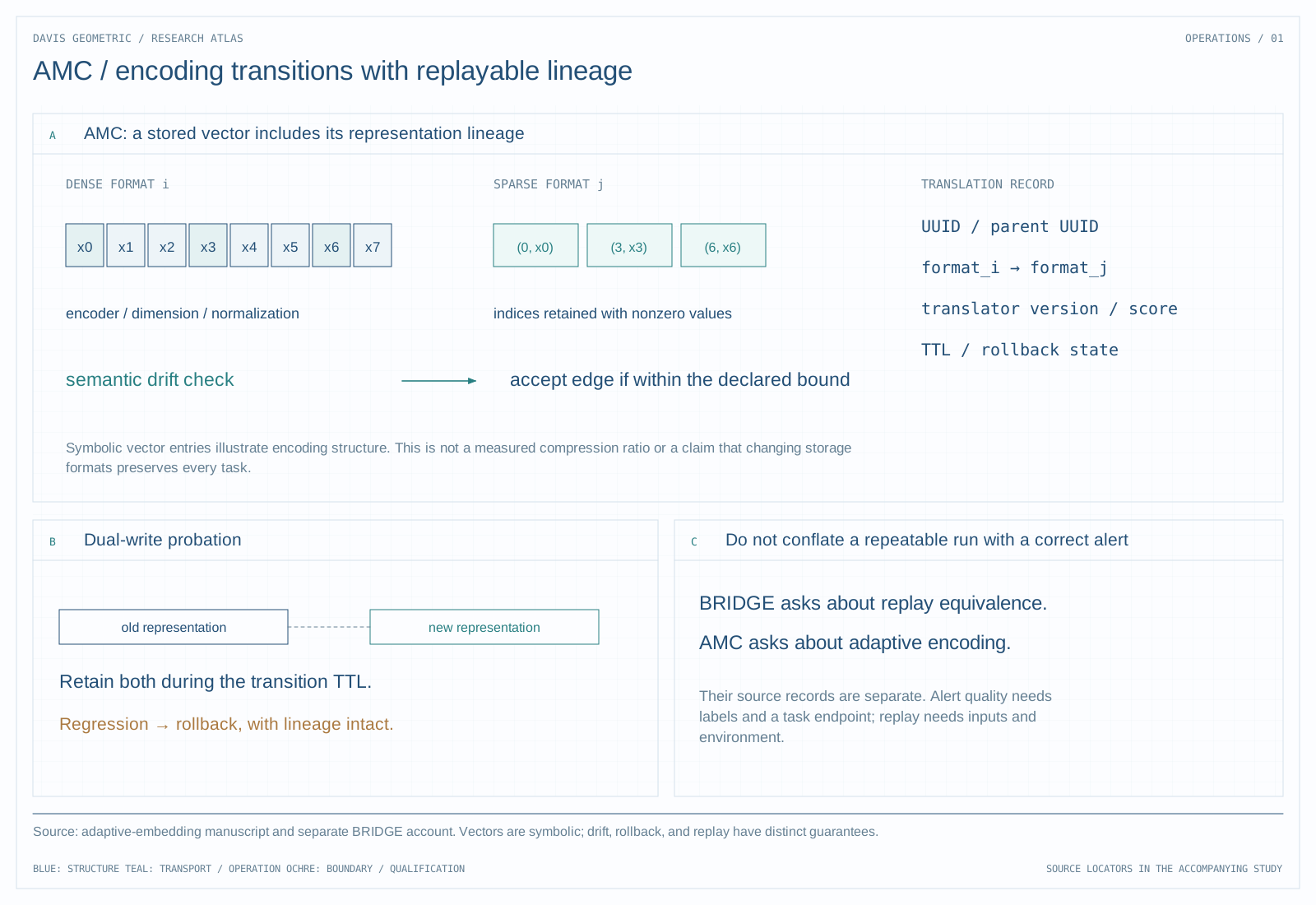
The telemetry manuscript describes AMC (Adaptive Multi-Vector Correlation), which chooses dense, sparse or quantized encoding for each data point using entropy, volatility, sparsity and anomaly-detection feedback, and translates between those formats with a stated bound on drift. Its abstract reports evaluation on NASA’s MODIS Earth-observation archive, chosen for sparsity ranging from 0.1% to 98.7%. The BRIDGE manuscript turns noisy instructional or penetration-testing transcripts into standard operating procedures. For file-observing commands (cat, type, ls, dir) it substitutes the recorded virtual file system state for the model’s output, and writes every step to an append-only JSONL log intended for replay.
Both deposits report quantitative results under their own conditions. On MODIS, the AMC abstract reports 37.1% storage savings against LZ4-compressed baselines, a reported 12.2% F1 improvement in anomaly detection over adaptive quantization, and median format selection under 2.4 ms. On 147 real transcripts (about 100,000 lines), the BRIDGE abstract reports an 87% reduction in transcript noise and a fall in time-to-fix from 15.3 to 4.7 minutes. These are the authors’ reported evaluations; this site has verified the deposit metadata, not reproduced the experiments.
Adaptive encoding grew out of telemetry work
At NASA, Davis describes preparing roughly two terabytes of daily telemetry for AI. The need to vectorize that data led to Adaptive Multi-Vector Correlation (AMC): adaptive formats with explicit translations between representations. Working with those vectors brought the data’s topology into view for her and motivated the subsequent mathematics. The published AMC evaluation uses public MODIS data, distinct from the original operational stream.
This creates a particular technical problem: a changed vector can reflect changed telemetry, changed dimensionality, changed normalization, or a changed encoder. The adaptive-format manuscript concerns the semantic translation between those encodings. Comparing vectors without retaining that translation would confuse an encoding change with a physical event.
BRIDGE asks what a later replay can recover
The BRIDGE deposit is titled Deterministic Replay for Hybrid AI-Assisted Operational Procedures via VFS Harmonization. Its subject is the reproducibility of a procedure that crosses computational interfaces, including AI-assisted steps. A replay record needs to identify the inputs and representation context behind each decision.
Replay and alert quality are different achievements. A procedure may be perfectly repeatable and still classify an event incorrectly. Conversely, an informative anomaly detector may depend on an external model or service whose response cannot be recreated exactly. The two papers should therefore retain separate guarantees.
The next research step
A concrete next case study would replay a recorded encoding transition, showing the raw measurements, both formats, the translation, and the resulting alert decision. For BRIDGE, the corresponding artifact is a replay whose equivalence criterion is explicitly stated.
Background mathematics and definitions
Record a versioned measurement x, its encoding Eᵥ, the analysis rule, and the decision environment. Compare outputs through a declared equivalence test. An adaptive encoding needs a cross-version comparison rule before geometric displacement can be interpreted as system change.
- v
- Encoder and schema version, including scaling and dimensionality.
- Replay equivalence
- Byte equality, field equality, or a specified behavioral equivalence.
- Decision validity
- Whether the decision meets a task criterion; independent of repeatability.
Illustrative example
Suppose a sensor changes its reported temperature from 20 °C to 68 °F at a software update. A raw numeric jump is large; a unit-aware comparison is zero. The example shows why representation changes must be recorded alongside telemetry.
This background example is separate from the source records and the main technical figure.
Source record
- AMC: foundational paper and NASA origins.
- AMC-Edge Rev D: precision adaptation.
- USAspending / IDAS: investigative data provenance.
- Adaptive Embedding Format Switching and Semantic Translation in High-Volume Telemetry Systems.
- BRIDGE: Deterministic Replay for Hybrid AI-Assisted Operational Procedures via VFS Harmonization.
No new experiments are reported in this research note. Figure captions distinguish saved research records, source-model calculations, and explanatory diagrams.