Physical sciences / Davis–Landau study
Superfluid onset: obstacle geometry and vortex nucleation
The Davis–Landau study asks whether obstacle geometry organizes the onset of vortices in Gross–Pitaevskii simulations. The research object is a simulated transition, measured relative to the model’s sound speed.
Research settingIndependent
TL;DR
In brief
The question
In simulated Bose–Einstein condensates, does the shape of an obstacle set the flow speed at which vortices first appear, relative to the speed of sound?
What the work does
Two-dimensional GPU Gross–Pitaevskii simulations for three atomic species and two obstacle profiles, measuring the onset velocity as a fraction of sound speed, with included simulation and figure code.
What is still open
Convergence and onset-detection uncertainty, obstacle families outside the original two, and whether the relation holds beyond two-dimensional, zero-temperature simulation regimes.
Available recordExisting simulation manuscript; the scope of any proposed onset law remains the simulated regimes.
From the research record
Inspect the work
Original figures, recorded values, and explicit model details. Each exhibit identifies its source and what the comparison means.
The two obstacle regimes actually compared
Scroll horizontally to inspect the full table →
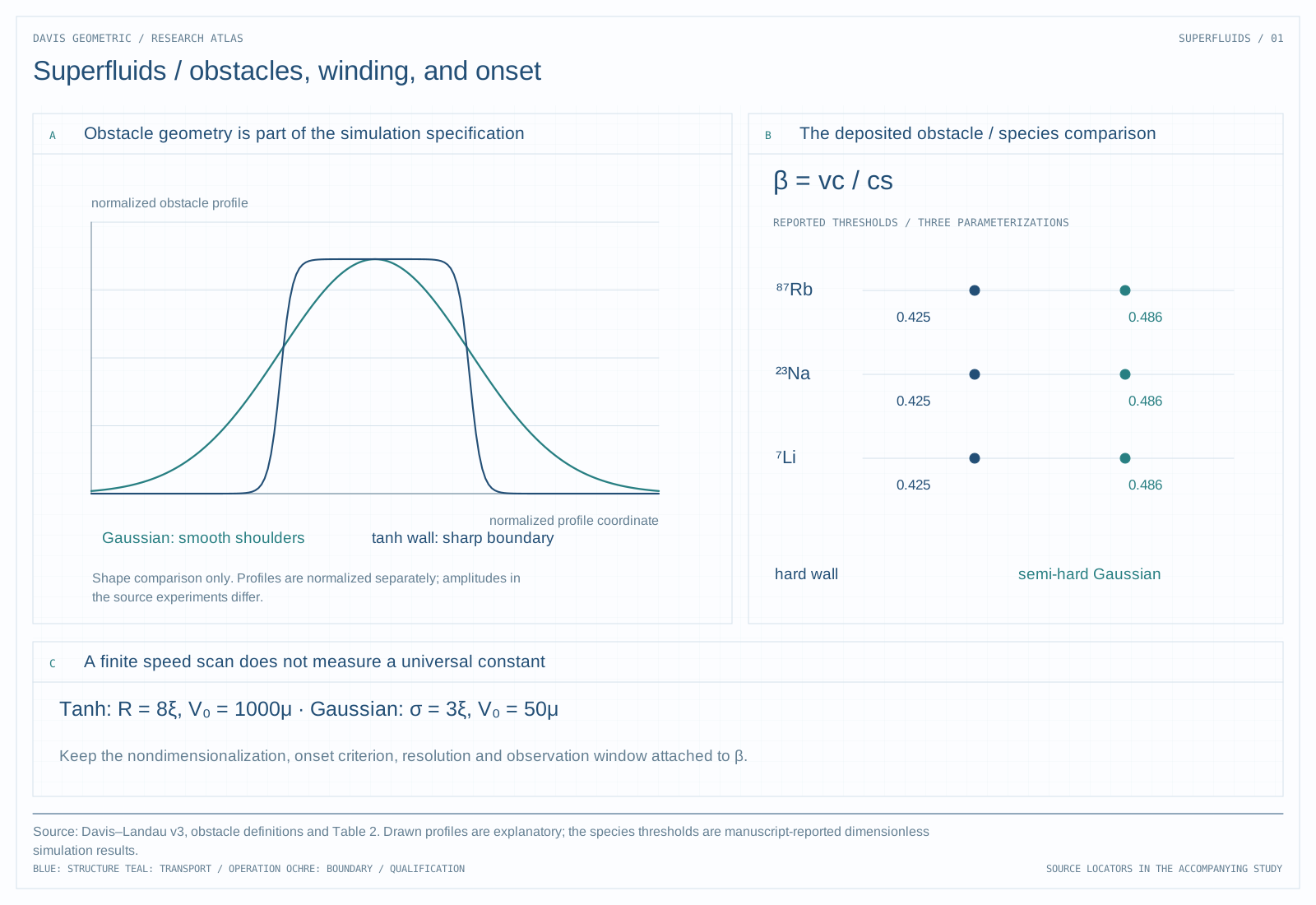
| Obstacle | Dimensionless parameters | β: ⁸⁷Rb | β: ²³Na | β: ⁷Li |
|---|---|---|---|---|
| Gaussian, semi-hard | σ = 3ξ; V₀ = 50μ | 0.486 | 0.486 | 0.486 |
| Tanh-wall, hard | R = 8ξ; V₀ = 1000μ | 0.425 | 0.425 | 0.425 |
β = vc / cs; ξ is healing length and μ chemical potential. These are the reported values at the sampled thresholds, not zero-uncertainty physical constants. Equal dimensionless outcomes for three parameterizations of a rescaled Gross–Pitaevskii model do not establish universality across temperatures, obstacle families or experiments.
The research in context
A superfluid, such as a Bose–Einstein condensate of ultracold atoms, can flow past an obstacle without friction—but only up to a critical speed. Above it the flow sheds quantized vortices, small whirlpools around which the phase of the quantum wavefunction winds by a whole number of turns. Landau’s classic argument gives one critical speed; experiments and simulations often find vortices at lower speeds that depend on the obstacle’s size and sharpness. The Gross–Pitaevskii equation, a nonlinear wave equation for the condensate, is the standard tool for studying this onset numerically.
The deposited study runs GPU-accelerated two-dimensional Gross–Pitaevskii simulations for three species, rubidium-87, sodium-23 and lithium-7, spanning a 12:1 mass ratio. It compares a hard obstacle with a steep (tanh) wall against a Gaussian potential of height 50 times the chemical potential, and records the critical velocity as β = v_c/c_s, the onset speed divided by the local sound speed. The deposit includes the main multi-species simulation script, a script testing the proposed curvature scaling, figure-generation code, and pre-computed result files.
The deposit reports β ≈ 0.425 for the hard obstacle and β ≈ 0.486 for the Gaussian obstacle, with the same value for each species, and compares the hard-wall figure with the earlier Frisch–Pomeau–Rica estimate of about 0.4. Because a dimensionless Gross–Pitaevskii formulation already absorbs mass and interaction strength into its units, identical values across species chiefly test that scaling. The geometric content lies in the difference between obstacle profiles. The deposit also reports a symmetric, in-phase wake oscillation after onset rather than alternating shedding.
From a flow disturbance to an onset measurement
The historical record describes simulations for several condensate species and proposes a geometric critical-velocity relation. Normalizing velocity by sound speed makes cases comparable, but the comparison still depends on the nondimensionalization, interaction model, obstacle potential, and boundary conditions.
A vortex is identified through the phase structure of the complex condensate field. The phase-winding construction below explains what that diagnostic looks for. It is not one of the study’s measured speed thresholds.
What a collapse across species would establish
If several normalized simulation curves follow a common relation, that is evidence about the chosen equations and parameter ranges. It does not alone show independence from dimension, temperature, preparation, or dissipation. The relation could reflect common modeling assumptions as well as a useful geometric simplification.
The onset decision also has a time scale. A brief disturbance and sustained vortex production can receive different labels under different observation windows. A representative account must retain the window and detection rule alongside the reported critical velocity.
The next research step
The next revision should put the actual obstacle families, speed scans, and phase-winding detections beside the proposed law, including cases that depart from it. Those records are more informative than a claim of species-independent universality.
Background mathematics and definitions
Use a dimensionless Gross–Pitaevskii model with all coefficients, obstacle motion, and boundary treatments declared. Define the onset rule before scanning speed. A geometrically motivated law is a candidate relation to evaluate, not a substitute for the model and detection procedure.
- ψ
- Complex condensate field in the stated nondimensionalization.
- V
- Specified potential, including the obstacle and its motion.
- g
- Interaction coefficient under that normalization.
Illustrative example
Around an idealized loop, a phase sequence 0, π/2, π, 3π/2 and back to 2π has one full winding. Detecting such winding in a simulated field requires enough spatial resolution and care near low-density regions. The hero illustrates the phase geometry, not a measured critical speed.
This background example is separate from the source records and the main technical figure.
Source record
No new experiments are reported in this research note. Figure captions distinguish saved research records, source-model calculations, and explanatory diagrams.