TESSERA / assembly context and the implemented encoder
Research settingIndependent
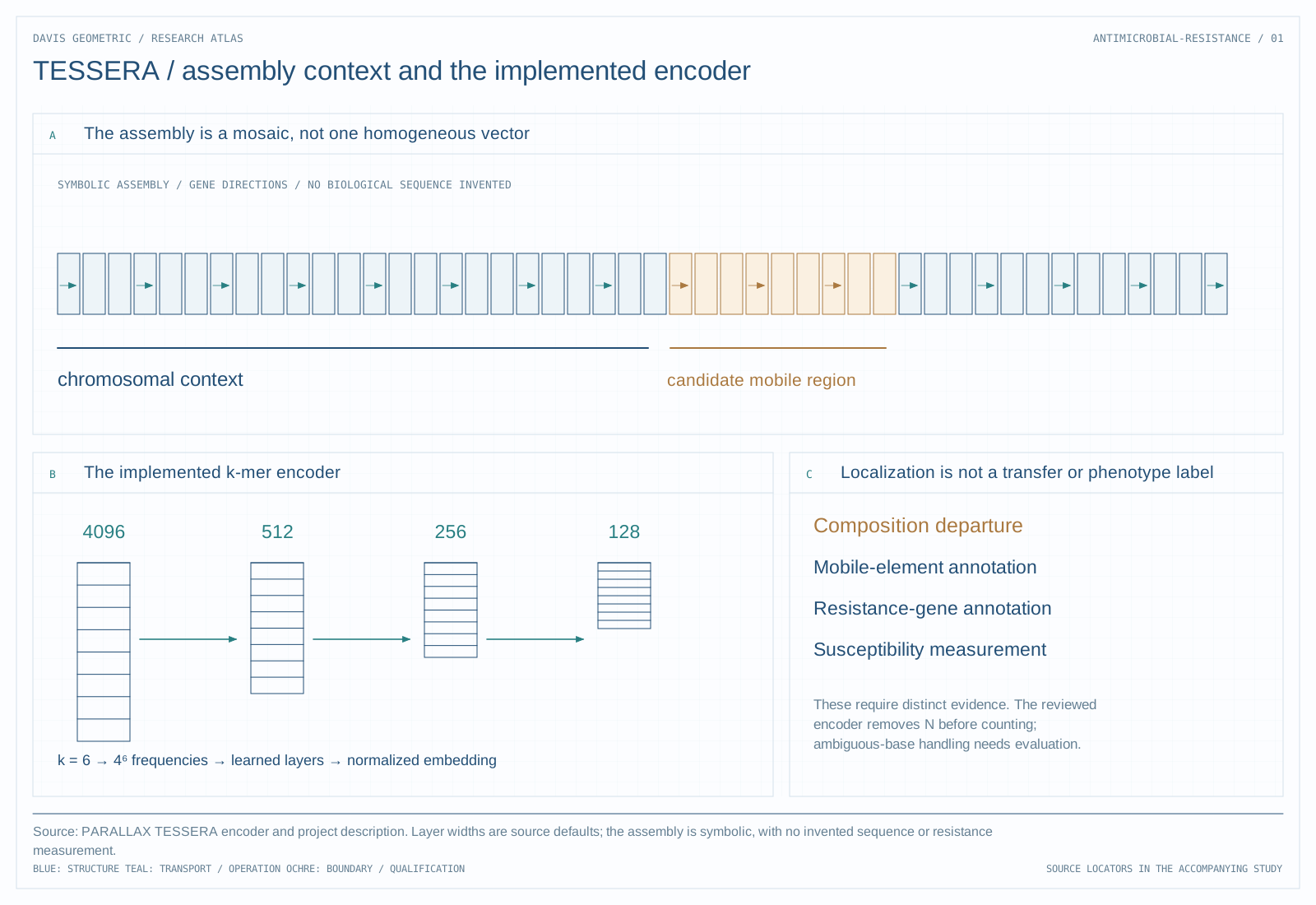
TESSERA represents bacterial assemblies as a mosaic: a relatively persistent chromosomal context and potentially mobile components. It investigates whether a compositional mismatch can help locate changes worth biological review.
From the research record
Inspect the work
Original figures, recorded values, and explicit model details. Each exhibit identifies its source and what the comparison means.
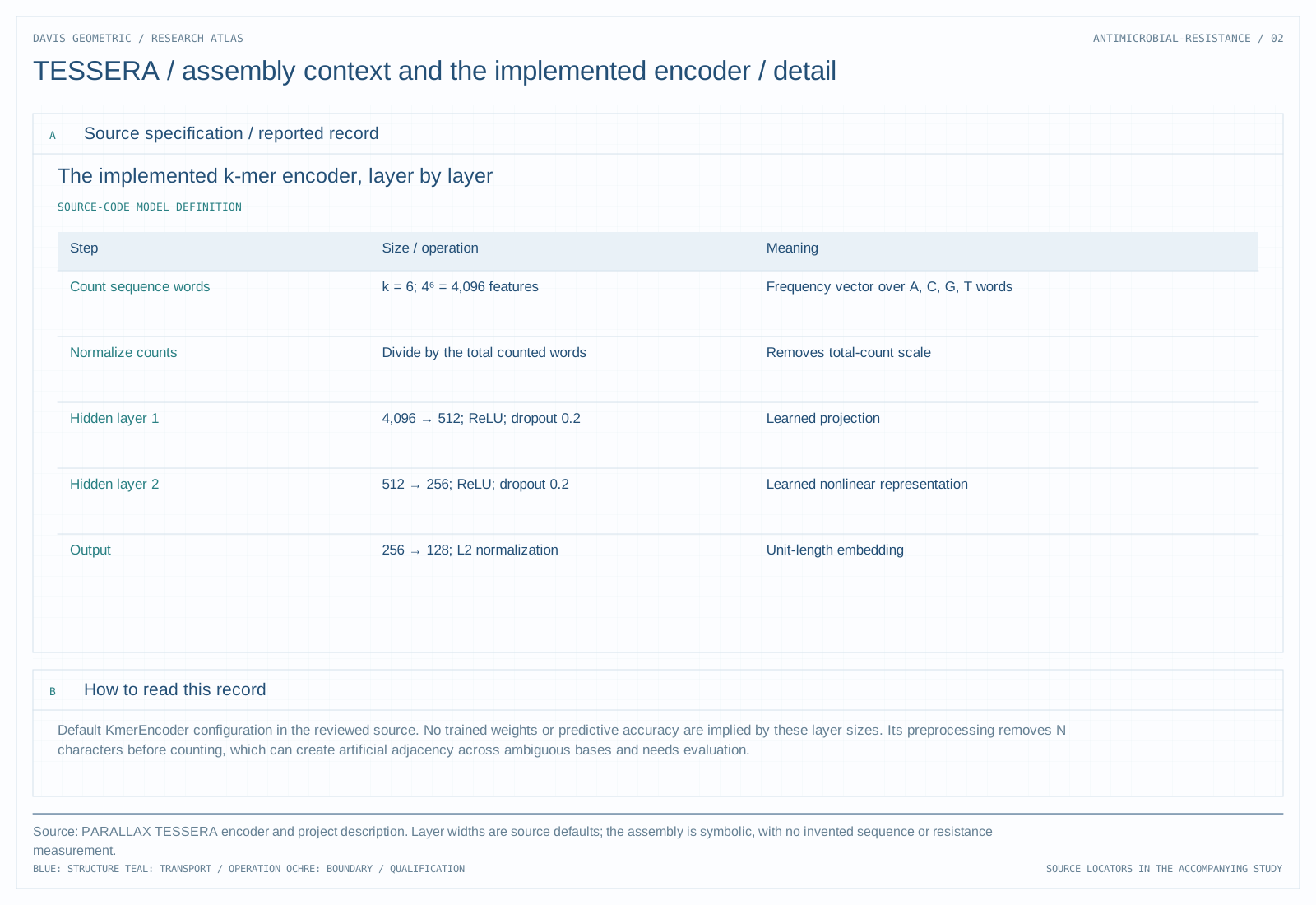
The implemented k-mer encoder, layer by layer
Scroll horizontally to inspect the full table →
| Step | Size / operation | Meaning |
|---|---|---|
| Count sequence words | k = 6; 4⁶ = 4,096 features | Frequency vector over A, C, G, T words |
| Normalize counts | Divide by the total counted words | Removes total-count scale |
| Hidden layer 1 | 4,096 → 512; ReLU; dropout 0.2 | Learned projection |
| Hidden layer 2 | 512 → 256; ReLU; dropout 0.2 | Learned nonlinear representation |
| Output | 256 → 128; L2 normalization | Unit-length embedding |
Default KmerEncoder configuration in the reviewed source. No trained weights or predictive accuracy are implied by these layer sizes. Its preprocessing removes N characters before counting, which can create artificial adjacency across ambiguous bases and needs evaluation.
tessera_encoder.py · KmerEncoder.__init__, count_kmers and forward
Three outputs that must not share one accuracy claim
Scroll horizontally to inspect the full table →
| Output in the project | Evidence type needed to evaluate it | Unit of comparison |
|---|---|---|
| Outbreak clustering | Independently supported outbreak / lineage labels | Assembly or isolate |
| Resistance-gene detection | Independent sequence annotation | Gene or region |
| Horizontal-transfer tracking | Supported mobile-element / transfer evidence | Segment and genomic context |
The task names come from PARALLAX; the evidence and comparison columns are the editorial evaluation map. No clinical resistance or transfer-rate measurements are present in this source.
README.md · TESSERA description and analysis gateway
Read the technical figure
Source: PARALLAX TESSERA encoder and project description. Layer widths are source defaults; the assembly is symbolic, with no invented sequence or resistance measurement.
Source: PARALLAX TESSERA encoder and project description. Layer widths are source defaults; the assembly is symbolic, with no invented sequence or resistance measurement.
Supporting detail
Why one embedding for an entire assembly can lose the question
The project descriptions use k-mer composition and a reduced representation of sequence windows. The proposed bundle separates a chromosomal backbone from plasmids and integrons. A segment whose composition departs from its surrounding context can then be examined as a possible mobile element rather than averaged into a whole-genome vector.
The older site calls this departure “shear.” That name identifies a proposed representation statistic. Its magnitude does not by itself date a transfer event or establish the donor, recipient, or mechanism.
Three outputs with different truth conditions
PARALLAX lists outbreak clustering, resistance-gene detection, and horizontal-transfer tracking under the bacterial analysis tool. A cluster of related assemblies, an annotated resistance determinant, and a measured resistant phenotype are three different outputs.
Assembly quality, lineage composition, and contamination can affect a geometric anomaly. Independent sequence annotations can help evaluate localization, while susceptibility measurements are needed for phenotype claims. A single threshold cannot validate all three tasks.
Sources, scope, and next question
Platform and representation descriptions; transfer events and resistance phenotypes require independent evidence.
A representative study should preserve segment-level predictions and compare them against independently annotated mobile regions, then evaluate resistance separately. Lineage-aware splits are necessary to show that the representation learns more than organism identity.
Additional source versions reviewed
-
parallax/README.mdLocal project manuscript or report · not republished here