AURORA / atmospheric state and discrete transport
Research settingNASA
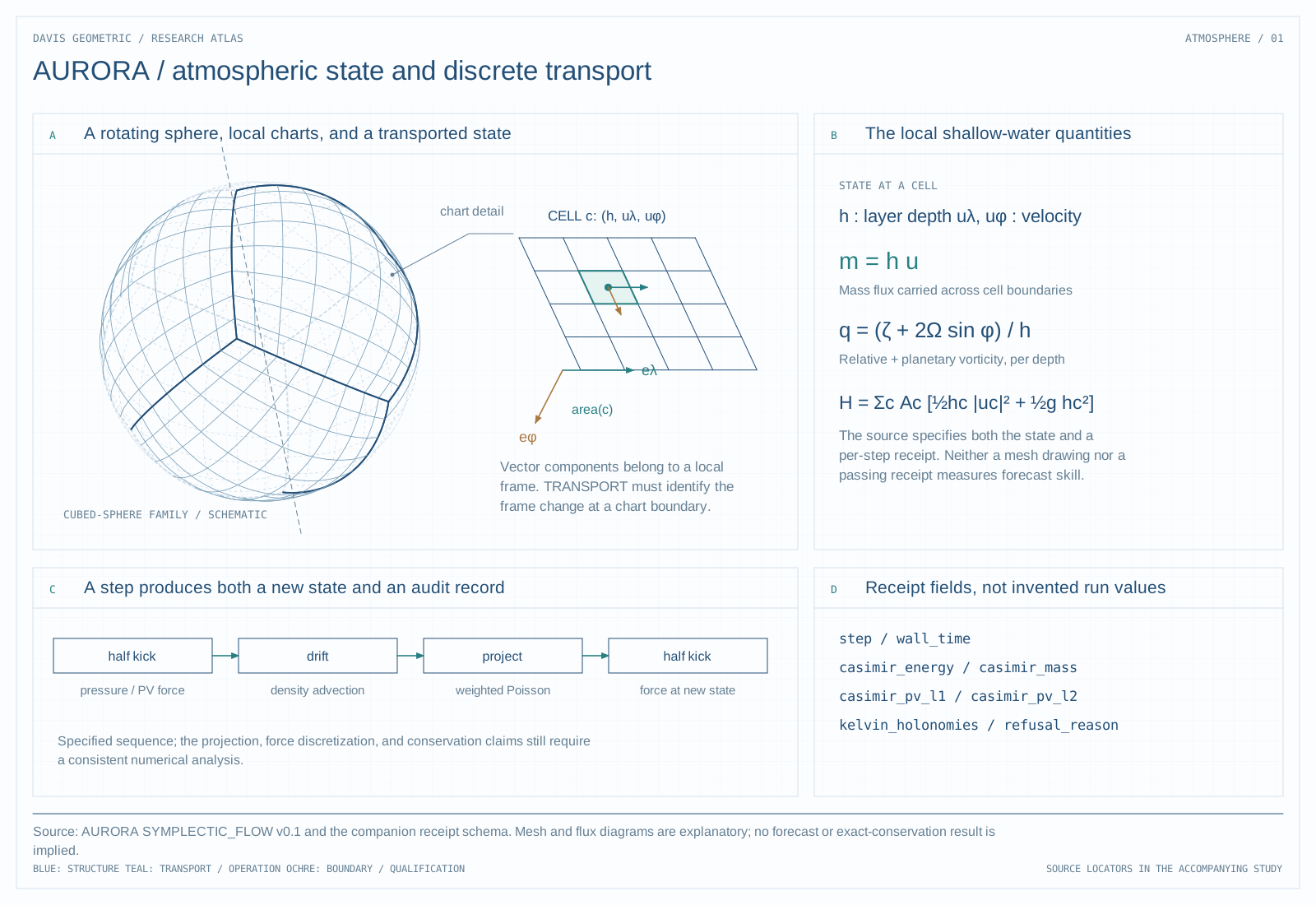
AURORA explores making conservation checks part of the simulation interface. Its specification records what each timestep should preserve and when the solver should refuse to continue.
From the research record
Inspect the work
Original figures, recorded values, and explicit model details. Each exhibit identifies its source and what the comparison means.
The staged benchmark ladder
Scroll horizontally to inspect the full table →
| Stage | Named comparison | Question being separated |
|---|---|---|
| Shallow-water core | Williamson cases 2, 5 and 6 | Balanced flow, topography and evolving wave structure |
| Forced dry atmosphere | Held–Suarez | Response to idealized forcing and damping |
| Idealized moist climate | Aquaplanet | Climate behavior under simplified boundary conditions |
| Prescribed surface conditions | Prescribed sea-surface-temperature experiments | Comparison with externally specified boundary forcing |
The named stages come from the companion; the right column is an editorial reading guide. This is a benchmark plan, not a pass/fail table. Conservation receipts and solution error must both be reported when a stage is run.
Read the technical figure
Source: AURORA SYMPLECTIC_FLOW v0.1 and the companion receipt schema. Mesh and flux diagrams are explanatory; no forecast or exact-conservation result is implied.
Source: AURORA SYMPLECTIC_FLOW v0.1 and the companion receipt schema. Mesh and flux diagrams are explanatory; no forecast or exact-conservation result is implied.
Supporting detail
What a timestep is expected to report
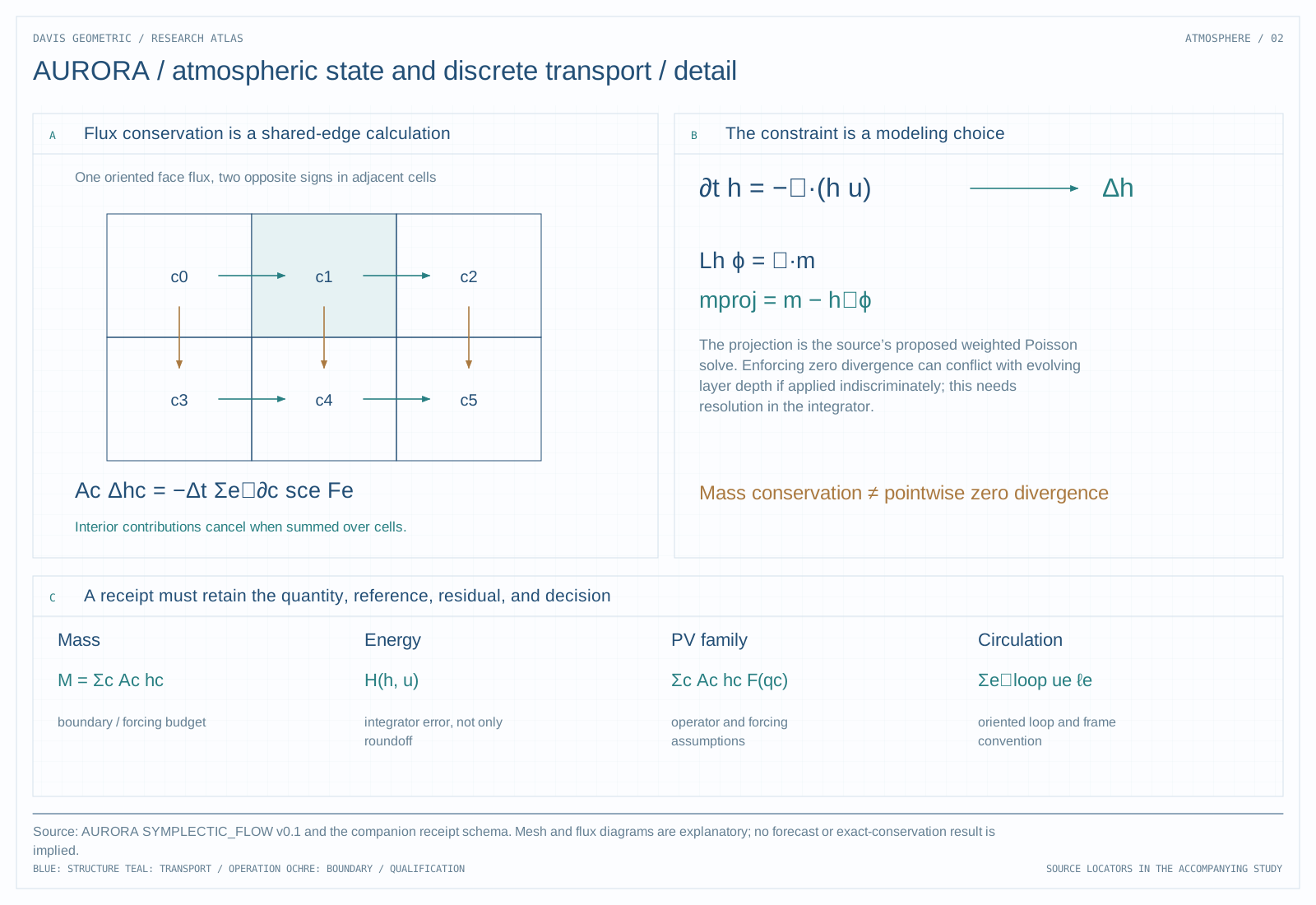
The proposed receipt includes energy, mass, potential-vorticity quantities, selected circulation loops, and a refusal reason when a check fails. The intended benefit is an inspectable account of numerical behavior during the run, rather than a drift statistic reported only after completion.
The design combines discrete geometric operators on a rotating sphere with explicit treatment of coordinate and frame changes. This connects the representation question to a concrete numerical task: the same atmospheric state should not acquire a different physical interpretation because it was expressed in another chart.
The benchmark sequence is part of the research design
The companion names Williamson test cases 2, 5, and 6, followed by Held–Suarez, aquaplanet, and prescribed-sea-surface-temperature experiments. This moves from idealized dynamical-core behavior toward a comparison with observations. Each stage tests a different claim.
The specification’s “8ε” receipt tolerance is a design claim requiring an error analysis for the actual implementation. A symplectic integrator does not generally preserve the original Hamiltonian exactly, and a stable conserved-quantity check alone does not establish accurate waves, circulation, or weather forecasts.
Why conservation is useful but insufficient
A solver can conserve a quantity while propagating a disturbance at the wrong speed. Clouds, forcing, assimilation, and initial-condition uncertainty also affect forecast skill. The representative contribution is the proposed conservation-aware computation and its staged tests, not a claim that a new dynamical core resolves climate uncertainty.
Sources, scope, and next question
Dynamical-core specification and staged benchmark plan; design targets are not completed benchmark results.
Publish the first completed benchmark with its mesh, integrator, timestep, error norms, and receipt history. Compare both conservation and the evolving solution before advancing to a broader forecast claim.
Additional source versions reviewed
-
aurora/AURORA_SYMPLECTIC_FLOW_SPEC.mdLocal project manuscript or report · not republished here