Compact topology / cycles and observation maps
Research settingIndependent
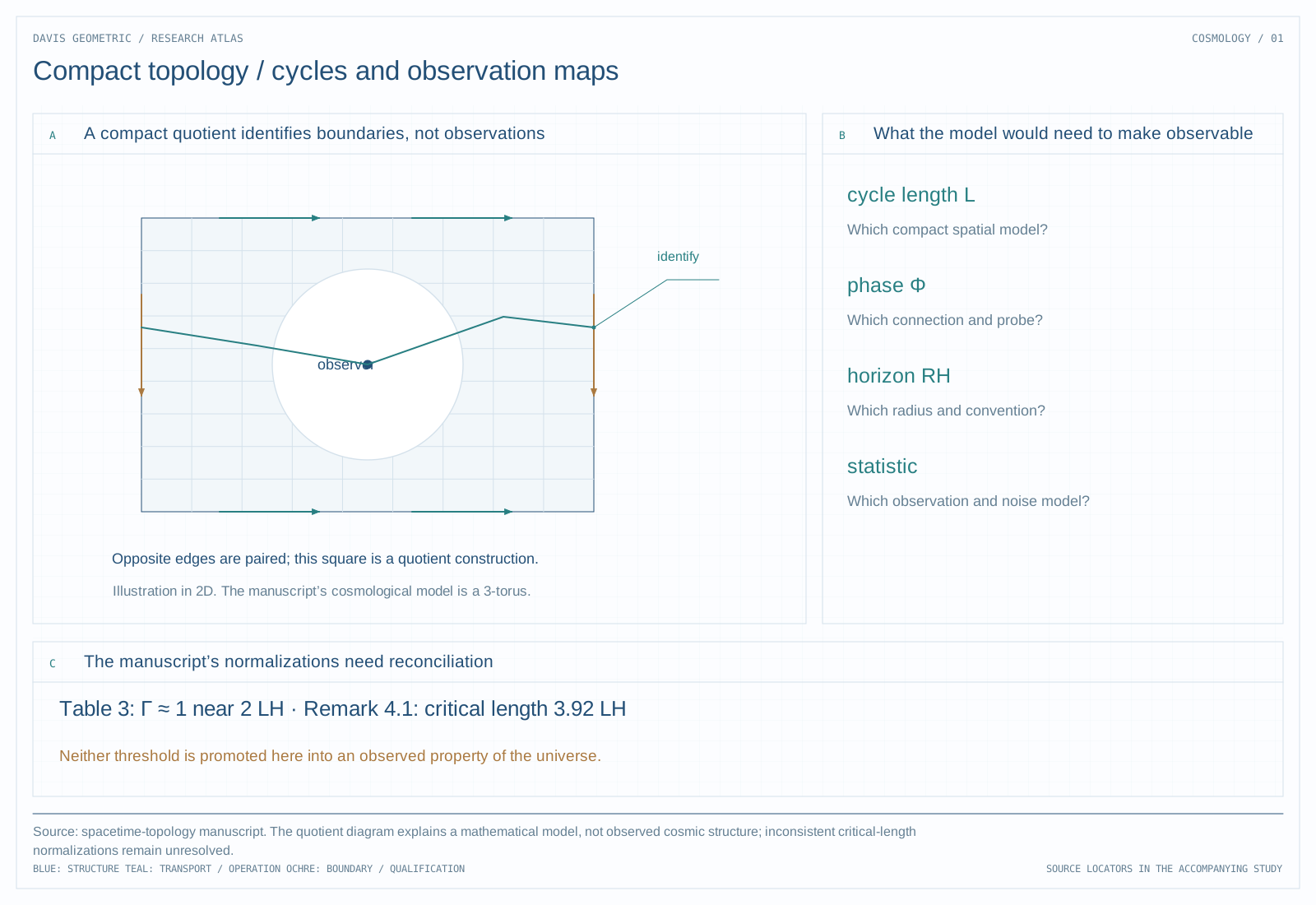
The manuscript Why the Universe Looks Random (And Isn’t) investigates a proposed connection between compact topology and limited observability. Its central research question concerns what an observer can distinguish, rather than an established explanation of cosmic randomness.
From the research record
Inspect the work
Original figures, recorded values, and explicit model details. Each exhibit identifies its source and what the comparison means.
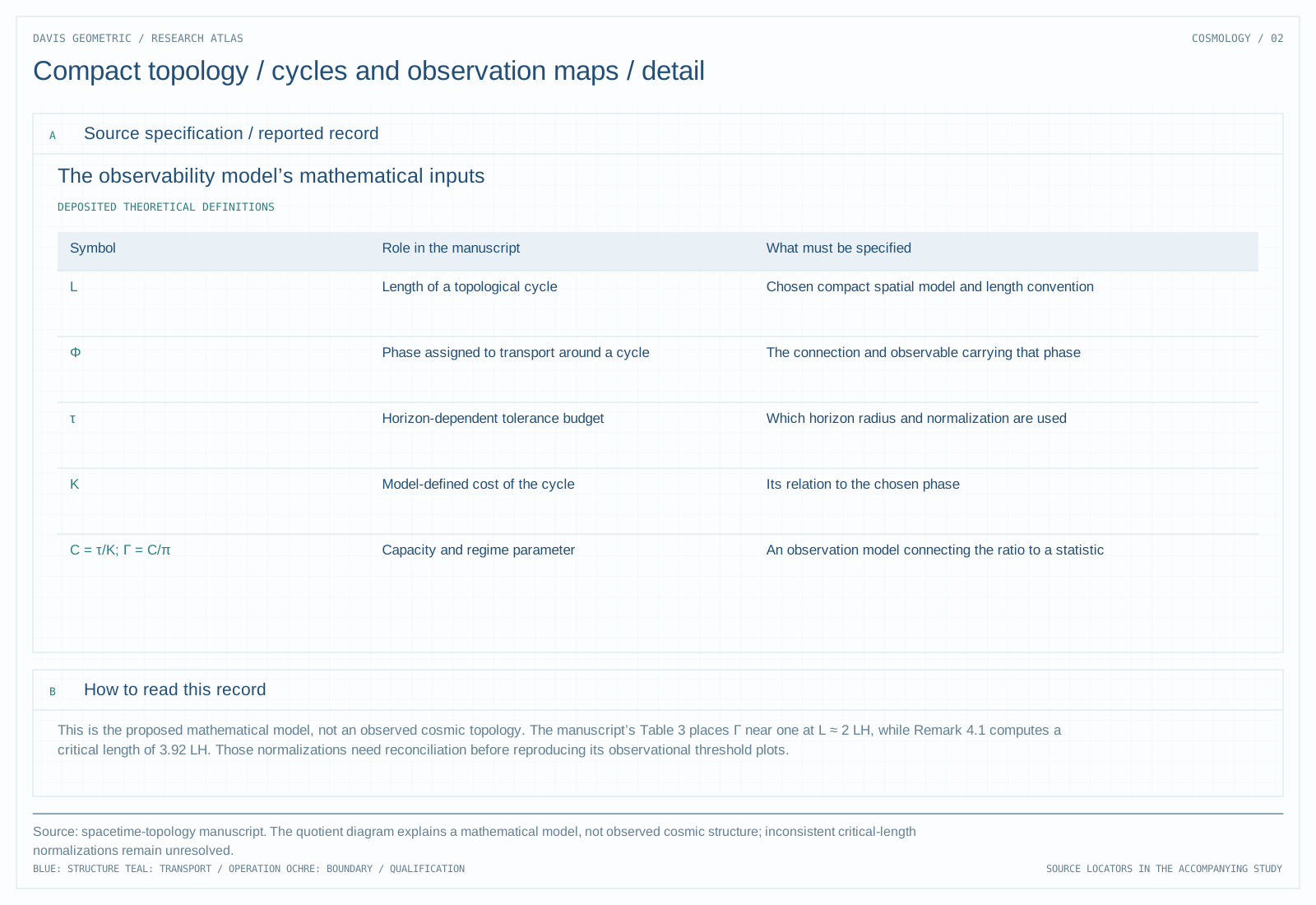
The observability model’s mathematical inputs
Scroll horizontally to inspect the full table →
| Symbol | Role in the manuscript | What must be specified |
|---|---|---|
| L | Length of a topological cycle | Chosen compact spatial model and length convention |
| Φ | Phase assigned to transport around a cycle | The connection and observable carrying that phase |
| τ | Horizon-dependent tolerance budget | Which horizon radius and normalization are used |
| K | Model-defined cost of the cycle | Its relation to the chosen phase |
| C = τ/K; Γ = C/π | Capacity and regime parameter | An observation model connecting the ratio to a statistic |
This is the proposed mathematical model, not an observed cosmic topology. The manuscript’s Table 3 places Γ near one at L ≈ 2 LH, while Remark 4.1 computes a critical length of 3.92 LH. Those normalizations need reconciliation before reproducing its observational threshold plots.
Read the technical figure
Source: spacetime-topology manuscript. The quotient diagram explains a mathematical model, not observed cosmic structure; inconsistent critical-length normalizations remain unresolved.
Source: spacetime-topology manuscript. The quotient diagram explains a mathematical model, not observed cosmic structure; inconsistent critical-length normalizations remain unresolved.
Supporting detail
The object of the proposal
The catalog describes a capacity relation, C = τ/K, used to ask whether topological structure remains detectable under a stated tolerance and geometric cost. To turn that into a physical claim, the manuscript must say what is observed, what observation noise is admitted, and which topologies the measurement is intended to distinguish.
Loss of distinguishability can arise because an observation map discards information. It does not follow that the underlying system is deterministic, that all apparent randomness has the same origin, or that the universe has the proposed topology.
The evidence this record actually provides
The deposited paper preserves the theoretical direction and its original title. The material reviewed for this website does not supply a cosmological likelihood analysis, a survey selection model, or a comparison with competing topologies. It would be misleading to write a results section as if those observations had been performed.
The teaching illustration concerns distinguishability under a representation. Its role is to introduce the question, not to stand in for a sky measurement.
Sources, scope, and next question
Deposited theoretical manuscript; no observational comparison is reconstructed in this note.
A testable continuation would specify two competing geometric models and an observation map, then determine which statistic separates them under declared noise and coverage. Only after that bridge exists can a capacity calculation become an observational claim.