Physical sciences / Topology and observability
Topology and observability: when structure becomes hard to distinguish
The manuscript Why the Universe Looks Random (And Isn’t) investigates a proposed connection between compact topology and limited observability. Its central research question concerns what an observer can distinguish, rather than an established explanation of cosmic randomness.
Research settingIndependent
TL;DR
In brief
The question
If space has a compact, finite topology, under what conditions could an observer inside it tell, and what would have to be measured?
What the work does
A deposited theoretical manuscript defines a capacity ratio C = τ/K for each topological cycle, states four theorems on flatness, observability regimes and the CMB two-point function, and derives candidate signatures.
What is still open
No likelihood analysis against sky data exists yet. The proposed signatures, such as anti-correlated matched circles, still need a defined search under realistic noise and sky coverage.
Available recordDeposited theoretical manuscript; no observational comparison is reconstructed in this note.
From the research record
Inspect the work
Original figures, recorded values, and explicit model details. Each exhibit identifies its source and what the comparison means.
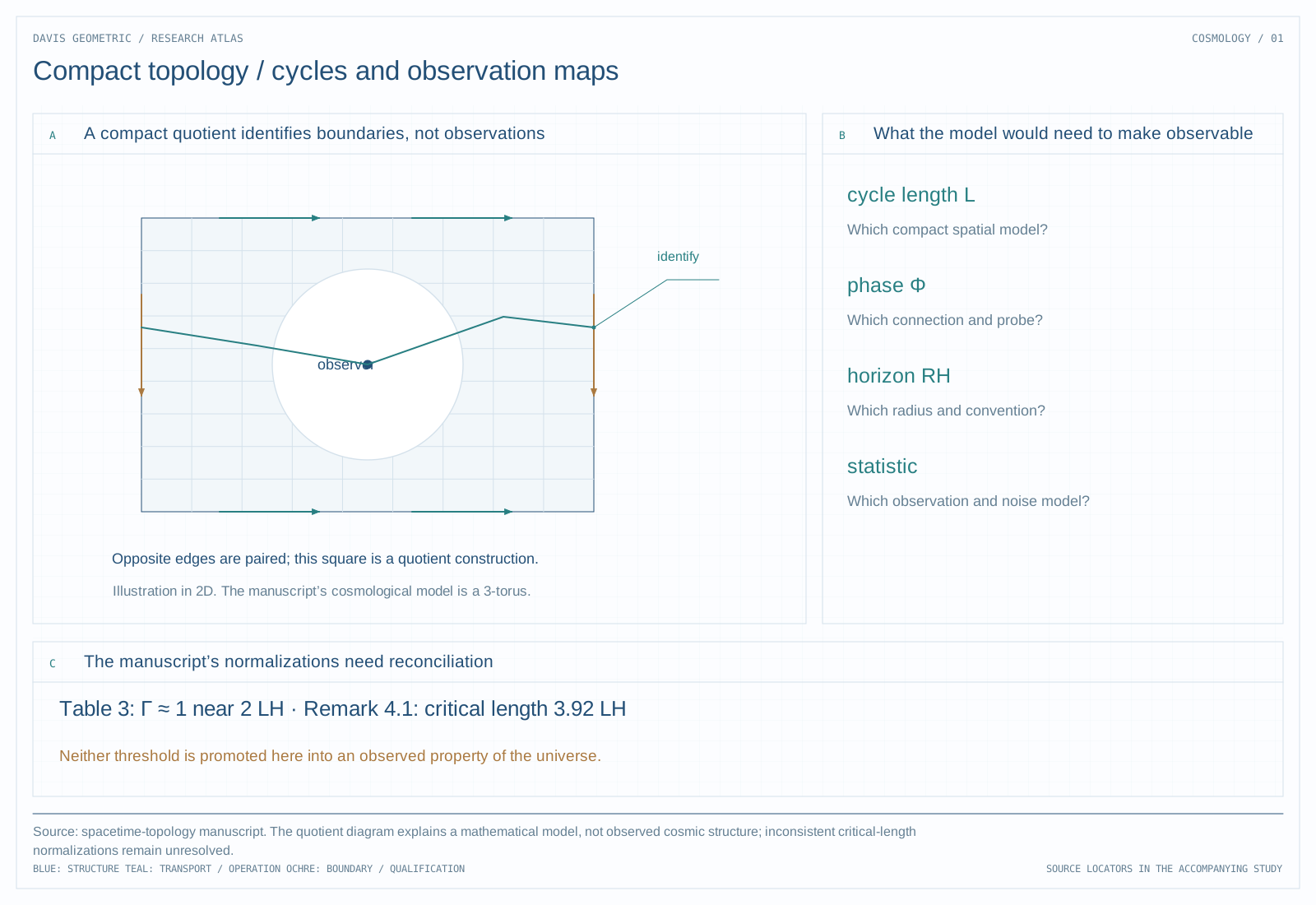
The observability model’s mathematical inputs
Scroll horizontally to inspect the full table →
| Symbol | Role in the manuscript | What must be specified |
|---|---|---|
| L | Length of a topological cycle | Chosen compact spatial model and length convention |
| Φ | Phase assigned to transport around a cycle | The connection and observable carrying that phase |
| τ | Horizon-dependent tolerance budget | Which horizon radius and normalization are used |
| K | Model-defined cost of the cycle | Its relation to the chosen phase |
| C = τ/K; Γ = C/π | Capacity and regime parameter | An observation model connecting the ratio to a statistic |
This is the proposed mathematical model, not an observed cosmic topology. The manuscript’s Table 3 places Γ near one at L ≈ 2 LH, while Remark 4.1 computes a critical length of 3.92 LH. Those normalizations need reconciliation before reproducing its observational threshold plots.
The research in context
Einstein’s field equations fix the local curvature of space but not its global shape, or topology. A flat universe could extend without limit, or it could close on itself like a three-dimensional torus, so that light leaving in one direction eventually returns from the other. Cosmologists have looked for such wrap-around in the cosmic microwave background (CMB), the oldest light in the sky, searching for pairs of circles with matching temperature patterns; the manuscript notes those searches have found nothing. The difficulty is that a flat, finite space looks locally identical to an infinite one, so any trace of its topology lives only in measurements that span the whole space.
The manuscript, Why the Universe Looks Random (And Isn’t), recasts the question in gauge-theoretic terms. On a flat compact space the connection that governs parallel transport has zero curvature everywhere, so local probes register no structure; a nontrivial topology shows up only as monodromy, a phase accumulated by travelling once around a non-contractible loop, analogous to the Aharonov–Bohm effect. The work defines a ratio Γ = C/π for each such loop and sorts cycles into determined (Γ > 1), critical (Γ = 1) and underdetermined (Γ < 1) regimes. It derives a phase-dependent “topological horizon” length and states a split of the CMB two-point function into a matched-circle part and a large-angle suppression part.
The manuscript also derives specific values under stated assumptions: within the standard ΛCDM expansion history Γ increases monotonically with time, and for a cubic three-torus at maximal holonomy the computed transition falls near a side length of 2.0 Hubble lengths. It proposes two searches: matched-circle searches that scan every phase offset rather than only zero, and a search for anti-correlated circle pairs at offset π, which the deposit says no published search has tested. These are derivations and proposals, not observations; whether they survive CMB noise, masking and foregrounds is the open step.
The object of the proposal
The catalog describes a capacity relation, C = τ/K, used to ask whether topological structure remains detectable under a stated tolerance and geometric cost. To turn that into a physical claim, the manuscript must say what is observed, what observation noise is admitted, and which topologies the measurement is intended to distinguish.
Loss of distinguishability can arise because an observation map discards information. It does not follow that the underlying system is deterministic, that all apparent randomness has the same origin, or that the universe has the proposed topology.
The evidence this record actually provides
The deposited paper preserves the theoretical direction and its original title. The material reviewed for this website does not supply a cosmological likelihood analysis, a survey selection model, or a comparison with competing topologies. It would be misleading to write a results section as if those observations had been performed.
The teaching illustration concerns distinguishability under a representation. Its role is to introduce the question, not to stand in for a sky measurement.
The next research step
A testable continuation would specify two competing geometric models and an observation map, then determine which statistic separates them under declared noise and coverage. Only after that bridge exists can a capacity calculation become an observational claim.
Background mathematics and definitions
Specify competing latent models and the map from each to observable data. Include a survey window, selection mechanism, nuisance parameters, and measurement noise. An observability diagnostic must be evaluated after these transformations, rather than solely on the latent construction.
- Latent topology
- The global structure proposed by the model.
- Observation operator
- The stated process producing measurable quantities.
- Identifiability
- Whether distinct candidate models imply distinguishable observable distributions.
Illustrative example
Two different signals outside a survey’s field of view can give exactly the same recorded data inside it. The observation operator has discarded their difference. No downstream statistic can recover that particular distinction without additional information or assumptions.
This background example is separate from the source records and the main technical figure.
Source record
No new experiments are reported in this research note. Figure captions distinguish saved research records, source-model calculations, and explanatory diagrams.