ICARUS: follow the sampling decision through the ascent
Research settingMach IndustriesCollaboration with Dr. Ryan Rapetti
ICARUS investigates geometric state representation and navigation advisories. Its saved ascent example makes one mechanism unusually clear: a small estimated error relative to a reachable envelope can coexist with an inadequate sampling rate.
From the research record
Inspect the work
Original figures, recorded values, and explicit model details. Each exhibit identifies its source and what the comparison means.
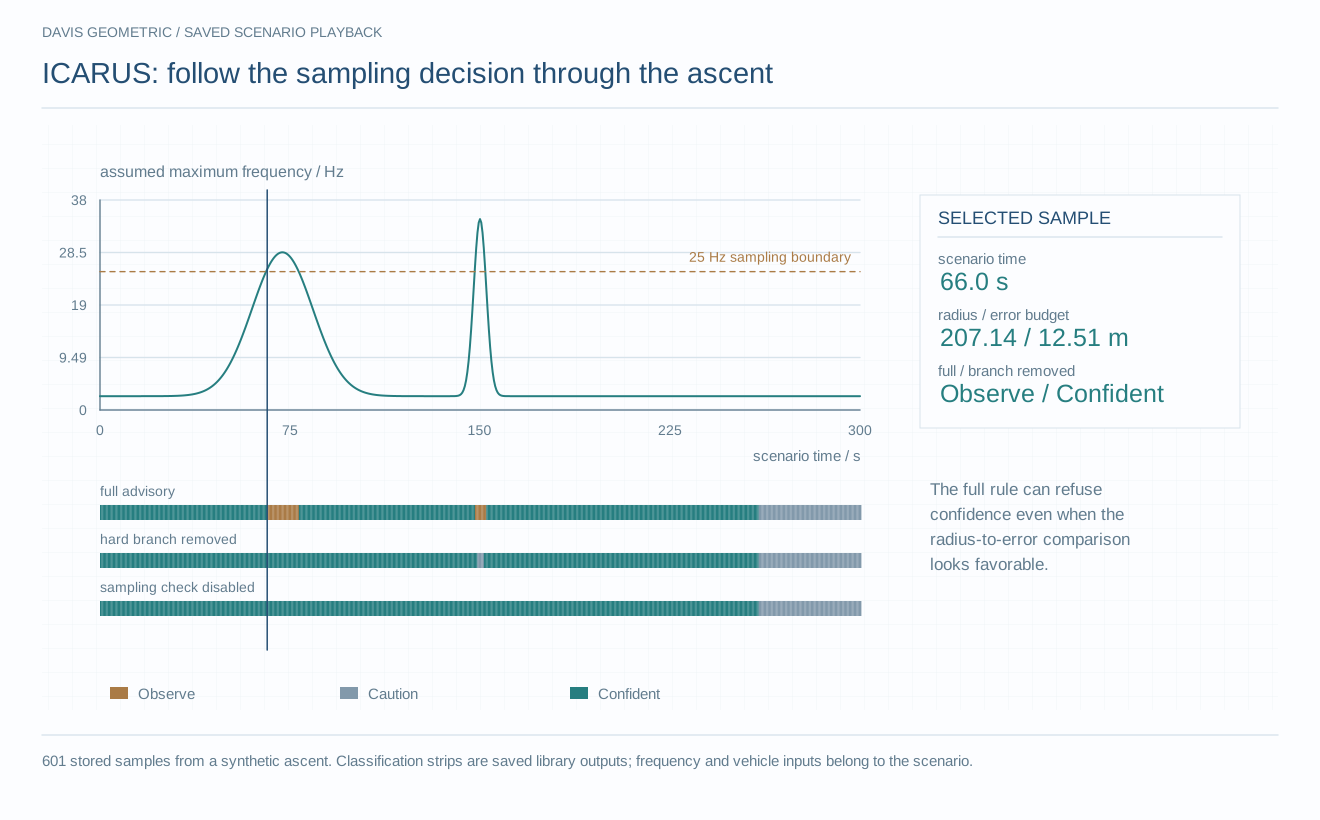
One instant, three advisory decisions
Scroll horizontally to inspect the full table →
| Quantity / configuration | Value at T + 66 s | Interpretation |
|---|---|---|
| Envelope radius | 207.142 m | Four-second model envelope |
| Error budget | 12.5109 m | About 6.04% of the radius |
| Highest represented frequency | 25.445 Hz | Above the 25 Hz Nyquist limit of 50 Hz navigation |
| Full advisory | Observe | Sampling guard remains active |
| Blind-envelope ablation | Confident | Saved levelBlind = 2 |
| Guard ablation | Confident | Saved levelAblate = 2 |
Read from sample 132 of the 601-point trace (zero-based indexing). A small budget/envelope ratio alone misses the sampling problem. The scenario is synthetic; these are not flight-test measurements.
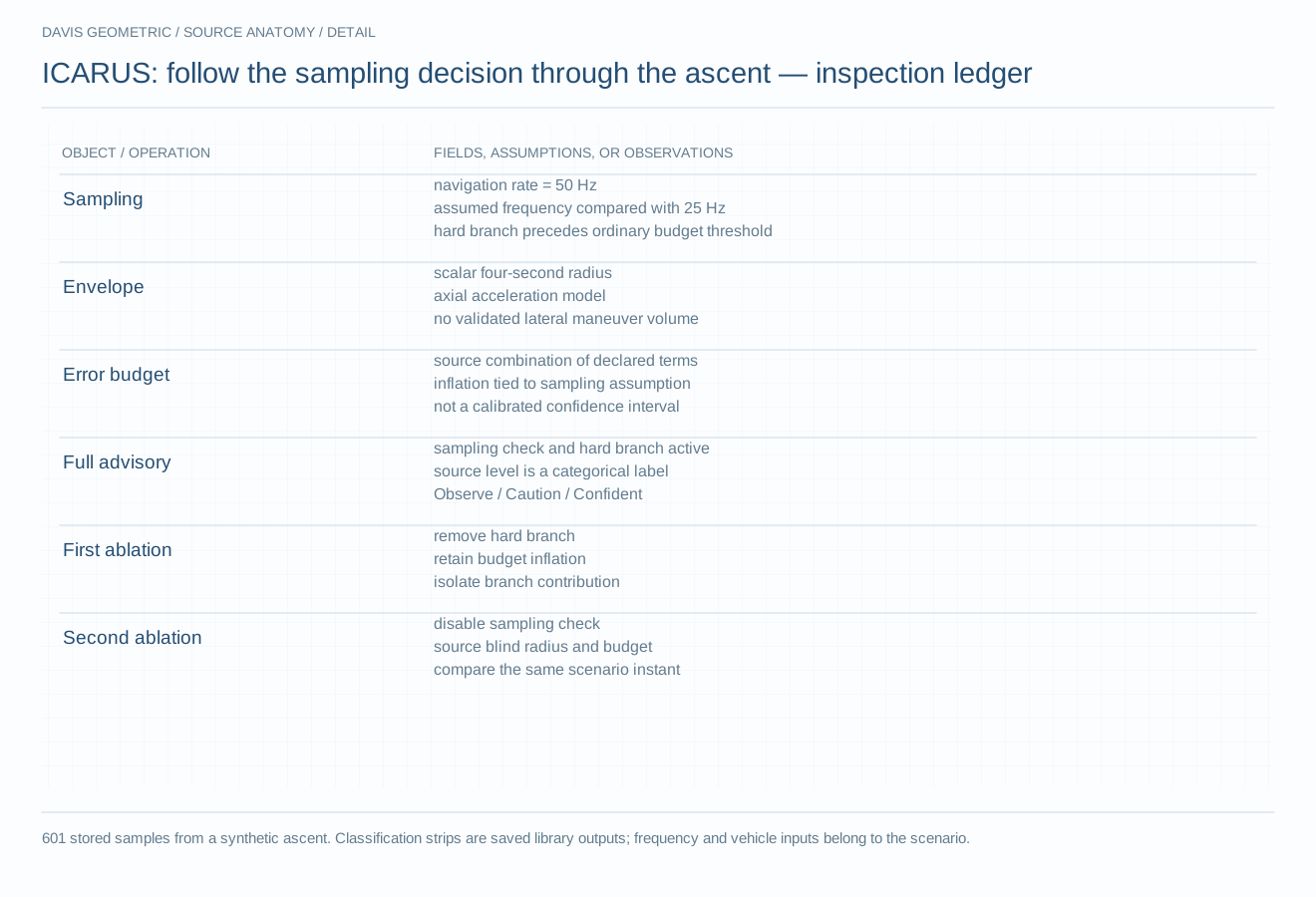
Read the technical figure
601 stored samples from a synthetic ascent. Classification strips are saved library outputs; frequency and vehicle inputs belong to the scenario.
- Sampling
-
navigation rate = 50 Hz
assumed frequency compared with 25 Hz
hard branch precedes ordinary budget threshold
- Envelope
-
scalar four-second radius
axial acceleration model
no validated lateral maneuver volume
- Error budget
-
source combination of declared terms
inflation tied to sampling assumption
not a calibrated confidence interval
- Full advisory
-
sampling check and hard branch active
source level is a categorical label
Observe / Caution / Confident
- First ablation
-
remove hard branch
retain budget inflation
isolate branch contribution
- Second ablation
-
disable sampling check
source blind radius and budget
compare the same scenario instant
Supporting detail
What happens at T + 66 seconds
The companion contains 601 samples over a synthetic 300-second ascent. At 66 seconds, its four-second envelope radius is 207.142 metres and its error budget is 12.5109 metres, about 6.04% of that radius. On that ratio alone the situation looks favorable.
The assumed dynamics at that instant have a maximum frequency of 25.445 Hz, while the navigation stream samples at 50 Hz. The implemented sampling rule fails because the assumed frequency exceeds the 25 Hz half-sampling-rate boundary. The full advisory returns Observe immediately.
An ablation explains the verdict
Removing the hard sampling branch while retaining its budget inflation changes the stored classification to Confident. Disabling the sampling check also returns Confident. These comparisons isolate why the complete implementation refuses the more favorable label.
Observe and Confident are names chosen by the algorithm, not calibrated probabilities or flight-readiness certifications. The companion identifies the radii, budgets, and classifications as library outputs; vehicle evolution, frequency inputs, and the residual-monitor behavior are scenario ingredients.
The drawing and its physical limits
The detailed illustration revolves the scalar radius model to explain the envelope. It does not establish lateral maneuvering authority: the source model uses axial thrust acceleration. The stored 8.5-second gap between the first advisory and one chosen residual-monitor crossing is also a scenario comparison, not a general advance-warning guarantee.
Sources, scope, and next question
Computational demonstrator developed in collaboration with Mach Industries and Dr. Ryan Rapetti; saved synthetic scenario and controlled ablations.
The next engineering comparison needs justified disturbance and control-authority models, followed by false-alert, missed-event, and delay measurements under sensor loss and timing errors. The existing ablation already provides a precise mechanism to test.