AMC / encoding transitions with replayable lineage
Research settingNASAAMC · NASA origins; BRIDGE · Independent
Two related manuscripts address different operational problems: adapting a telemetry encoding to incoming data, and retaining enough context to replay an AI-assisted procedure. Their common concern is the meaning that can be lost between representations.
From the research record
Inspect the work
Original figures, recorded values, and explicit model details. Each exhibit identifies its source and what the comparison means.
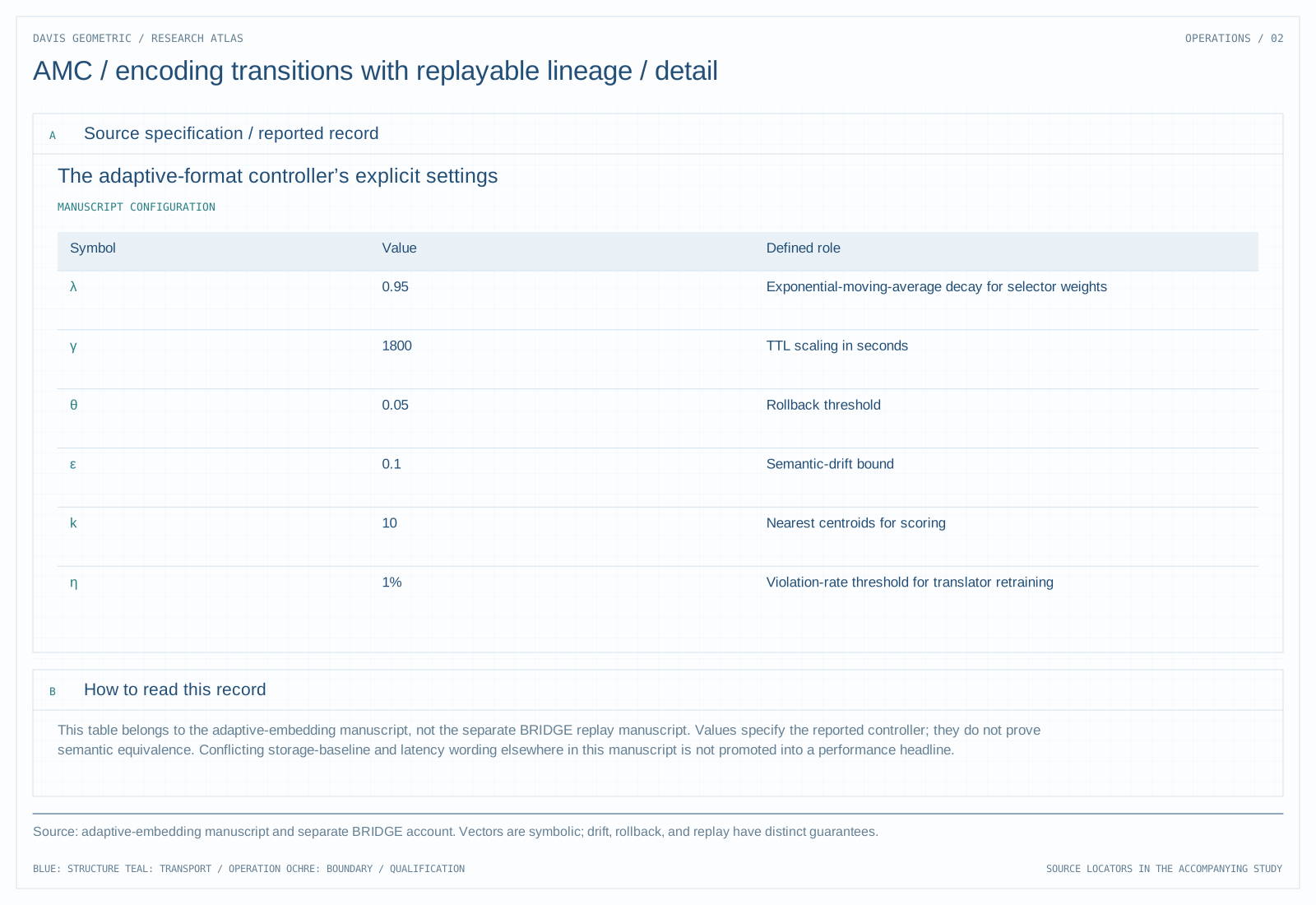
The adaptive-format controller’s explicit settings
Scroll horizontally to inspect the full table →
| Symbol | Value | Defined role |
|---|---|---|
| λ | 0.95 | Exponential-moving-average decay for selector weights |
| γ | 1800 | TTL scaling in seconds |
| θ | 0.05 | Rollback threshold |
| ε | 0.1 | Semantic-drift bound |
| k | 10 | Nearest centroids for scoring |
| η | 1% | Violation-rate threshold for translator retraining |
This table belongs to the adaptive-embedding manuscript, not the separate BRIDGE replay manuscript. Values specify the reported controller; they do not prove semantic equivalence. Conflicting storage-baseline and latency wording elsewhere in this manuscript is not promoted into a performance headline.
Adaptive_Embedding_Format_Switching_and_Semantic_Translation_in_High_Volume_Telemetry_Systems-10.pdf · Table I and §IV.B–E, PDF pages 5–6; file suffix -10
Read the technical figure
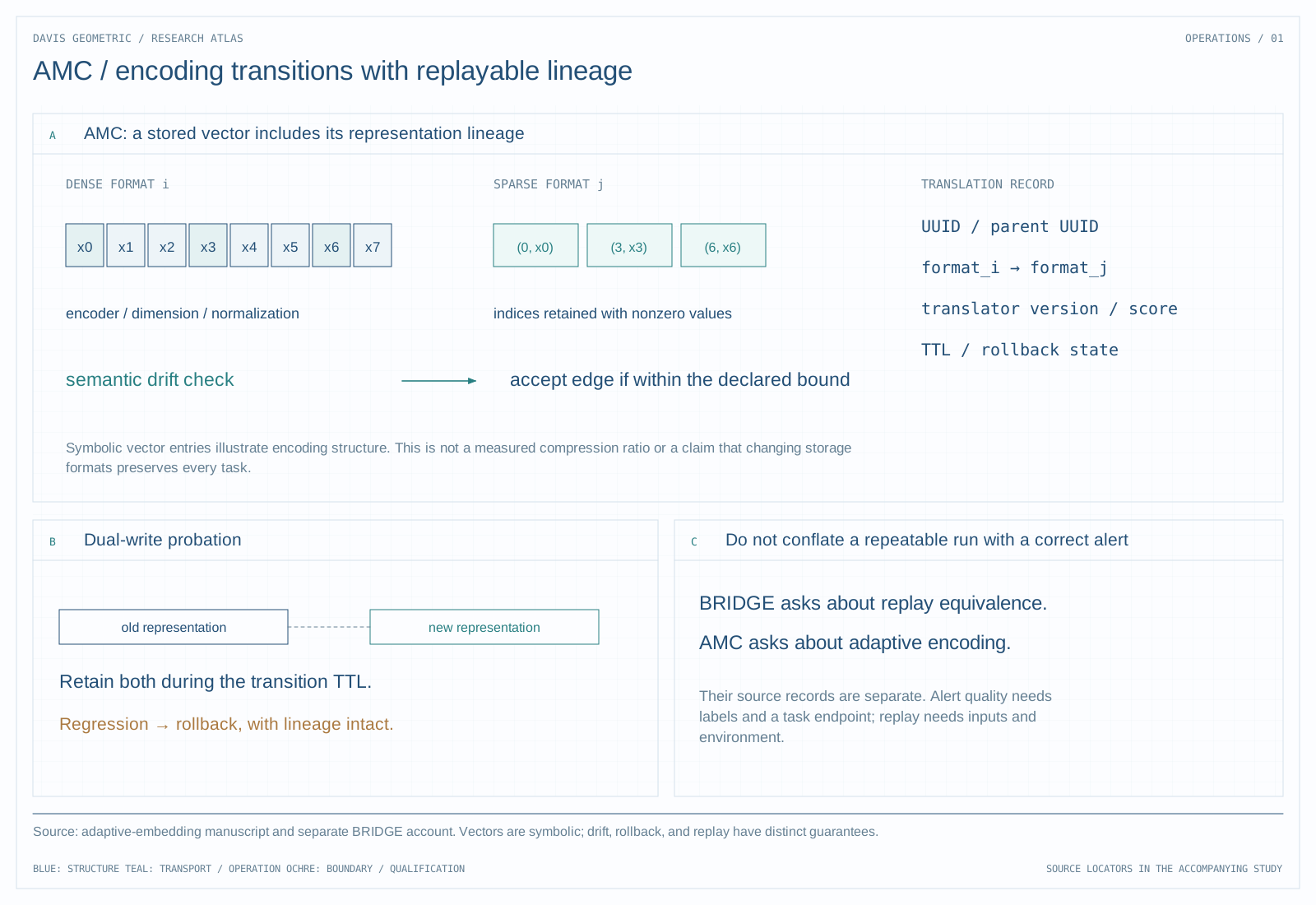
Source: adaptive-embedding manuscript and separate BRIDGE account. Vectors are symbolic; drift, rollback, and replay have distinct guarantees.
Source: adaptive-embedding manuscript and separate BRIDGE account. Vectors are symbolic; drift, rollback, and replay have distinct guarantees.
Supporting detail
Adaptive encoding grew out of telemetry work
At NASA, Davis describes preparing roughly two terabytes of daily telemetry for AI. The need to vectorize that data led to Adaptive Multi-Vector Correlation (AMC): adaptive formats with explicit translations between representations. Working with those vectors brought the data’s topology into view for her and motivated the subsequent mathematics. The published AMC evaluation uses public MODIS data, distinct from the original operational stream.
This creates a particular technical problem: a changed vector can reflect changed telemetry, changed dimensionality, changed normalization, or a changed encoder. The adaptive-format manuscript concerns the semantic translation between those encodings. Comparing vectors without retaining that translation would confuse an encoding change with a physical event.
BRIDGE asks what a later replay can recover
The BRIDGE deposit is titled Deterministic Replay for Hybrid AI-Assisted Operational Procedures via VFS Harmonization. Its subject is the reproducibility of a procedure that crosses computational interfaces, including AI-assisted steps. A replay record needs to identify the inputs and representation context behind each decision.
Replay and alert quality are different achievements. A procedure may be perfectly repeatable and still classify an event incorrectly. Conversely, an informative anomaly detector may depend on an external model or service whose response cannot be recreated exactly. The two papers should therefore retain separate guarantees.
Sources, scope, and next question
Two deposited manuscripts; the encoding and replay guarantees require their own assumptions.
A concrete next case study would replay a recorded encoding transition, showing the raw measurements, both formats, the translation, and the resulting alert decision. For BRIDGE, the corresponding artifact is a replay whose equivalence criterion is explicitly stated.
- AMC: foundational paper and NASA origins.
- AMC-Edge Rev D: precision adaptation.
- USAspending / IDAS: investigative data provenance.
- Adaptive Embedding Format Switching and Semantic Translation in High-Volume Telemetry Systems.
- BRIDGE: Deterministic Replay for Hybrid AI-Assisted Operational Procedures via VFS Harmonization.