PHAETHON: the complete benchmark topology and spectrum
Research settingIndependent
PHAETHON studies how an electrical grid keeps its generators in step, how disturbances erode that synchronism, and how to represent the transition when a machine slips a full electrical cycle. It brings oscillation modes, generator-angle history, energy barriers and local stress into a geometric description intended to make grid stability easier to inspect.
From the research record
Inspect the work
Original figures, recorded values, and explicit model details. Each exhibit identifies its source and what the comparison means.
All nine inter-machine modes
Scroll horizontally to inspect the full table →
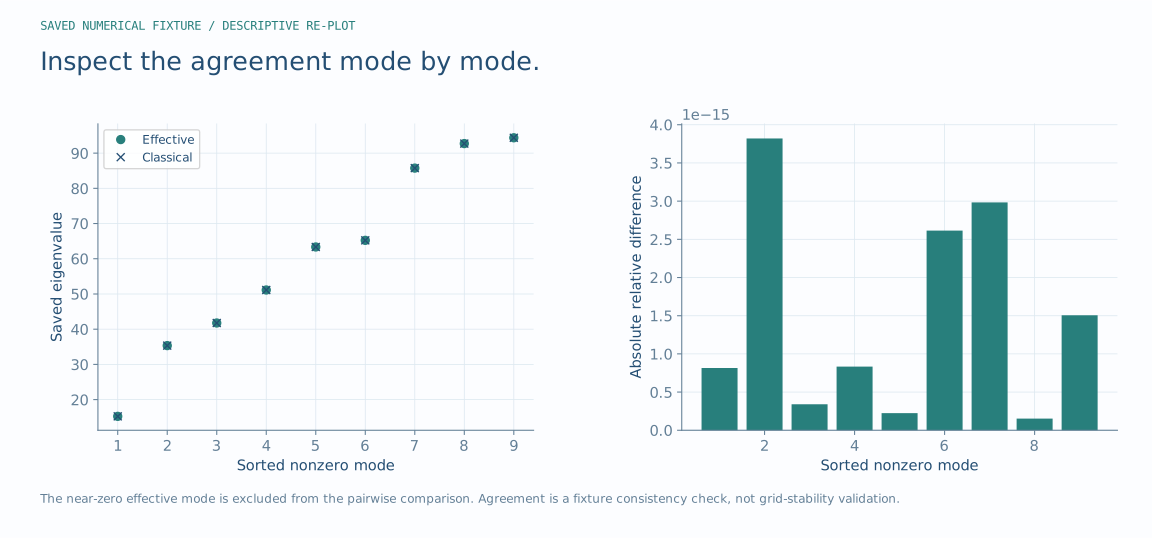
| Mode | Effective operator eigenvalue | Classical undamped ω² | Relative difference |
|---|---|---|---|
| 1 | 15.242756558688 | 15.242756558688 | 8.158e-16 |
| 2 | 35.334664630263 | 35.334664630263 | 3.821e-15 |
| 3 | 41.756163125938 | 41.756163125938 | 3.403e-16 |
| 4 | 51.128735571200 | 51.128735571200 | 8.338e-16 |
| 5 | 63.348513125872 | 63.348513125872 | 2.243e-16 |
| 6 | 65.229304216625 | 65.229304216626 | 2.614e-15 |
| 7 | 85.745491583703 | 85.745491583703 | 2.983e-15 |
| 8 | 92.714172402740 | 92.714172402740 | 1.533e-16 |
| 9 | 94.360580494108 | 94.360580494108 | 1.506e-15 |
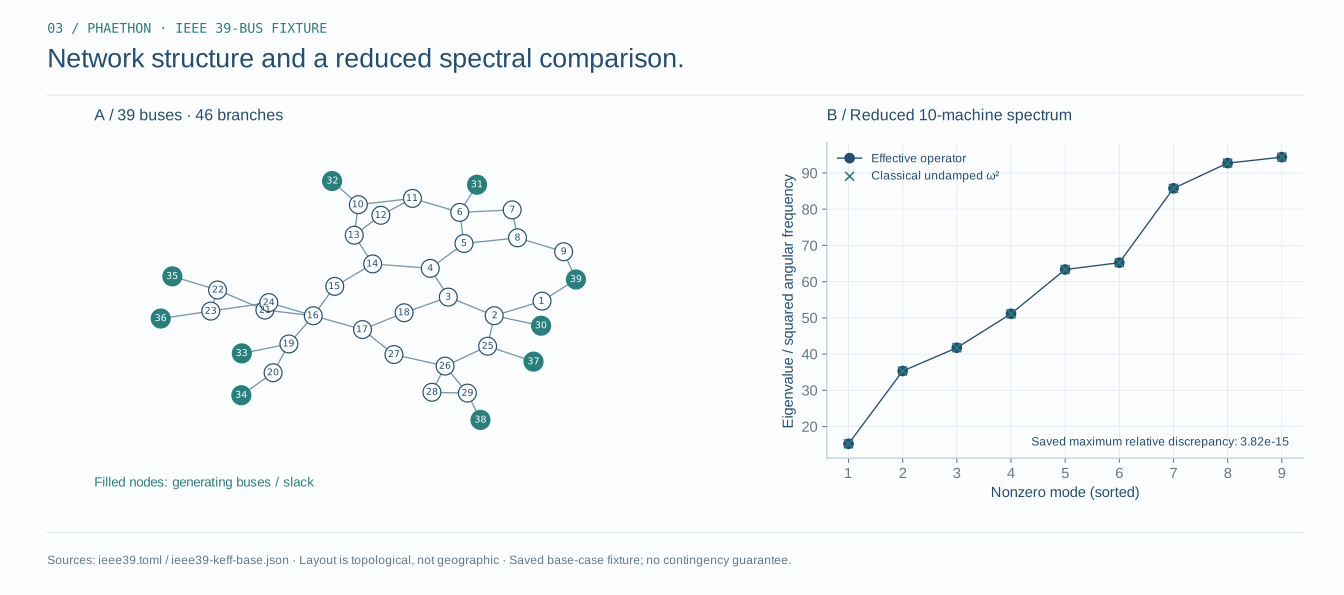
IEEE 39-bus base case; the near-zero common-angle mode is excluded. The maximum relative difference is 3.821 × 10⁻¹⁵. The operators are algebraically equivalent: agreement checks implementation, not forecasting advantage.
Read the technical figure
The saved IEEE 39-bus topology and spectral fixture; agreement is an algebraic consistency check.
The saved IEEE 39-bus topology and spectral fixture; agreement is an algebraic consistency check.
Supporting detail
What PHAETHON is trying to make visible
A grid is a coupled dynamical system: machines exchange power through transmission lines, and a disturbance changes how their electrical angles move relative to one another. PHAETHON asks three connected questions: which groups of machines oscillate together, which changes to the network weaken their coupling, and what separates a recoverable swing from a full loss of step.
The intended use is an inspectable stability analysis. Given a network and an operating point, the project relates system-wide modes to individual generators, line outages and local stress contributions. The wider program is motivated by grids with changing generation mixes and large infrastructure-dependent loads. Its completed static calculation concerns synchronous machines; an inverter-control model is a separate workstream.
From a network model to an oscillation spectrum
The calculation starts with network connections, line impedances, machine inertias and an operating point obtained from power flow. Kron reduction replaces the intermediate network with an effective network between the generators. The Hessian describes how the swing-energy function bends near equilibrium; weighting it by machine inertia accounts for how differently sized machines respond to the same disturbance.
The resulting generalized eigenproblem is Kred v = ω² M̃v. Each eigenvector describes a pattern of relative generator motion, and its eigenvalue gives a squared angular frequency in the conservative model. This is the same operator used by the conservative part of classical small-signal analysis, expressed in the project’s geometric coordinates.
On the IEEE 39-bus benchmark, the manuscript reports recovery of all nine inter-machine modes with a maximum relative error of 3.8 × 10⁻¹⁵. Across 33 single-line outages, it reports identical rankings to the classical comparator. These checks show that the implementation recovers the established calculation; they do not measure an improvement over it.
Why keeping the angle’s history matters
Angles separated by 360° occupy the same position on a circle, but a generator that has gained a full electrical cycle relative to the others has undergone a physical event. Reducing every angle modulo 2π can erase that history. PHAETHON retains an unwrapped description and an integer winding vector, so that the continuous state and the number of completed turns travel together.
A pole slip is then a transition between winding sectors. The manuscript studies the energy barrier between them: the lowest peak energy a path must cross to leave the current sector. Its barrier statement requires a nondegenerate controlling unstable equilibrium to exist in the relevant direction. In the two-machine reduction, it connects to the classical equal-area criterion.
The practical question is how much disturbance the modeled operating point can absorb before crossing that barrier. This is different from asking only whether small oscillations around the point are stable. It is also a research question about the model, not a demonstrated warning time for a real grid event.
What the analysis produces—and what can be reproduced
The project examines mode spectra, single-line-outage rankings, generator-specific energy barriers and per-bus stress contributions from voltage, inertia, reactive power and line loading. A dynamic extension adds a term calibrated on synthetic cascades. The interpretation of a stress threshold remains an operator-policy choice; it is not a universal boundary established by these tests.
The public reproduction kit includes IEEE 9- and 39-bus case data, saved power-flow and eigenvalue results, contingency and per-generator tables, and a standalone NumPy/SciPy verifier. It lets a reader inspect the static identity, outage ordering, stress-score direction and energy-barrier ranking. The project also describes a Rust API and React interface; that full application is not included in the compact public kit.
The manuscript reserves full historical-event evaluation and an inverter-mode operator for later work. The South Australia 2016 and Northeast 2003 events have quantitative falsifiers; the West Texas 2023 case records the expected absence of the required inverter mechanism from the present model. They are proposed tests of scope and prediction, not three successful event reconstructions.
Sources, scope, and next question
Independent research: a manuscript and public reproduction kit for synchronous-machine models, with synthetic dynamic checks and further event-data and inverter studies proposed.
Evaluate the stated historical-event tests against event records, with false alarms and missed transitions reported alongside detections. Derive and test the inverter-control operator separately, so that a successful synchronous-machine calculation is not presented as coverage of inverter-driven instability.
- PHAETHON project and research program.
- Static spectrum and topology.
- PHAETHON deposit and artifact.
- PHAETHON — A Curvature-of-Section Formulation of Multi-Machine Stability.
Additional source versions reviewed
-
phaethon/papers/paper1_static_K_limit_recovery/phaethon_paper.texLocal project manuscript or report · not republished here