Economic & social systems / PSYCHOHISTORY · The Geometry of War
The Geometry of War / PSYCHOHISTORY: integration, alignment and network structure
PSYCHOHISTORY models bilateral relationships using economic integration and diplomatic alignment. The later manuscript adds a separate treatment for weakly connected dyads where the original ratio becomes unstable.
Research settingCrowdStrikeCollaboration with Dr. Paolo Di Prodi on the Psychohistory analysis tool
TL;DR
In brief
The question
Can combining economic integration with diplomatic alignment for each pair of states flag structural stress before armed conflict, and how should such flags be tested?
What the work does
A monthly panel of 156 directed state pairs among 42 states, 1990–2022, with integration and tolerance indices, a five-level alert scheme and a separate mode for weakly linked pairs.
What is still open
Alerts have not been issued prospectively or replayed with release-dated inputs; scoring across all dyad-months, including quiet ones and base-rate comparisons, is not yet reported.
Available recordHistorical-modeling manuscript with reported retrospective evaluations; causal inevitability and prospective warning are not established.
From the research record
Inspect the work
Original figures, recorded values, and explicit model details. Each exhibit identifies its source and what the comparison means.
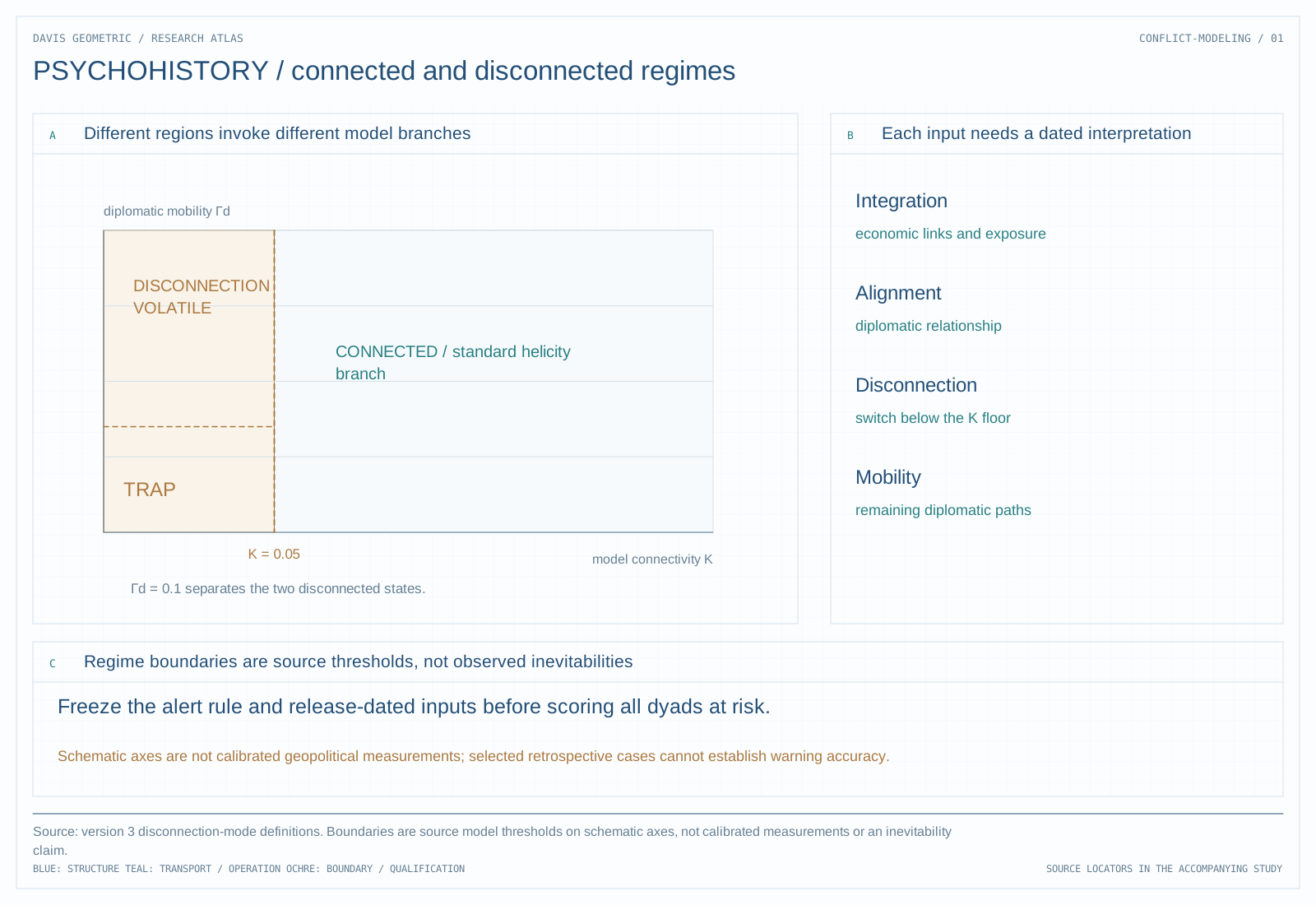
The branch added for weakly connected dyads
Scroll horizontally to inspect the full table →
| Source state label | Condition | Which model branch is used |
|---|---|---|
| CONNECTED | K ≥ 0.05 | Standard helicity |
| DISCONNECTION_TRAP | K < 0.05 and Γd < 0.1 | Disconnection metrics; low diplomatic mobility |
| DISCONNECTION_VOLATILE | K < 0.05 and Γd ≥ 0.1 | Disconnection metrics; diplomatic paths remain |
K and Γd are model-defined quantities, not direct measures of inevitability. These are source thresholds, not newly calibrated cutoffs. A prospective warning claim needs release-dated data and false-alert accounting.
psychohistory_paper_v3.tex · Version 3.0: K-floor gate and disconnection-mode classification table
The research in context
Quantitative conflict research tries to identify pairs of states (dyads) at elevated risk of militarized disputes. Scholars disagree about the role of trade: the commercial-peace tradition holds that economic ties make war costly and therefore rarer, while the idea of weaponized interdependence holds that dependencies can become instruments of coercion. Disputes are rare relative to the number of dyad-months observed, so a model can look accurate after the fact by describing what is already known. Useful warning requires a stated horizon, a defined event, and only the information that was available on each date.
The version 3 manuscript builds a monthly panel of 156 directed dyads among 42 states, the G20 members plus 22 states it classes as higher risk, from January 1990 to December 2022, 61,776 dyad-months in all, with a separate archival reconstruction of the US–Japan dyad from 1930 to 1945. Inputs include UN Comtrade trade, IEA and BP energy dependency, UN General Assembly voting similarity, ATOP treaty data and a sanctions database. An integration index (K) combines trade, investment, energy and supply-chain links; a tolerance index (τ) combines alliances, shared institutions, diplomatic history and communication channels. Divergence is flagged when τ falls while K holds steady or rises.
Outcomes are disputes with at least 25 fatalities, of which the manuscript counts 47 in the panel. It scores a Level 4 alert as correct if it falls within 180 days before onset and reports 35 such cases, 12 conflicts without a prior alert and 14 alerts not followed by conflict, while explicitly leaving correctly quiet months out of the count. These are retrospective reconstructions from data compiled after the events. Case studies cover Russia–Ukraine, US–Japan before 1941, US–Iran under the disconnection mode, and a China–Taiwan watch.
The hypothesis behind the representation
The manuscript proposes that persistent economic links combined with deteriorating alignment can indicate structural stress. This translates “weaponized interdependence” into measurable features of a dyad rather than treating all international relationships as a single scalar similarity.
The strong historical wording that conflict becomes inevitable goes beyond this representation. Similar feature patterns can precede different political decisions; an observed association does not establish an unavoidable causal outcome.
Why version 3 adds a disconnection mode
The local version 3 manuscript recognizes that its standard helicity expression breaks down as the stated curvature quantity approaches zero. It introduces a floor and switches to security-posture, hostility, and a disconnection-mode spectral diagnostic.
That branch is part of the model specification and needs its own evaluation. It also shows why “one ratio across all dyads” would misrepresent the actual work. The manuscript’s historical lead times require release-dated inputs and frozen alert rules before they can be interpreted as available warning.
The next research step
A representative validation should reconstruct what was knowable at each date and score all dyads at risk, including non-events. Selected conflicts and retrospective case narratives cannot by themselves establish alert calibration.
Background mathematics and definitions
Define the entity or dyad, event label, prediction horizon, and availability date of every feature. Treat the geometric representation as a candidate predictor. Separate forecasting from explanation and from any claim that a conflict was inevitable.
- Dyad
- The declared pair of entities used as an evaluation unit.
- Prediction horizon
- The future interval to which the event label refers.
- Base rate
- Event frequency in the full eligible evaluation population.
Illustrative example
If a rare event occurs in one of one hundred illustrative periods, a method that always predicts no event is 99% accurate but gives no warning. This arithmetic example shows why overall accuracy alone is unsuitable for assessing rare-event alerts.
This background example is separate from the source records and the main technical figure.
Source record
- The Geometry of War: study & book.
- Psychohistory v3 paper.
- Predicting Interstate Conflict 72 Days in Advance: A Topological Approach to Weaponized Interdependence.
Additional source versions reviewed
-
helicity/theory/psychohistory_paper_v3.texLocal project manuscript or report · not republished here
No new experiments are reported in this research note. Figure captions distinguish saved research records, source-model calculations, and explanatory diagrams.