Life sciences / MIRADOR / molecular geometry
MIRADOR: keep the molecule, target, and response context connected
MIRADOR’s therapeutic-geometry specification decomposes drug–organism response into a pipeline of linked representations. The research ambition is to retain context as a candidate moves from molecular structure to binding, disposition, and response.
Research settingIndependent
TL;DR
In brief
The question
Can a drug candidate’s path from molecular shape through target binding, body disposition and dosing be held in one connected geometric pipeline that improves a defined prediction?
What the work does
A v0.2 specification for a ten-layer Rust pipeline, each layer assigned a geometric object, invariants and planned tests, with planned adapters for PDB, AlphaFold, ChEMBL, ZINC and PharmGKB data.
What is still open
No completed target–candidate study with held-out chemistry, a named assay endpoint and a baseline comparison is reported; the specification’s known-answer tests are the first step.
Available recordTherapeutic-design specification and project material; proposed layers are not evidence of clinical efficacy.
From the research record
Inspect the work
Original figures, recorded values, and explicit model details. Each exhibit identifies its source and what the comparison means.
The ten specified therapeutic layers
Scroll horizontally to inspect the full table →
| Layer | Input / task | Proposed mathematical object |
|---|---|---|
| 0 | Patient genome / phenome | Patient manifold (P, gP) |
| 1 | Disease target | Target manifold (T, h) |
| 2 | Molecular configuration | Candidate manifold (M, gM) |
| 3 | Binding interaction | Fiber bundle π: E → T |
| 4 | Pharmacophore extraction | Topological invariant τ |
| 5 | ADMET | Total curvature K |
| 6 | Optimization | C* = max(τ/K) |
| 7 | Resistance | Holonomy group Hol(∇) |
| 8 | Combination therapy | Tensor product E₁ ⊗ E₂ |
| 9 | Dosing schedule | Parallel transport along c(t) |
These are the manuscript’s proposed objects. The table does not assert that each object has a calibrated biological meaning or an empirically validated implementation. In particular, binding, exposure, toxicity and clinical response remain distinct endpoints.
MIRADOR_SPEC.md · Version 0.2, Architecture Overview: layers 0–9
The research in context
Getting from a disease target to a usable medicine involves several distinct problems. A molecule must bind the intended protein, which is often flexible and adopts several shapes. It must be absorbed, reach the right tissue, survive metabolism and be cleared without toxicity — together called ADMET. The target may mutate to escape it, and the dose must keep concentrations in a useful window for a particular patient, whose liver enzymes and kidney function vary. Computational tools usually address these stages separately, so a candidate that looks strong at one stage can fail at the next for reasons the earlier model never represented.
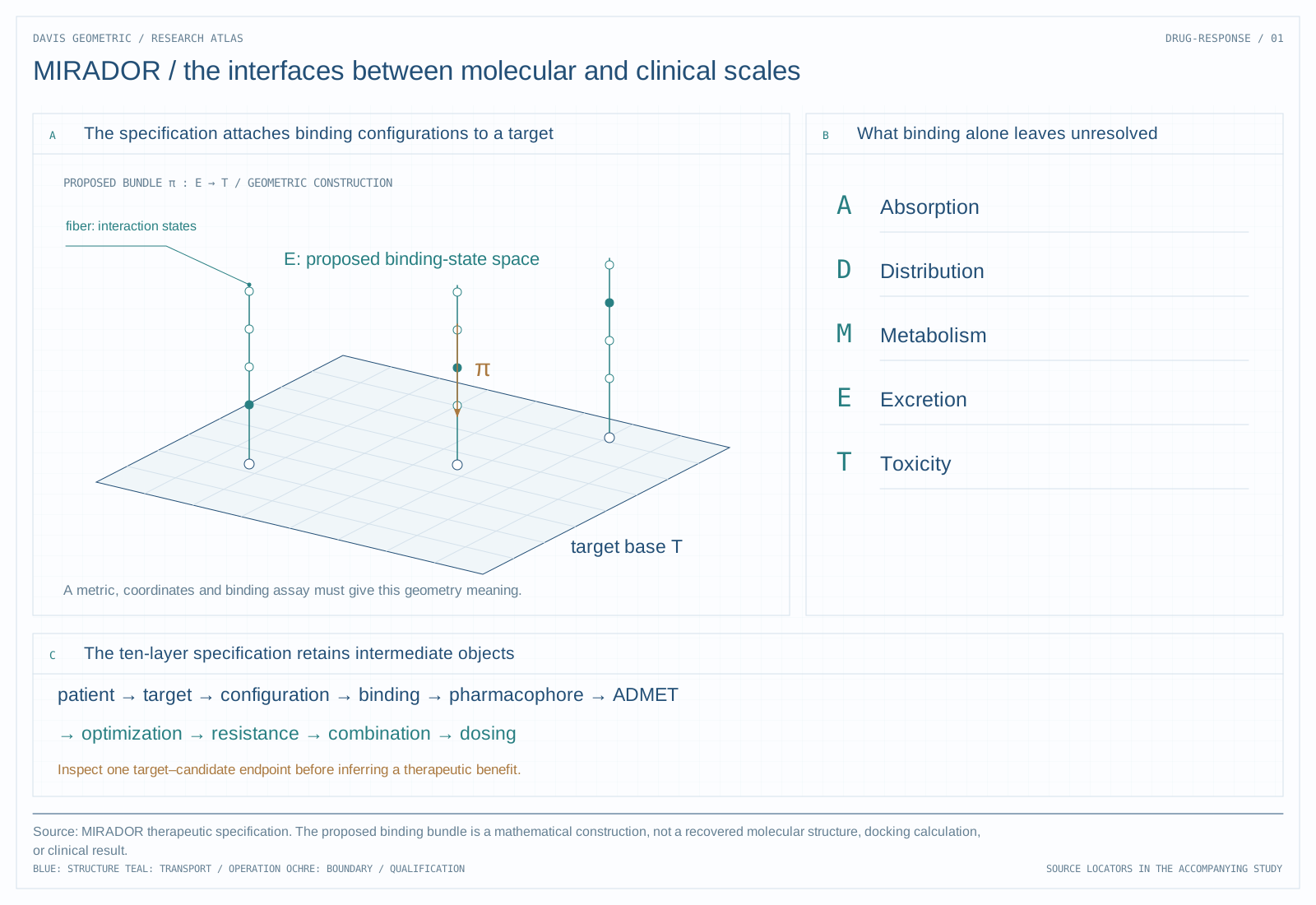
MIRADOR’s specification (v0.2, March 2026) lays out ten layers: a patient-state space with pharmacogenomic coordinates such as CYP2D6 and CYP2C19 metabolizer status, organ function and age; a space of target conformations; a molecular candidate space; and a fiber bundle linking molecules to the target conformations they can engage. Later layers extract the pharmacophore as a topological feature via persistent homology, express absorption, distribution, metabolism, excretion and toxicity as separate curvature terms, model resistance as holonomy, combine therapies as tensor products and treat dosing as transport along a concentration curve. The core is planned in Rust, with Python adapters for PDB, AlphaFold, ChEMBL, ZINC and PharmGKB data and RDKit for chemistry primitives.
The specification frames its integration tests as known-answer checks against established pharmacology. One asks whether, given type 2 diabetes with the DPP-4 enzyme as target, the pipeline produces a candidate near sitagliptin with the expected pharmacophore and dosing range. Another supplies two hypertension patients who differ in CYP2D6 status, kidney function and age, and asks whether the pipeline recommends different therapies, as clinical practice would. These are designed as tests of the pipeline; the reviewed specification does not report their outcomes.
The pipeline makes its intermediate objects explicit
The reviewed specification separates patient state, disease target, molecular configuration, binding interaction, pharmacophore structure, ADMET, optimization, resistance, combination therapy, and dosing. Each stage is assigned a mathematical object and a proposed set of checks.
This decomposition matters because a favorable binding geometry does not settle exposure or toxicity. A molecular candidate can look promising at one stage and fail at another. Retaining the intermediate states makes it possible to locate which assumption led to the recommendation.
Two MIRADOR lines should not be collapsed
The therapeutic pipeline and the earlier mirror-manifold immune-design paper share a name and geometric motivation, but they do not report the same experiment. The immune paper develops conditional panel-coverage arguments. The broader therapeutic specification proposes an architecture spanning multiple biological processes.
The historical binding-affinity headline lacks an inspectable linked benchmark in the reviewed site record. It is therefore omitted here. The existence of a ten-layer design does not establish improved hit rate, personalized treatment selection, or successful molecular generation.
The next research step
The representative empirical unit should be one completed target–candidate study with a named dataset, held-out chemistry, assay endpoint, and comparison. That is the scale at which one can learn whether the retained geometric context improves a biological prediction.
Background mathematics and definitions
Define a molecule representation and an endpoint measured under a recorded assay context. State which information is available at prediction time. A geometric distance becomes a candidate predictor to compare with conventional descriptors, not an automatic measure of biological similarity.
- Endpoint
- The specific measured quantity and assay protocol.
- Scaffold split
- A division intended to separate related molecular structures across evaluation sets.
- Domain shift
- A difference between training conditions and the conditions of intended use.
Illustrative example
Two records for the same compound can have different responses under different assays. Treating the compound identifier alone as the complete input can turn context variation into apparent label noise. A useful evaluation states whether the task is within-assay prediction or transfer across assays.
This background example is separate from the source records and the main technical figure.
Source record
Additional source versions reviewed
-
mirador/MIRADOR_SPEC.mdLocal project manuscript or report · not republished here
No new experiments are reported in this research note. Figure captions distinguish saved research records, source-model calculations, and explanatory diagrams.