Physical sciences / Navier–Stokes investigations
Navier–Stokes: a geometric regularity program and its missing estimate
The fluid-dynamics manuscript interprets vortex stretching through a geometric energy cost. Its proposed route to regularity depends on controlling that cost strongly enough to control the fluid solution.
Research settingIndependent
TL;DR
In brief
The question
Could a geometric quantity measuring the cost of vortex stretching be bounded tightly enough to keep three-dimensional Navier–Stokes solutions smooth for all time?
What the work does
A manuscript defines a geometric “mass gap” functional built from vorticity and its gradient, sketches a conditional regularity argument through the Beale–Kato–Majda criterion, and reports finite Taylor–Green vortex simulations.
What is still open
The estimate tying the proposed functional to a standard vorticity norm, without assuming regularity, is not established; the manuscript’s own bound also degrades exponentially as viscosity shrinks.
Available recordTheoretical manuscript with reported finite simulations; global regularity is not established by the reviewed record.
From the research record
Inspect the work
Original figures, recorded values, and explicit model details. Each exhibit identifies its source and what the comparison means.
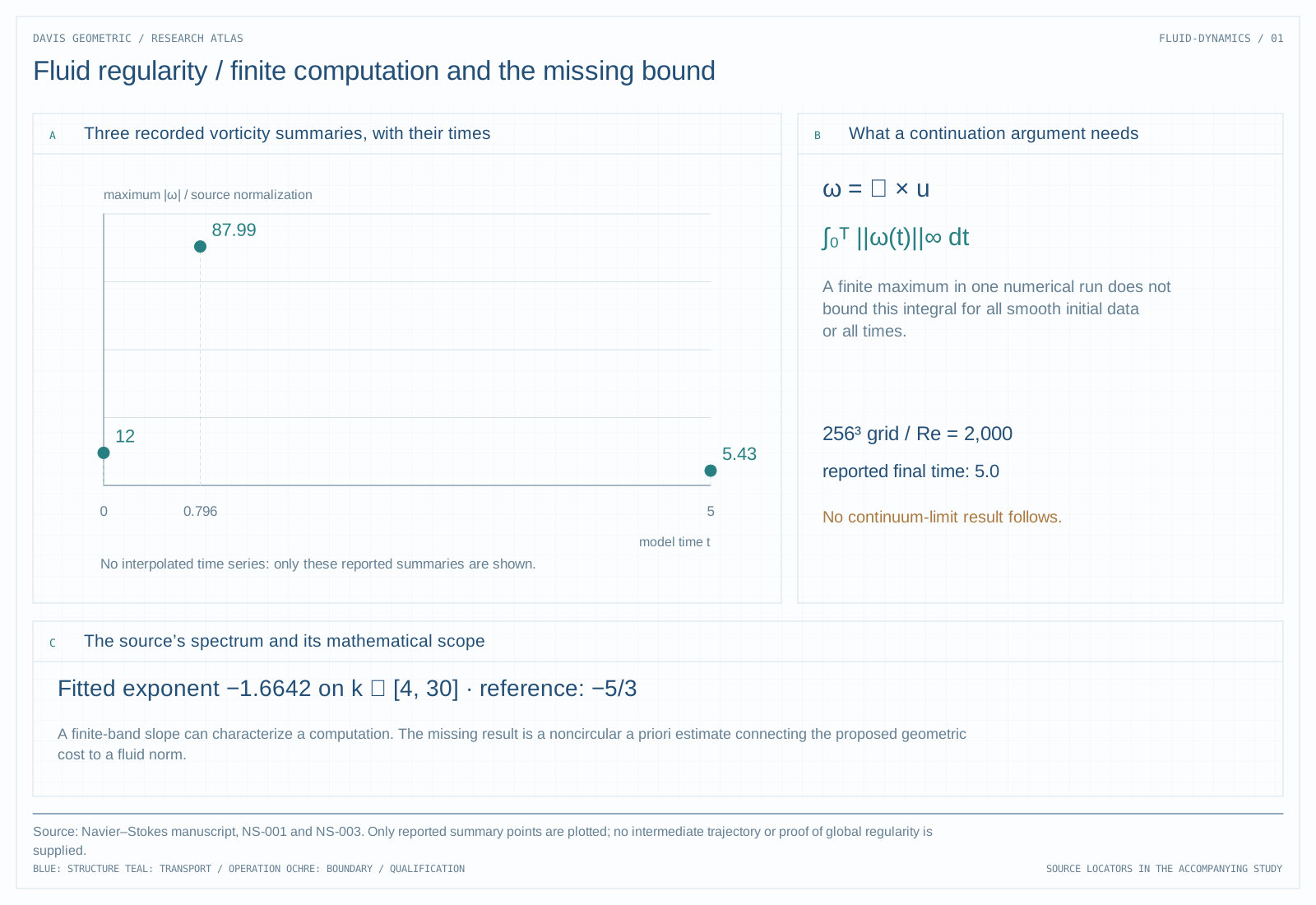
What the finite simulation is reported to contain
Scroll horizontally to inspect the full table →
| Diagnostic | Reported value | Time / range |
|---|---|---|
| Initial maximum vorticity | 12.0 | t = 0 |
| Peak maximum vorticity | 87.99 | t = 0.796 |
| Final maximum vorticity | 5.43 | t = 5.0 |
| Fitted spectral exponent | −1.6642 | k ∈ [4, 30] |
| Reference slope | −5/3 ≈ −1.6667 | Inertial-range comparison |
The manuscript specifies a 256³ Taylor–Green simulation at Re = 2,000. Values are transcribed, not rerun; source nondimensionalization applies. A bounded finite trajectory and a fitted spectrum do not prove global regularity or a continuation criterion.
davis_navier_stokes.tex · Experimental Verification NS-001 and NS-003 tables
The research in context
The Navier–Stokes equations describe how an incompressible fluid such as water moves under pressure and viscosity. In three dimensions it is still unknown whether smooth starting flows always stay smooth, or whether velocity gradients can become infinite in finite time; this is one of the Clay Millennium Prize problems. The danger comes from vortex stretching: a spinning filament of fluid that is stretched spins faster, which can stretch it further. A classical result, the Beale–Kato–Majda criterion, says a smooth solution can break down only if the time integral of the maximum vorticity (local rate of spin) becomes infinite, so controlling vorticity is the central target.
The local manuscript, The Geometric Regularization of Turbulence (December 2025), treats the space of divergence-free velocity fields on a periodic box as a configuration manifold and defines a functional Δ that sets the squared gradient of vorticity against a vortex-stretching term scaled by kinetic energy. Its main theorem is explicitly conditional: if Δ stays finite on a time interval, the solution stays smooth there. The Zenodo deposit takes a related, more axiomatic route. It groups fluid states into basins labelled by circulation around a fixed skeleton of loops plus a vorticity scale, and adopts two “bridge postulates” and a capacity law as added structure rather than as consequences of the equations.
The deposit’s argument runs in four steps. A blowup would, by Beale–Kato–Majda, drive the vorticity scale to infinity; continuity would then force the trajectory through infinitely many basins; each basin transition carries a minimum time cost under the capacity law; so a finite-time blowup would require infinite time. The deposit states that the result stands or falls with acceptance of these added axioms, and it includes a ledger separating axioms, classical inputs and postulates, together with stated falsifiability conditions. That bookkeeping locates the analytic burden precisely: in showing the postulates follow from the Navier–Stokes equations themselves.
The proposed bridge to regularity
The reviewed manuscript treats the energy cascade as flow on a configuration manifold and introduces a geometric “mass gap” intended to measure the cost of vortex stretching. Its central implication is that a bound on this quantity should yield a bound on vorticity.
That implication carries the proof burden. A named geometric quantity must be bounded by estimates available from the Navier–Stokes equations, and the resulting vorticity control must be strong enough for the stated continuation criterion. Relabeling a possible singularity as an infinite geometric cost does not rule it out.
What the finite calculations can contribute
The local manuscript reports a spectrum close to a k⁻⁵ᐟ³ law and a finite 256³ simulation at Reynolds number 2,000 in which vorticity peaks and then decreases. These are manuscript-reported computations, not rerun results in this website revision.
A finite simulated trajectory can test a diagnostic and illustrate a mechanism. It cannot establish control for all smooth initial data, all later times, or the continuum limit. In particular, observing a bounded maximum during a run is not a global bound on the time integral required by a vorticity continuation argument.
The next research step
The mathematical next step is to isolate the precise a priori estimate linking the proposed geometric cost to a standard fluid norm, with constants and hypotheses. That estimate—not a visually stable flow—is the missing bridge to a regularity theorem.
Background mathematics and definitions
State the equation, domain, boundary conditions, initial-data class, and candidate estimate. Track which constants depend on resolution or on the very regularity being proved. A finite discretization and the limiting equation have different proof obligations.
- Uniform bound
- A bound with the required independence from the approximation parameter.
- Solution class
- The precise regularity and integrability assumed of the solution.
- Continuation criterion
- A sufficient condition for extending the specified solution.
Illustrative example
For n≥1, the smooth functions fₙ(x)=sin(nx) remain bounded in amplitude while their derivatives have maximum magnitude n. A bounded plot of the functions does not supply a uniform derivative bound. This exact example explains why visually regular simulations do not settle regularity.
This background example is separate from the source records and the main technical figure.
Source record
Additional source versions reviewed
-
helicity/theory/davis_navier_stokes.texLocal project manuscript or report · not republished here
No new experiments are reported in this research note. Figure captions distinguish saved research records, source-model calculations, and explanatory diagrams.