Physical sciences / HALCYON
HALCYON: a finite SU(2) trajectory on a truncated icosahedron
HALCYON has an inspectable computational result: a finite gauge-field simulation on a 60-vertex, 90-edge, 32-face lattice. That record is distinct from the conceptual hardware and the separate mechanical-response illustration.
Research settingIndependent
TL;DR
In brief
The question
Can a small SU(2) gauge-field simulation on a buckyball-shaped lattice be validated against exact results, and what does that validation leave untested?
What the work does
A ten-section validation report: substrate identities, energy and constraint conservation, time reversal, gauge invariance, agreement with an exact plaquette result across six couplings, and a sampling-method cross-check that fails.
What is still open
The microcanonical–canonical gap needs longer trajectories and multiple seeds; any hardware or inertia claim awaits seven preregistered apparatus gates that no run has yet addressed.
Available recordSaved June 2026 simulation report and explicit response-model assumptions.
From the research record
Inspect the work
Original figures, recorded values, and explicit model details. Each exhibit identifies its source and what the comparison means.
The complete saved validation verdict
Scroll horizontally to inspect the full table →
| Check | Recorded verdict |
|---|---|
| Substrate identities | PASS |
| Energy conservation | PASS |
| Covariant Gauss residual | PASS |
| Time reversibility | PASS |
| Migdal-Witten analytical target | PASS |
| Gauge invariance | PASS |
| Microcanonical vs canonical | FAIL |
| Beta-scan | PASS |
| Operational beta envelope | PASS |
| Sector classifier | NOT APPLICABLE |
Run halcyon_dde14a276d54: eight PASS, one FAIL, and one NOT APPLICABLE. In particular, microcanonical versus canonical does not pass. These checks concern the finite simulation and do not establish a hardware effect.
The research in context
Lattice gauge theory replaces the continuous fields of particle physics with variables on the edges of a graph. Each edge carries a group element—here SU(2), the simplest non-abelian case—and each face measures the field’s curvature through a ‘plaquette’, the product of edge variables around it. Such models let researchers compute what continuum theory cannot yet settle, including the Yang–Mills mass gap, one of the Millennium Prize problems. A small lattice is a convenient testbed because some quantities have exact answers to check against, but small size also limits what any result can say about the continuum.
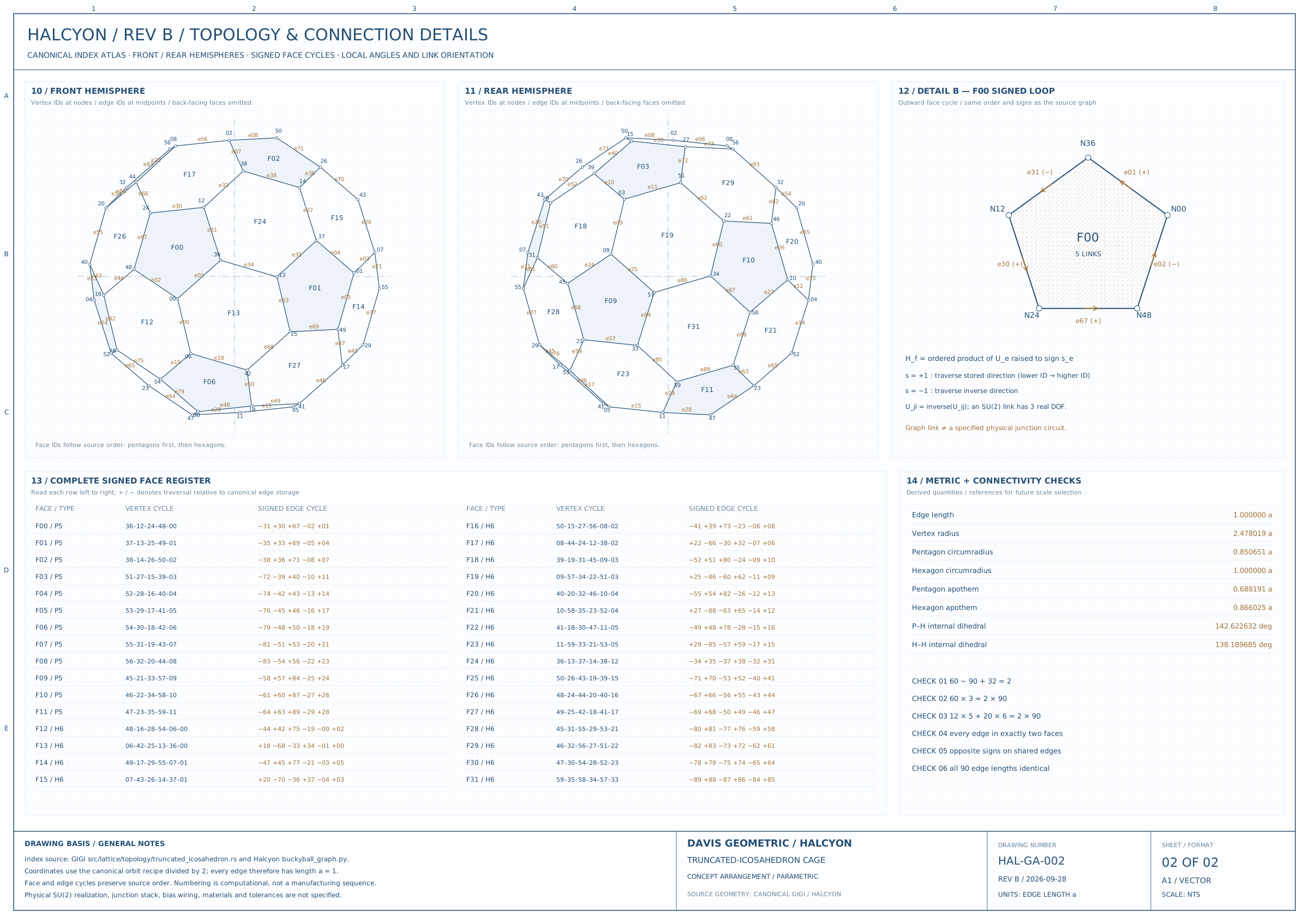
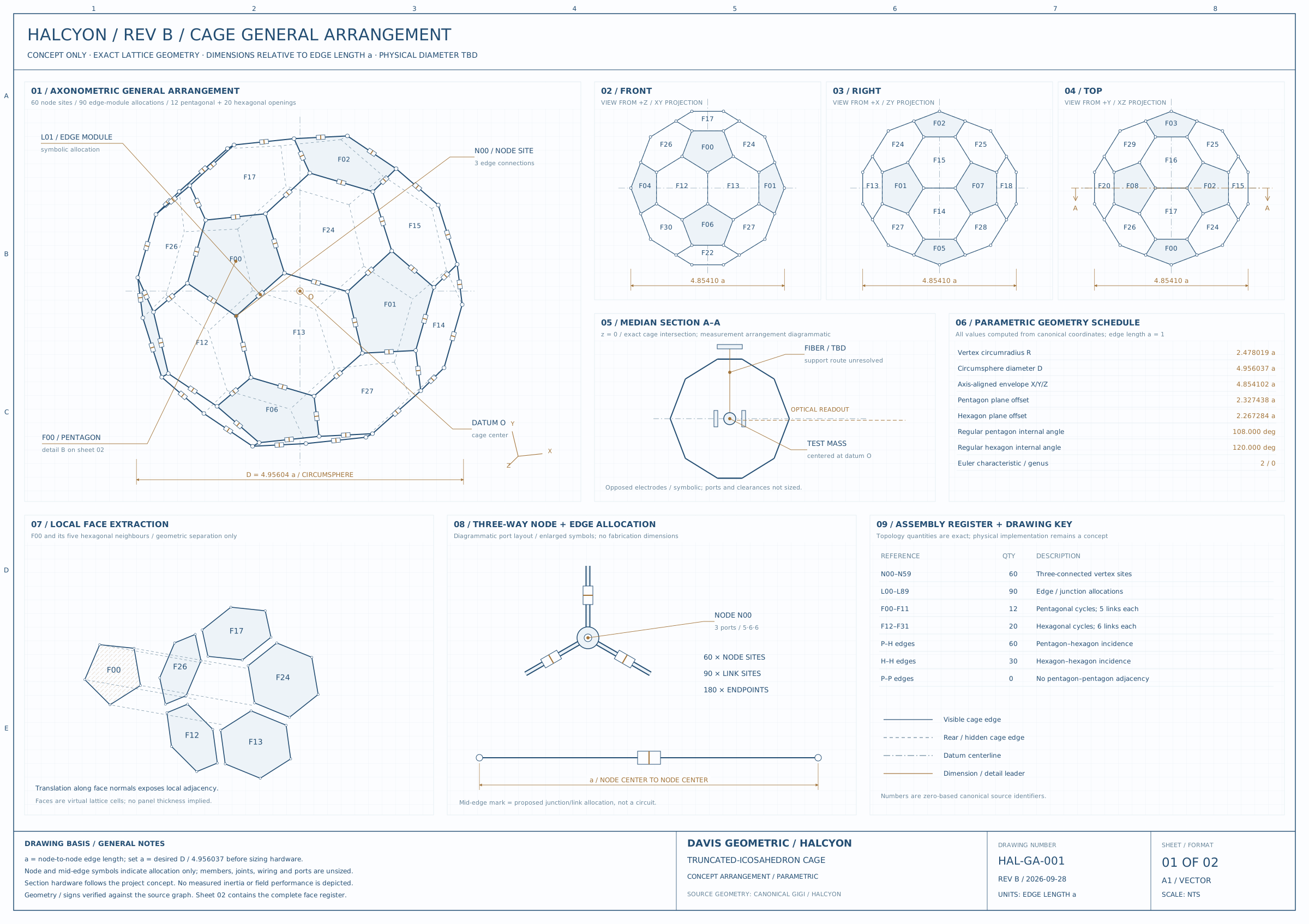
HALCYON uses the truncated icosahedron, the soccer-ball polyhedron of 12 pentagons and 20 hexagons, as its lattice. The run thermalizes with 200 heat-bath sweeps, evolves with a time-reversible leapfrog integrator, and then audits itself. Reversing the trajectory returns the initial state to about 5 × 10⁻¹². Random gauge transformations leave the action, plaquette and constraint unchanged to about 10⁻¹⁶. The heat-bath plaquette at β = 2.5 is 0.5068 against an exact Migdal–Witten value of 0.5072, and a scan from β = 0.5 to 6 stays within its 0.01 tolerance.
One check fails. The time-averaged plaquette from the energy-conserving trajectory, 0.448, differs from the heat-bath value by 0.059, three times the tolerance; the report attributes this tentatively to short trajectories on 93 transverse degrees of freedom, but says this is not yet demonstrated. Its open-items section lists what the run cannot test: the hardware encoding, the inertia claim, and seven apparatus gates, including null drives, blind analysis and reversal of the programmed winding.
What the recorded run contains
Run halcyon_dde14a276d54 uses SU(2), coupling β = 2.5, FP64 arithmetic, and second-order leapfrog integration with timestep 0.02 for 1,000 steps. The report records a seed, code commit, library versions, and 50 measurement frames spanning model time 0.4 to 20.0.
The substrate identities are checked explicitly: 60 − 90 + 32 = 2, the summed face perimeters equal 180, and every edge belongs to two faces. These are checks on the constructed finite lattice.
A diagnostic that changed when the correct operator was used
The saved report gives a maximum sampled relative energy change of 4.850 × 10⁻⁵. It also contrasts the covariant Gauss residual with a flat residual on the same state: the final covariant maximum is 4.968 × 10⁻¹⁵, while the flat residual is 0.84252. The distinction is operationally important because the gauge model uses the covariant constraint.
The report explicitly identifies its conjugate-gradient Gauss projection as a global elliptic solve used for validation/restoration. It is not a local physical update. Residuals sampled at measurement frames do not certify unobserved intermediate steps.
Why the mechanical animation is a different model
The nudge demonstration solves a damped, forced oscillator with an inertia ratio selected by the visitor. The field trajectory does not produce that ratio. At 50% assumed inertia, the initial acceleration doubles under the same force because the oscillator equation was given half the inertial mass.
This is a useful explanation of a proposed measurement, but it is not evidence that the gauge configuration changes inertia. The finite simulation also does not establish a continuum Yang–Mills mass gap.
Inspect the project record
The next research step
The computational follow-up is trajectory and discretization sensitivity. The hardware follow-up is a separate controlled measurement with a physical coupling model; it cannot be supplied by reinterpreting the oscillator animation.
Background mathematics and definitions
Assign an SU(2) link variable to each oriented edge, with the inverse assigned to the reversed edge. Multiply links in path order around a face. State the update rule, normalization, and conserved quantities of the finite model before interpreting its trajectory.
- Uₑ
- A link variable on an oriented lattice edge.
- ∂f
- The ordered boundary of one face.
- Response parameter
- An input to the separate mechanical model, not a measurement of changed inertia.
Illustrative example
For the identity assignment Uₑ=I on every edge, every face product equals I. This exact baseline is a useful implementation check. It does not test whether any hardware realizes the assumed link variables.
This background example is separate from the source records and the main technical figure.
Source record
- Simulation report.
- Response-model assumptions.
- The Incompressibility of Topological Charge and the Energy Cost of Distinguishability: An Information-Geometric Reduction of the Yang-Mills Mass Gap.
No new experiments are reported in this research note. Figure captions distinguish saved research records, source-model calculations, and explanatory diagrams.