Engineering systems / KRAKEN
KRAKEN: keep sensor disagreement visible through fusion and replay
KRAKEN explores a multi-modal maritime analysis workflow in which translated sensor information, uncertainty, and decision provenance remain inspectable. The repository presents a blind-test demonstrator rather than a field-validated detection system.
Research settingIBM
TL;DR
In brief
The question
Can a pipeline fusing seabed fiber, sonar, satellite and radio observations keep each sensor's contribution, disagreement and uncertainty visible to an analyst?
What the work does
A Rust/WebAssembly demonstrator replaying seeded synthetic scenarios through modality translation, signature-template matching, persistence tests, tail-risk fusion and Merkle-hashed audit, plus a specification for an operator-facing display.
What is still open
No labeled field data has been evaluated; detection, false alerts and delay under missing or conflicting sensors still need measurement on held-out scenarios.
Available recordDemonstrator and interface specifications; displayed scenario contacts are not operational detection evidence.
From the research record
Inspect the work
Original figures, recorded values, and explicit model details. Each exhibit identifies its source and what the comparison means.
Which information survives a fused contact
Scroll horizontally to inspect the full table →
| Retained object | Fields / operation | What can be inspected |
|---|---|---|
| Contact state | Identity, bearing, course, range | The contact being described |
| Modal evidence | Originating sensor and modality contribution | Which observation supports which part of the state |
| Uncertainty | Covariance-aware comparison and tail-risk fusion | Disagreement and the scope of confidence |
| Translation | Bounded mappings and pullback geometry | Representation changes before fusion |
| Audit record | Merkle-linked replay | Integrity and provenance of the computation |
Condensed from the interface specification. Mock contact values have intentionally not been turned into detection measurements. Replay integrity and classification accuracy are different properties.
KRAKEN_DEMO_REDESIGN_SPEC.md · Multi-modal contact interface and audit/replay design
The research in context
Undersea surveillance asks analysts to notice faint, slow-moving contacts among shipping, fishing, marine life and seismic activity. The evidence comes from sensors that measure very different things: distributed acoustic sensing (DAS) reads tiny strain changes along a seabed fiber-optic cable, passive sonar hydrophones record sound, satellite radar and imagery see only the sea surface, and signals intelligence listens for radio emissions. Each has its own blind spots and failure modes. Combining them can expose a contact that no single sensor confirms on its own, but a combined score that hides which sensor contributed what is difficult to audit or to challenge.
The project's technical manuscript describes a pipeline that builds a separate representation for each modality, translates between modalities under an explicit error bound, matches acoustic signatures against stored class templates (called genomes) by Mahalanobis distance, requires a detection to persist across processing windows through a cumulative-sum (CUSUM) test, and fuses evidence with a tail-risk measure, conditional value at risk. The demonstrator is a Rust crate compiled to WebAssembly, with a module for each stage, a Merkle-tree audit log and five phased test suites running from the data layer to browser integration. Its scenarios are generated from seeded random streams and stored in a file sealed with a BLAKE3 hash, so a replay can be checked against the original.
A redesign specification addresses who reads the output. It argues that an anti-submarine analyst works in a detect, classify, track and recommend cycle and thinks in bearing, range, course and speed rather than in pipeline quantities. The proposed display replaces engineering panels with contact cards, a tactical map with uncertainty ellipses, a bearing-time waterfall and a narrowband frequency display on which matched tones are annotated. Internal quantities are translated rather than removed: a template distance becomes a stated signature match and a persistence count becomes consecutive cycles held, with the underlying calculation one level deeper. The contacts in that specification are scripted scenario content.
A shared representation without erasing the sensor
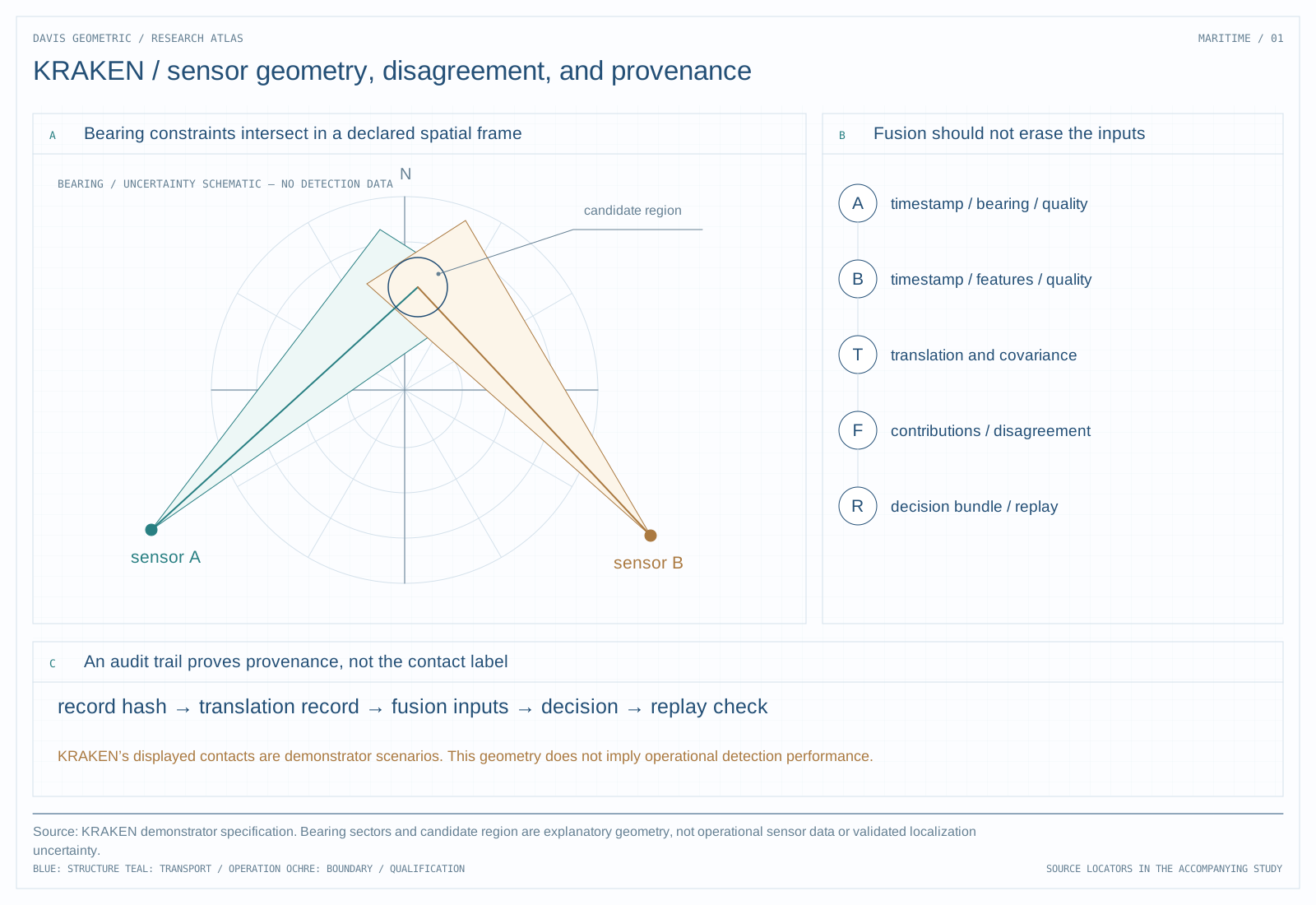
The project record describes bounded translation, pullback geometry, covariance-aware signature comparison, and tail-risk fusion. These components address a specific difficulty: two sensors can support different aspects of the same contact, and their disagreements can matter as much as their agreement.
The proposed interface makes contact identity, bearing, course, range, modal contributions, and uncertainty visible together. Acoustic features and other observations should remain traceable to their originating modality rather than disappearing into one unexplained confidence percentage.
A replayable decision is a distinct achievement
The demonstrator includes Merkle-linked audit-replay concepts. These can help show which records and transformations produced a decision. Integrity of that record is separate from whether the contact was classified correctly.
Likewise, a blind test is informative only relative to how its scenarios were generated and concealed. Sealed labels on synthetic contacts do not establish performance against real sensor noise, propagation conditions, or an operationally representative mixture of contacts.
The next research step
A representative evaluation should expose the scenario provenance and compare individual modalities with the fused result, retaining disagreement and abstention. Field-performance claims require a separate labeled observational record.
Background mathematics and definitions
Map each modality into a declared common state or decision space. Specify covariance, dependence, timestamps, and quality flags. Evaluate the fused estimate separately from the downstream alarm threshold and from the ability to replay the decision.
- Modality
- A distinct measurement channel with its own observation process.
- Cross-correlation
- Shared error that can invalidate an independence assumption.
- Decision threshold
- A frozen rule turning the fused output into an action or alert.
Illustrative example
Two sensors with the same bias do not provide two independent confirmations. Averaging readings of 12 and 12 still returns 12 when the true quantity is 10. Agreement can therefore coexist with error, even before a classification decision is made.
This background example is separate from the source records and the main technical figure.
Source record
Additional source versions reviewed
-
kraken/KRAKEN_DEMO_REDESIGN_SPEC.mdLocal project manuscript or report · not republished here
No new experiments are reported in this research note. Figure captions distinguish saved research records, source-model calculations, and explanatory diagrams.