Algorithms & computing / Graph computation
PageRank: can a geometric diagnostic pay for itself?
This line of work proposes using graph geometry to help choose an iterative solver. The relevant distinction is between describing a graph’s mixing behavior and reducing the total cost of computing its PageRank vector.
Research settingIndependent
TL;DR
In brief
The question
Can a cheap structural reading of a graph pick the PageRank iteration scheme that reaches a given accuracy at the lowest total cost, including the reading itself?
What the work does
A Rust implementation that selects Jacobi or Gauss–Seidel with over-relaxation (ω = 1.3) from average out-degree, reporting iterations and residuals on clustered, social-network, chain, tree and road-like graphs.
What is still open
Whether the selection rule still saves time at a common measured residual, with diagnostic cost included, on held-out graphs and against fixed solvers.
Available recordDeposited manuscript with reported iteration counts and residuals; the comparison has not been independently rerun.
From the research record
Inspect the work
Original figures, recorded values, and explicit model details. Each exhibit identifies its source and what the comparison means.
Iteration counts with the final residuals beside them
Scroll horizontally to inspect the full table →
| Graph / size | Jacobi iterations | Selected method iterations | Jacobi residual | Selected method residual |
|---|---|---|---|---|
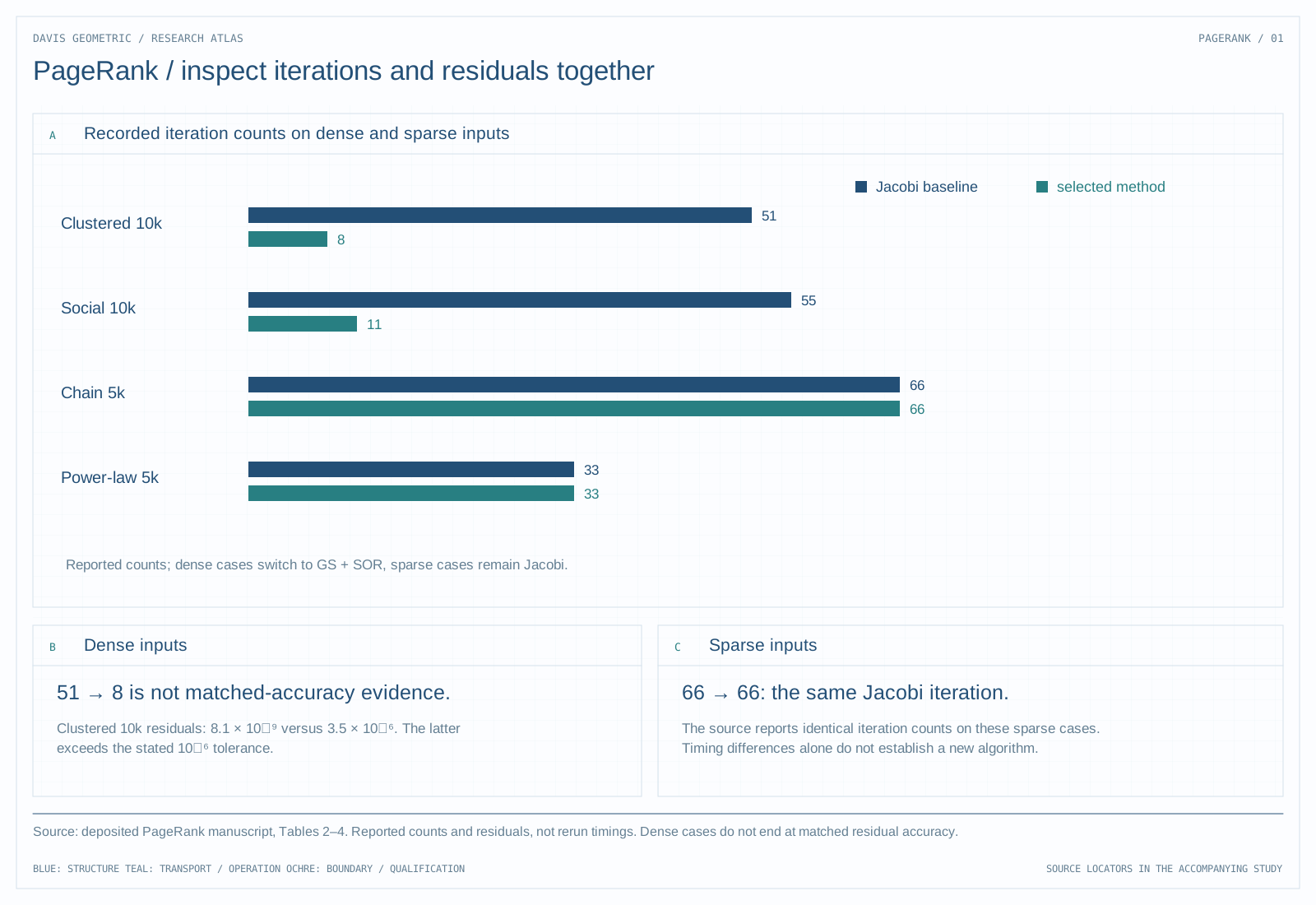
| Clustered / 10,000 | 51 | 8 | 8.1 × 10⁻⁹ | 3.5 × 10⁻⁶ |
| Social / 10,000 | 55 | 11 | 8.1 × 10⁻⁹ | 9.1 × 10⁻⁷ |
| Chain / 5,000 | 66 | 66 | 7.5 × 10⁻⁹ | 7.5 × 10⁻⁹ |
| Power-law / 5,000 | 33 | 33 | 5.3 × 10⁻⁹ | 5.3 × 10⁻⁹ |
Joined by graph and size from Tables 2–4. Dense cases use Gauss–Seidel with SOR; sparse cases use Jacobi in both arms. Dense iteration savings are not a comparison at matched residual. The clustered residual 3.5 × 10⁻⁶ also exceeds the manuscript’s stated 10⁻⁶ threshold, contrary to its nearby prose. Counts are manuscript-reported, not rerun.
The research in context
PageRank scores the vertices of a directed graph by the fixed point of a linear equation: each vertex’s rank is a restart term plus a damped share of the rank held by vertices that link to it. On large graphs the equation is solved by iteration. Jacobi iteration updates every vertex from the previous sweep’s values; Gauss–Seidel reuses values already updated in the current sweep, and successive over-relaxation pushes each update further by a factor ω. Which method converges fastest depends on graph structure, and the stopping test matters: a method that stops at a looser residual can look faster without doing comparable work.
The deposited manuscript (January 2026) defines a per-vertex proxy, κ(v) = (out-degree − average degree) / average degree, and calls its mean square the curvature variance. It states a bound in which the Gauss–Seidel convergence factor improves as that variance grows, with an unspecified structure-dependent constant, and a corollary that uniform-degree graphs gain nothing over Jacobi. The operational rule uses average degree: Jacobi below 15, Gauss–Seidel with over-relaxation at ω = 1.3 at or above it; the manuscript calls the threshold empirically derived, not universal. Tests cover clustered and social-network graphs at 1,000 to 10,000 vertices plus chain, binary-tree and road-network graphs, with a Rust implementation and benchmark scripts.
The manuscript checks correctness by the L1 residual of the fixed-point equation, and its deposit description states verification within 10⁻⁹. The same description’s dense-graph table, however, lists residuals from about 2 × 10⁻⁷ to 3.5 × 10⁻⁶ for the selected method, all above 10⁻⁹ and two above 10⁻⁶; reported savings such as 55 to 11 iterations on the 10,000-vertex social-network graph are therefore measured at looser stopping points than stated. Because the proxy needs only out-degrees, the diagnostic in this version is inexpensive. The open question is whether the iteration savings survive at equal accuracy.
What the proposed diagnostic is meant to change
The catalog describes a Davis Manifold treatment of PageRank with curvature-driven solver selection. PageRank repeatedly propagates probability through a graph while adding a damping-dependent restart term. A structural diagnostic would be useful here if it predicted which available iteration scheme reaches a specified residual at the lowest total cost.
The diagnostic is itself computation. Constructing a neighborhood graph, estimating a spectrum, or computing a curvature proxy can cost more than the iterations saved. The object of the research is therefore the combined diagnostic-and-solve procedure, not a geometric score considered in isolation.
What is preserved from the manuscript record
The deposited paper selects Gauss–Seidel with SOR for dense graphs and Jacobi for sparse ones. Its tables report 51 versus 8 iterations on the 10,000-vertex clustered graph, but the final residuals differ: 8.1 × 10⁻⁹ for Jacobi and 3.5 × 10⁻⁶ for the selected method. The latter also exceeds the stated 10⁻⁶ threshold. The table above keeps both the savings and this discrepancy visible.
On the 5,000-vertex chain and power-law examples, both arms use Jacobi and have identical iteration counts. Those cases cannot support a new algorithmic acceleration claim. The source tables are reported evidence; the small probability-flow example below is a separate teaching construction.
The next research step
Repeat the selection rule against fixed solvers at a common measured residual, including diagnostic and preprocessing time. That would distinguish the benefit of changing iteration schemes from differences in stopping accuracy.
Background mathematics and definitions
Choose a column-stochastic transition matrix P, a probability vector v, and a damping parameter strictly between zero and one. State the treatment of dangling vertices before constructing P. The displayed update is the reference fixed-point equation; it is not a proposed new PageRank definition.
- P
- Transition matrix with each column summing to one.
- α
- Damping parameter satisfying 0 < α < 1.
- r(x)
- Residual x − αPx − (1 − α)v used for a common stopping test.
Illustrative example
Consider two vertices that point to each other, with v=(1/2,1/2). Starting at x=(1/2,1/2) already satisfies the fixed-point equation. A selector that performs an expensive structural analysis cannot improve this zero-iteration case; its overhead belongs in the comparison.
This background example is separate from the source records and the main technical figure.
Source record
No new experiments are reported in this research note. Figure captions distinguish saved research records, source-model calculations, and explanatory diagrams.