A collection of questions, methods, and computational studies. Browse by domain, project, or evidence status.
The working notes explain the methods, artifacts, findings, and open questions in each project. These research notes summarize existing work; they do not report new experiments or establish peer review. Original manuscripts remain linked with their own titles and scope.
33 research areas
08 / Algorithms & computing
Telemetry & reproducible operations
Research settingNASAAMC · NASA origins; BRIDGE · Independent
Which operational properties can be checked when records change format or AI-assisted procedures are replayed?
TL;DR. Two deposited manuscripts: AMC, a per-datapoint embedding format switcher with a semantic translation layer tested on NASA MODIS data; and BRIDGE, a transcript-to-procedure system with log-based replay.
Scope. Reproducing a decision does not show that the decision was correct. A bounded representation error does not automatically bound downstream operational risk.
How should conservation and regime diagnostics be evaluated in the proposed rotating-sphere model?
TL;DR. A v0.1 specification for a shallow-water integrator on the sphere: a four-step Störmer–Verlet scheme with in-step divergence projection, per-step receipts for energy, mass, potential vorticity and circulation, and ten test gates.
Scope. An exact discrete identity is not evidence of accurate weather or climate forecasts. Conservation and regime-classification targets must not be presented as completed empirical validation.
How reliably can transferred physical parameters support interpretation of farm telemetry across sites?
TL;DR. A v2.0 specification: a per-field daily data model joining public soil, weather, satellite and equipment feeds; one resource ratio instantiated for moisture, nutrients, equipment, phenology and markets; and worked examples.
Scope. Transferred constants do not remove model uncertainty or site dependence. Data volume alone does not establish agronomic benefit or reliable operational recommendations.
Which results follow from the stated geometric assumptions, and which proposed implications require further proof?
TL;DR. Deposited manuscripts on representation manifolds, translation–distance equivalence, double covers, holonomy and operator conjectures, plus a 2026 review running exact checks and constructing counterexamples against selected steps.
Scope. A deposited manuscript is not independent confirmation of a proof. Introducing additional axioms or a restricted object class does not establish the original unrestricted conjecture.
Can an analyst trace a flagged spending-data pattern back to trustworthy records and the exact checks that produced it?
TL;DR. A NASA engineering specification for CSV/Parquet and Bronze/Silver parity, key quality, schema governance, and traceable evidence bundles. The companion walks through the check rules and an interactive row-count example.
Scope. Integrity checks and configurable screens support human investigation; they do not establish fraud. The companion presents the design and illustrative calculations, not production investigation results.
Can structural representations improve candidate triage on a defined security workload?
TL;DR. SCJ studies relationships between operations, guards and code structure. Three accepted F Prime contributions add local size checks and a reusable CodeQL rule, with public reviews and regression evidence.
Scope. A similar function is not necessarily vulnerable, and a detected anomaly is not necessarily malicious. Individual confirmed cases do not establish corpus-wide recall or a low false-positive rate.
What does geometric analysis reveal about internal hash computations under a precisely stated model?
TL;DR. Instrumented SHA-256 implementations, heat-kernel graphs on sampled working states, one-bit intervention and cube-sum measurements, frozen receipts, 57 tests and a 26-check verifier that recomputes reported numbers.
Scope. An internal pattern, non-invertible embedding or underdetermined representation does not establish collision resistance, preimage resistance, or an attack on SHA-256.
How does a multimodal fusion method perform when sensor quality and agreement vary?
TL;DR. A Rust/WebAssembly demonstrator replaying seeded synthetic scenarios through modality translation, signature-template matching, persistence tests, tail-risk fusion and Merkle-hashed audit, plus a specification for an operator-facing display.
Scope. Auditability is not detection accuracy. A controlled demonstrator does not establish field performance, deployment readiness or reliable threat identification.
Which state and relationships must a security simulator preserve for an experiment to be replayed and its suggestions inspected?
TL;DR. A simulated filesystem, service registry and response rules support controlled replay. A graph-based memory records transitions and ranks related techniques. The companion includes live comparisons, a console, a score breakdown and 204 supplied parity checks rerun against saved reference captures.
Scope. The browser fixtures and parity checks evaluate the current reconstruction. They do not establish real-system fidelity, universal determinism or training effectiveness. Transcript ingestion is not part of the browser demonstration.
How do proposed geometric state and confidence representations behave in a specified estimation and control task?
TL;DR. The work implements a C++ advisory library, wraps it as a passive F Prime component with no output ports, and drives a synthetic two-stage ascent through it, saving 601 samples.
Scope. A simulation or heuristic confidence score does not establish flight readiness, closed-loop stability or calibrated risk. A complete operational GNC claim needs component and integrated-system evidence.
What can a propulsion-control demonstration establish about adaptation under changing model conditions?
TL;DR. An interactive application with hand-written numerical routines: an F-16 short-period plant plus elevator actuator, analyzed through frequency response, LQR, Kalman estimation, Lyapunov design, model-reference adaptation and four update laws.
Scope. A demonstrator does not establish improved engine efficiency, safety or hardware performance. Stability claims require a stated plant model, uncertainty set and proof or defined empirical test.
How should a geometric conflict-risk model be evaluated without confusing historical reconstruction with prospective warning?
TL;DR. A monthly panel of 156 directed state pairs among 42 states, 1990–2022, with integration and tolerance indices, a five-level alert scheme and a separate mode for weakly linked pairs.
Scope. A reconstructed historical alert does not establish that a forecast was issued before the event. Geometric stress measures do not make conflict inevitable, and headline lead time alone omits false alarms.
SSSP · Reported timing ratios from the September 2026 companion. The density sweep and cross-input comparison include cases favoring the heap. A dash means the summary does not report that comparison. Single machine, sequential execution; no benchmarks rerun.Explore the figure and its evidence →Recorded data
How do bucket width, duplicate suppression, and local lookahead affect sequential shortest-path execution?
TL;DR. Rust implementations of bucket-based Δ-stepping variants and a binary-heap Dijkstra, timed on synthetic graphs and three DIMACS road networks: 192 configurations, 53,460 timed runs, one machine, distances checked.
Scope. Results concern the author's implementations, one machine and a limited set of graph families. Teaching traces are not timing measurements, and geometric features did not demonstrate acceleration in the reported lookahead tests.
When does geometric scheduling help a GPU constraint solver on a specified instance family?
TL;DR. A three-phase CUDA Sudoku solver (bitmask propagation, continuous relaxation, prioritized depth-first search) with an instance-routing rule, run on 15-clue extreme puzzles and eleven known hard puzzles on a laptop GPU.
Scope. A Sudoku comparison does not establish a general CSP speedup. Cross-language, CPU/GPU and different-algorithm comparisons confound the contribution of the scheduling rule.
Can graph-derived diagnostics inform solver selection without costing more than they save?
TL;DR. A Rust implementation that selects Jacobi or Gauss–Seidel with over-relaxation (ω = 1.3) from average out-degree, reporting iterations and residuals on clustered, social-network, chain, tree and road-like graphs.
Scope. A proposed mixing-time interpretation does not establish a uniform performance guarantee. Solver choice may depend on damping, tolerance, graph construction and preprocessing.
What costs and capabilities distinguish bundle-based storage, geometric indexing and structured serialization on defined workloads?
TL;DR. GIGI, a Rust engine served by one binary over a REST API, with a query language (GQL v2.2) whose verbs cover storage, reads, joins, aggregation, curvature, transport, spectral and topological diagnostics.
Scope. Index complexity is conditional on the query and data structure. Compression, token reduction and retrieval timing are workload-dependent; they do not imply a general database advantage or cryptographic security.
Which prediction and inference tasks benefit from the proposed geometric representations under matched evaluation?
TL;DR. A next-token predictor built from corpus counts and fixed grammatical coordinates without gradient training, and a runtime composing cited replies from indexed GIGI bundles behind a distance-based refusal gate.
Scope. Perplexities from different tokenizers, corpora and model versions are not directly comparable. A geometric interpretation of attention is a hypothesis, not proof of the mechanism of reasoning or hallucination.
The same stability calculation responds differently to four geometry classes. Dots show all 40 saved model evaluations; lines join sampled points. The full study opens the boundary calculations, plateau checks and separate diagnostic channels.Explore the figure and its evidence →Open CHIHIRO ↗
How do spectral and geometric quantities relate to stability in specified plasma models?
TL;DR. Saved sweeps of a Miller-shaped ballooning model and an ITER-like graph-spectrum calculation across normalized pressure, plus an interactive shear–pressure model across several cross-section shapes.
Scope. Agreement in a model or recovery of a known limit does not establish predictive performance on experimental discharges. The work is not a solution to fusion confinement.
How does an obstacle's geometry affect vortex onset within the simulated condensate model?
TL;DR. Two-dimensional GPU Gross–Pitaevskii simulations for three atomic species and two obstacle profiles, measuring the onset velocity as a fraction of sound speed, with included simulation and figure code.
Scope. Simulation agreement across selected parameterizations does not prove a universal law across species, temperatures, dimensionalities or experimental conditions.
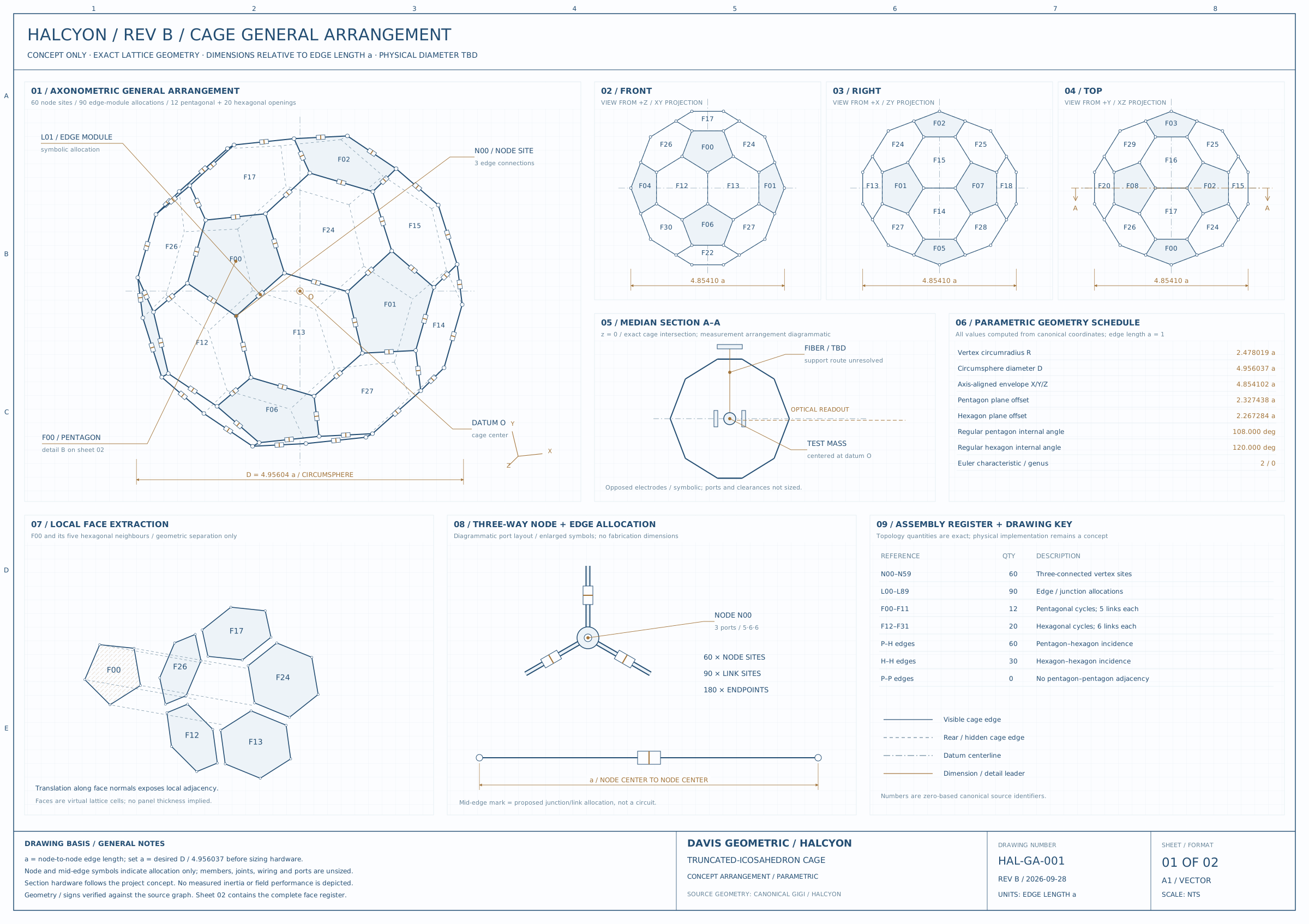
HALCYON / GA-001 · The project’s Rev B engineering sheet, with normalized dimensions, sections, face register and node details. Geometry is specified; hardware arrangements remain conceptual and no physical effect is established.Explore the figure and its evidence →Drawing scope
What can finite-lattice calculations establish, and which apparatus-level response hypotheses remain untested?
TL;DR. A ten-section validation report: substrate identities, energy and constraint conservation, time reversal, gauge invariance, agreement with an exact plaquette result across six couplings, and a sampling-method cross-check that fails.
Scope. Conservation checks on a finite graph do not establish the continuum Yang–Mills mass gap or a physical change in inertia. The displayed mechanical response is conditional on an assumed inertia ratio.
Which inputs are required to recover a horizon-temperature expression in the proposed geometric construction?
TL;DR. A derivation manuscript covering five spacetimes and three analog media, a numerical test suite checking formula routes, and CALCIFER, a Rust-with-Python tool that locates analog horizons and computes temperature.
Scope. Reproducing a known temperature expression or passing consistency tests is not independent evidence for a new quantum-gravity theory. A quantum constant supplied as input cannot be claimed as derived.
Under which assumptions could an observation distinguish a proposed global topology?
TL;DR. A deposited theoretical manuscript defines a capacity ratio C = τ/K for each topological cycle, states four theorems on flatness, observability regimes and the CMB two-point function, and derives candidate signatures.
Scope. A proposed capacity or observability measure does not establish the universe's topology or explain observed randomness. Observational equivalence and selection effects must be addressed.
What estimates would be required for a geometric regularity argument to apply to the stated fluid equations?
TL;DR. A manuscript defines a geometric “mass gap” functional built from vorticity and its gradient, sketches a conditional regularity argument through the Beale–Kato–Majda criterion, and reports finite Taylor–Green vortex simulations.
Scope. The catalog preserves the manuscript as a proposed argument. It does not endorse a resolution of the general regularity problem or infer one from finite simulations.
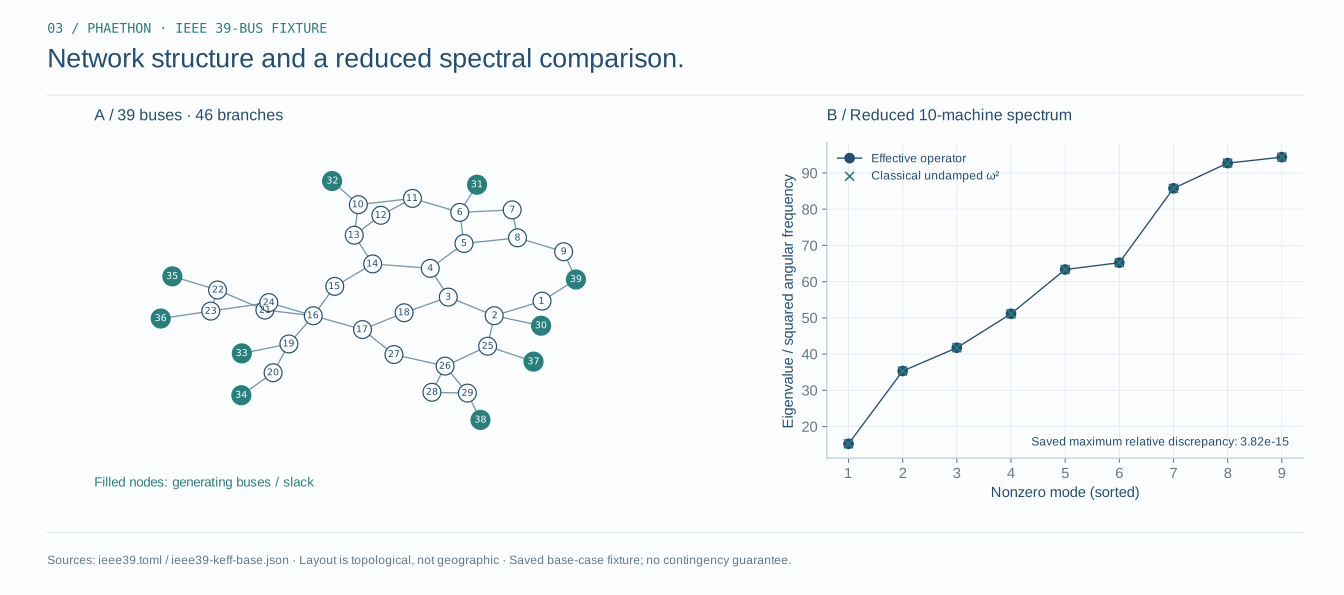
PHAETHON · The source IEEE 39-bus topology and saved base-case spectral comparison. Node placement is a visualization layout, not geography. The fixture agreement is a numerical consistency check, not a guarantee of grid stability.Explore the figure and its evidence →Saved spectral fixture
How can a grid model connect generator oscillations, winding history and energy barriers to study the loss of synchronism?
TL;DR. PHAETHON combines an inertia-weighted stability operator with generator-angle history, winding counts, energy barriers and local stress measures. Its manuscript and public kit recover classical modes on IEEE benchmarks and examine line outages and generator-specific barriers; dynamic extensions use synthetic cases.
Scope. Algebraic equivalence is not independent operational validation. Thresholds and inverter-rich behavior need separate assessment; a finite-network energy barrier is not the continuum Yang–Mills problem.
Do geometric representations add predictive value for a defined binding or drug-response endpoint?
TL;DR. A v0.2 specification for a ten-layer Rust pipeline, each layer assigned a geometric object, invariants and planned tests, with planned adapters for PDB, AlphaFold, ChEMBL, ZINC and PharmGKB data.
Scope. A geometric score is not evidence of therapeutic efficacy. The earlier hit-rate claim is omitted because the reviewed site entry does not identify the dataset, comparator and evaluation protocol needed to assess it.
What can a proposed panel-coverage bound guarantee when its modeling assumptions hold?
TL;DR. The preprint builds a coupled antigen-receptor construction trained contrastively, derives a coverage bound on neutralization, inverts it into an empirical error budget, and states an existence theorem for the receptor geometry.
Scope. A theoretical coverage bound does not demonstrate neutralization or clinical protection. A useful guarantee depends on justified error bounds, calibration and in-distribution path assumptions.
Can sequence-based divergence signals provide useful early indications under realistic data-availability constraints?
TL;DR. The HERALD preprint constructs a Riemannian pullback metric over a protein-language-model representation, regularizes it, fuses drift signals through a probability-integral transform, and states conditional guarantees plus evaluation and governance protocols.
Scope. A retrospective alert before a naming date does not establish a prospective prediction. Sequence divergence alone does not demonstrate immune escape, severity or outbreak risk.
Can representations of bacterial assemblies help identify candidate transfer or resistance patterns?
TL;DR. The work builds TESSERA, a k-mer compositional encoder and pipeline for bacterial assemblies inside the PARALLAX platform, which accepts FASTA uploads and returns clustering, resistance-gene and transfer outputs.
Scope. Compositional similarity or a shear threshold does not establish horizontal transfer or clinical resistance. A patent filing is not evidence of predictive validity.
What can mutation-derived representations distinguish in retrospective cancer datasets?
TL;DR. The work builds GEODESIC's cancer-evolution tool inside PARALLAX: a mutation-profile encoder and pipeline that accept VCF or MAF variant files and return clonal-architecture and trajectory output with a PDF report.
Scope. Retrospective separation of known cancer cohorts does not establish screening or diagnostic performance. This project is distinct from the GEODESIC indexing project.
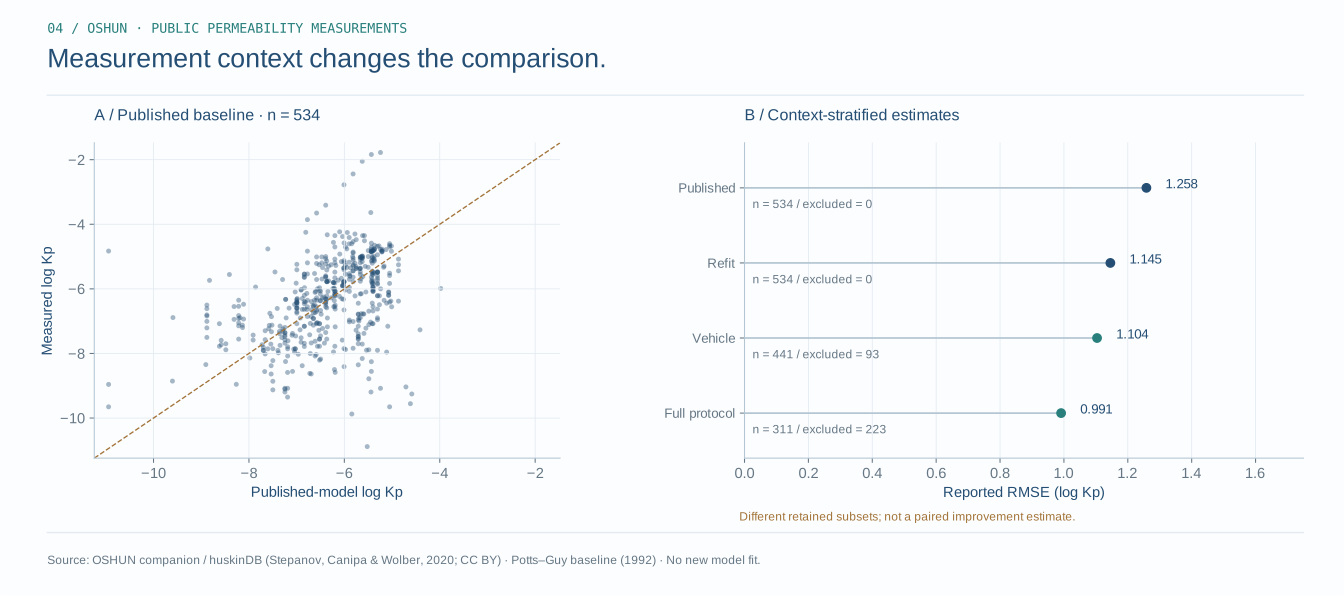
OSHUN · 534 public permeability observations and the companion’s reported error estimates. Context-stratified rows retain different subsets, so the apparent error reduction is not a paired improvement estimate. Data: huskinDB, Stepanov, Canipa & Wolber (2020), CC BY.Explore the figure and its evidence →Measurements & estimates
How can ingredient predictions preserve measured substrate context, and what hair-fiber data would make them useful for textured-hair formulation?
TL;DR. OSHUN combines a context-preserving data model, a skin-permeability feasibility study and an interactive ingredient checker. It compares predictions with and without experimental context, explains ingredient-level refusals, and specifies a controlled panel for measuring hair geometry and response.
Scope. A skin-permeability study does not validate hair-performance predictions. Pooled laboratory variation cannot isolate a causal substrate response.
How accurately can records from different payment formats be reconciled under explicit error costs?
TL;DR. A pure-Python v0.1 pipeline covering five message formats, 512-dimensional block embeddings, hub-and-spoke translators with error bounds, robust amount consensus and hash-sealed decision bundles, tested on generated multi-rail data.
Scope. A headline match rate without a dataset and denominator is not a general accuracy claim. Software tests and deterministic replay do not independently establish production reconciliation quality.
How often does LAMINAR select an order-flow coherence label, and how does that selection change under perturbation and a different context?
TL;DR. A three-scale dashboard (macroeconomic series, futures bars, level-2 order book) and a measurement study of one order-flow label across 12 futures instruments, 194 sessions and surrogate controls.
Scope. Historical replay does not establish predictive skill, profitability or live risk reduction. A spectral or circulation diagnostic does not by itself forecast price direction.
What does a complexity separation under additional geometric axioms imply about standard computational models?
TL;DR. A deposited preprint pairing an energy-landscape analysis of random 3-SAT, counting metastable basins and curvature barriers, with two stated axioms that link that geometry to computational cost.
Scope. A separation under extra assumptions is not a resolution of P versus NP in its standard formulation. An energy landscape or slow solver is not by itself a complexity lower bound.
Original titles are retained for citation accuracy, including titles with stronger claims than the summaries above. Metadata lookup establishes the identity of a deposit; it does not verify a result or establish peer review.